Bitcoin is trading at $63,500, down 5.47% in the last 24 hours. The key reasons include stalled US–Iran negotiations and concerns around the Strait of Hormuz, Strategy’s first Bitcoin sale since 2022, continued ETF outflows, and weaker macro data has weighed on overall risk sentiment.
From a technical perspective, BTC remains weak following its recent lower time frame breakdown. Momentum is still bearish, and unless a strong catalyst emerges, the current structure suggests further downside pressure in the near term.
• Lack of progress in US–Iran negotiations is keeping geopolitical tensions elevated, with concerns around the Strait of Hormuz adding uncertainty to global markets.
• Rising oil prices are increasing inflation concerns and reducing expectations for aggressive rate cuts, creating pressure on risk assets.
• Strategy’s first Bitcoin sale since 2022 has negatively impacted market sentiment, raising concerns about demand from one of Bitcoin’s largest corporate holders.
• Continued Bitcoin ETF outflows indicate short-term institutional caution as investors reduce exposure amid uncertainty.
• Weaker-than-expected macro data last month has hurt risk appetite, while this week’s weaker ISM PMI and JOLTS job openings data have further reinforced concerns about slowing economic activity, keeping traders defensive.
Bitcoin Technical Analysis (June 04, 2026)
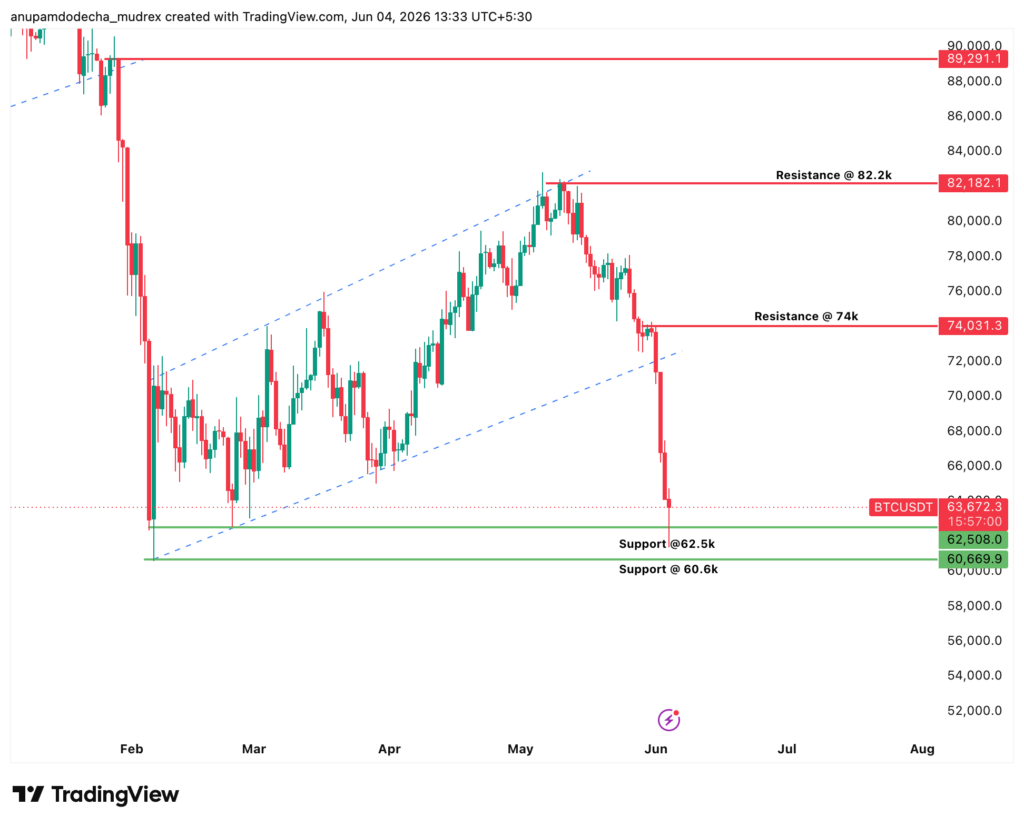
Technically, BTC has already given a lower time frame range breakdown and continues to remain in a downtrend. As long as price stays below key resistance levels, further downside pressure is expected to continue.
The key levels to watch are: • Resistance: $74K • Support: $60.6K
From a technical perspective, the market structure has turned bearish, with Bitcoin showing weakness and a higher probability of continued downside movement. Macro and external factors are also adding pressure, further strengthening the short-term bearish outlook.
Macro conditions remain cautious as weaker economic data, including soft ISM PMI and JOLTS job openings figures, have reinforced concerns about slowing U.S. growth. Markets are now focused on this week’s unemployment report, which could significantly influence risk sentiment.
At the same time, ongoing US–Iran tensions and uncertainty around the Strait of Hormuz continue to support oil prices and add inflationary pressure, keeping investors cautious across risk assets.
Spot Bitcoin ETF Flows
Spot Bitcoin ETF flows have seen net outflows consistently over the last couple of weeks, reflecting growing caution among institutional investors amid rising macro uncertainty.
The recent outflows suggest that institutions are reducing exposure in the short term as market sentiment weakens and risk appetite declines. Overall, ETF activity indicates a more defensive stance from investors, with participants waiting for stronger market confirmation before re-entering aggressively.
BTC ETF Flows
Bitcoin’s Trend
Week in Review
Bitcoin remained under pressure over the past week, extending its decline after breaking down from its lower time frame range. Market sentiment weakened due to ongoing US–Iran tensions, concerns around the Strait of Hormuz, recent ETF outflows, Strategy’s first Bitcoin sale since 2022, and weaker macroeconomic data.
Monthly Outlook
On the monthly timeframe, Bitcoin still maintains its broader bullish structure, but short-term momentum has weakened significantly. Macro uncertainty, geopolitical risks, and cautious institutional positioning could keep price action defensive until a stronger catalyst emerges.
Conclusion
Overall, Bitcoin had a bearish week as sellers remained in control and risk sentiment deteriorated. Continued ETF outflows and growing macro and geopolitical concerns have led investors to adopt a more cautious approach.
What to Watch
• US–Iran Tensions: Markets remain highly sensitive to any developments around the conflict and the Strait of Hormuz, as changes in the situation could impact oil prices and global risk sentiment.
• Spot Bitcoin ETF Flows: ETF flows remain a key indicator of institutional demand. Continued outflows could add further pressure on Bitcoin.
• Macro Data: Following weak ISM PMI and JOLTS data, markets are now focused on upcoming unemployment data and broader economic indicators for clues on growth, inflation, and future Fed policy.
Staying updated on these evolving factors doesn’t have to be complicated—our Telegram community delivers clear, timely insights and real-time alerts to help you navigate the crypto market confidently and effectively.
Bitcoin is dropping due to a combination of rising geopolitical tensions around the US–Iran conflict, continued ETF outflows, Strategy’s recent Bitcoin sale, and weak macroeconomic data. These factors have weakened risk sentiment and increased selling pressure across crypto markets.
Is Bitcoin going to crash?
A major Bitcoin crash is not the base case right now. The recent decline appears to be driven by macro uncertainty, US–Iran tensions, ETF outflows, and weaker market sentiment rather than a breakdown of Bitcoin’s broader market structure. While short-term momentum remains bearish, the higher time frame trend is still intact for now.
Why is the crypto market down today?
The crypto market is down due to a combination of escalating US–Iran tensions, concerns around the Strait of Hormuz, record Bitcoin ETF outflows, and weaker macro sentiment following soft economic data. Strategy’s first Bitcoin sale since 2022 has also weighed on market psychology, while traders remain cautious ahead of key U.S. labor market data later this week. Bitcoin’s recent lower time frame breakdown has further accelerated selling pressure across the broader market.
What are the key Bitcoin levels to watch?
Key support is around $60.6K, while the immediate resitsnace is near $74K now acts as the main resistance level.
Anupam has over 3 years of experience in the crypto industry, having worked with top indian crypto exchanges. He writes about Bitcoin, altcoins, AI, and emerging tech, helping readers understand what’s driving markets and where the digital asset ecosystem is headed.