The Polygon vs Ethereum 2026 debate is heating up as on-chain data reveals rising network activity, growing ecosystem adoption, and intensifying competition between the two networks. As one of the leading Layer 2 scaling solutions, Polygon continues to expand its role within the Ethereum ecosystem — driven by higher transaction volumes, stablecoin activity, and protocol integrations.
This guide breaks down POL price performance, on-chain metrics, Layer 2 positioning, and exactly how Polygon compares to Ethereum in 2026
What Is POL ?
POL is Polygon’s native token, upgraded from MATIC. It powers network fees, validator staking, governance, and ecosystem security.
It operates as a Layer 2 scaling solution built on top of Ethereum:
Ethereum — the security and liquidity settlement layer
Polygon — the speed and low-cost execution layer
By February 2026, Polygon had become one of the most active networks in crypto, measured by daily transactions and fee generation. That activity is a core reason the POL vsETH 2026 comparison has become one of the most discussed topics in the Layer 2 space.
Polygon vs Ethereum 2026: On-Chain Fee and Transaction Comparison
In mid-February 2026, POL briefly generated more daily transaction fees than Ethereum — a milestone that caught the attention of analysts and investors alike.
Key takeaway: Ethereum still dominates in Total Value Locked (TVL) and remains the base settlement layer. However, Polygon outperformed Ethereum in transaction count and short-term fee revenue during this period. This is not Ethereum losing dominance — it is demonstrating execution strength. For live TVL data, refer to DeFiLlama’s Layer 2 dashboard.
Why Is Polygon Outperforming Ethereum in Transactions?
The primary driver behind Polygon’s transaction surge in 2026 is Polymarket — a leading prediction market platform that runs entirely on Polygon. Every bet placed, modified, or settled generates an on-chain transaction.
This has produced:
Millions of daily micro-transactions
Over $100K in short-term fee contributions
Significant POL token burns through fee activity
Sustained spikes in daily active users
Prediction markets require cheap transactions, fast confirmations, and high throughput. Polygon delivers all three, making it the natural infrastructure choice for platforms like Polymarket.
The most important signals to watch are transaction growth and burn rate. When high activity continues, supply decreases while usage increases — a combination that structurally supports long-term token valuation
Polygon vs Ethereum: $POL Analysis & Growth Outlook 2026
POL Price Analysis and Key Technical Levels
Polygon vs Ethereum: $POL Analysis & Growth Outlook 2026
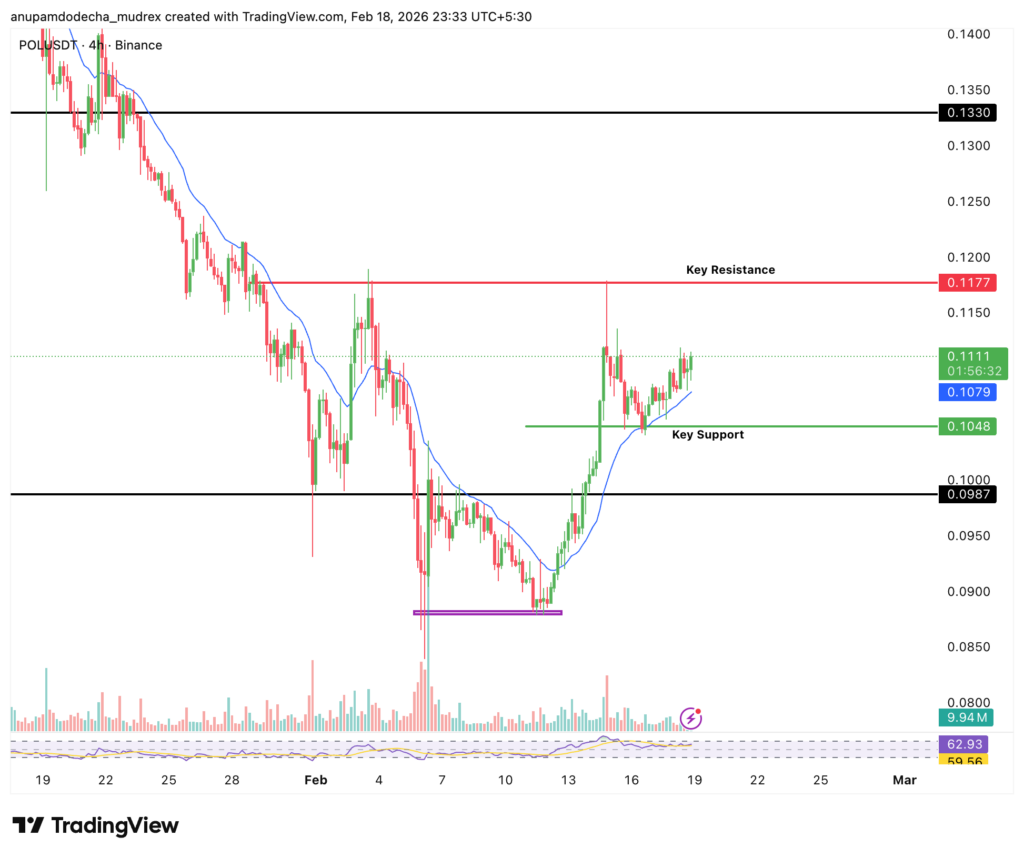
If we look at the charts, $POL is showing strong relative performance and outperforming other tokens.
On the lower timeframe, it has broken its downtrend, signaling short-term bullish momentum.
However, the higher timeframe structure remains bearish, meaning the broader trend has not yet shifted.
Key Resistance:
$0.1177
$0.1330
Key Support:
$0.1048
$0.0990
A break above resistance could drive further upside, while losing support may bring sellers back in control.
How Does POL Rank Among Layer 2 Tokens in 2026?
The total Layer 2 sector market cap stands at approximately $7.4B. Within that, POL consistently ranks second by market cap — a strong position in an increasingly competitive space.
Polygon leads in transaction count and fee activity. Arbitrum leads in TVL. Mantle leads in overall market cap. Each L2 occupies a distinct niche.
POL Price Outlook and Scenarios
Based on current on-chain trends and market structure, here are three POL price scenarios for 2026:
Scenario
Price Target
Conservative
$0.11–$0.16
Moderate Growth
$0.22–$0.33
Strong Bull Cycle
$0.40–$1.30+
Bullish catalysts to watch:
Sustained Polymarket transaction activity
Continued POL token burns reducing supply
AggLayer expansion driving new integrations
Broader crypto market bull cycle
Key risks to monitor:
Growing competition from other Layer 2 networks
A slowdown in transaction activity
Macro-driven market-wide volatility
Final Verdict: Polygon vs Ethereum 2026
The story is backed by real data — not speculation. Polygon’s surge in daily fees, transaction volume, token burns, and Layer 2 ranking all point to genuine network demand.
Ethereum remains the dominant base layer for security and liquidity. It is proving it can lead on execution. If on-chain activity sustains its current pace, POL remains one of the most structurally compelling Layer 2 tokens heading into the rest of 2026.
FAQs
Is POL worth buying in 2026?
POL has a strong on-chain foundation — ranked #2 among Layer 2 tokens, rising burn rate, and growing ecosystem activity. However, crypto carries risk. Always do your own research before investing.
What is the POL token price prediction for 2026?
Analysts project $0.11–$0.16 in a conservative market, $0.22–$0.33 with moderate growth, and $0.40–$1.30+ in a full bull cycle.
Can Polygon overtake Ethereum in 2026?
In terms of price and market cap, no. Ethereum’s market cap stands at hundreds of billions while POL sits at ~$1.15B. ETH trades at thousands of dollars versus POL at ~$0.11. However, in daily transaction volume and fee activity, it is already competing — and briefly surpassed Ethereum in daily fees in February 2026.
Anupam has over 3 years of experience in the crypto industry, having worked with top indian crypto exchanges. He writes about Bitcoin, altcoins, AI, and emerging tech, helping readers understand what’s driving markets and where the digital asset ecosystem is headed.