
Arbitrum [ARB] keeps showing up on “best crypto to buy” lists, but is it actually worth buying now, or smarter to wait?
The platform is a leading Ethereum [ETH] Layer 2 with users, apps, and activity. Still, ARB is mainly a governance token, not a straightforward “fee-capture” asset. This means, the reasons it might rise (or stall) are different.

In this blog, we’ll build a clear thesis.
If you’re searching “Arbitrum explained” or “what is Arbitrum”, here’s the simple version.
Arbitrum is an Ethereum Layer 2 designed to make Ethereum faster and cheaper to use. It scales Ethereum using an optimistic rollup, which means most transactions happen on Arbitrum (off Ethereum’s main chain), then Arbitrum bundles that activity and settles it back to Ethereum. In plain English, it reduces congestion and gas costs while still leaning on Ethereum as the final settlement layer.
When people talk about Arbitrum, they usually mean Arbitrum One. This is the main network where higher-value activity tends to live. It’s built for users who care about liquidity and strong security assumptions.
Arbitrum Nova is for ultra-low fees and high throughput. It’s the best for gaming, social apps, and high-volume transactions where cost matters more than maximum security guarantees.
Holding ARB gives you governance rights in the Arbitrum DAO. This means you can vote on proposals that shape the ecosystem, like how treasury funds are spent, how incentives are allocated, and what upgrades or policies the network prioritizes. In practice, ARB also supports ecosystem growth through incentive programs (for developers, users, and liquidity), which can accelerate network activity and mindshare.
This leads to a common misconception in price prediction content: if the protocol succeeds, the token must automatically go up. In reality, protocol success does not mean that the token automatically accrues value.
Arbitrum can have strong usage, and ARB can still underperform if the market doesn’t see clear value capture.
Even as a governance token, ARB can still gain value in a few ways:
Arbitrum’s architecture isn’t hard to grasp if you focus on three pieces:
But the skepticism is healthy:
Before making that assessment, consider the following:
| Layer 2 | Where it’s strongest | Distribution & narrative | Developer traction & ecosystem | Investor takeaway in L2 competition |
|---|---|---|---|---|
| Arbitrum | DeFi + liquidity; mature infra; strong UX/fees | “Established L2 leader” narrative; strong ecosystem | Large app surface area; strong liquidity attracts builders | Often seen as a top best Ethereum layer 2 contender, but token performance depends on ARB utility + dilution + demand |
| Optimism (OP) | Ecosystem alignment and partnerships; strong brand | Clear narrative around the “Superchain”; coordinated expansion | Solid dev traction; ecosystem strategy focuses on network effects | In arbitrum vs optimism, OP may benefit from cohesive narrative, while Arbitrum often wins on current DeFi depth |
| Base | Massive distribution potential via Coinbase; consumer onboarding | Strong “on-ramp” narrative; mainstream reach | Fast-growing ecosystem; builder attention can follow distribution | In arbitrum vs base, Base’s distribution can accelerate adoption quickly; Arbitrum leans on established liquidity + DeFi gravity |
| zkSync | zk narrative; long-term scalability promise | “ZK future” narrative is strong, but execution matters | Growing ecosystem; still proving stickiness at scale | ZK L2s can win share; token outcomes can differ widely based on utility and sustained usage |
| Starknet | ZK tech depth; performance roadmap | Strong tech narrative; ecosystem still maturing | Developer community exists, but user scale varies | A serious competitor in L2 competition, but adoption + UX + liquidity depth are key for mainstream traction |
When evaluating, it helps to define what would make you more bullish over the next 6-24 months.
ARB price has slid from the prior range near $0.20 to the current $0.09716 close, a fall of about -52.21%. Session was tight at the time of writing, with price holding just above the recent base around $0.096-$0.098 after repeated tests.
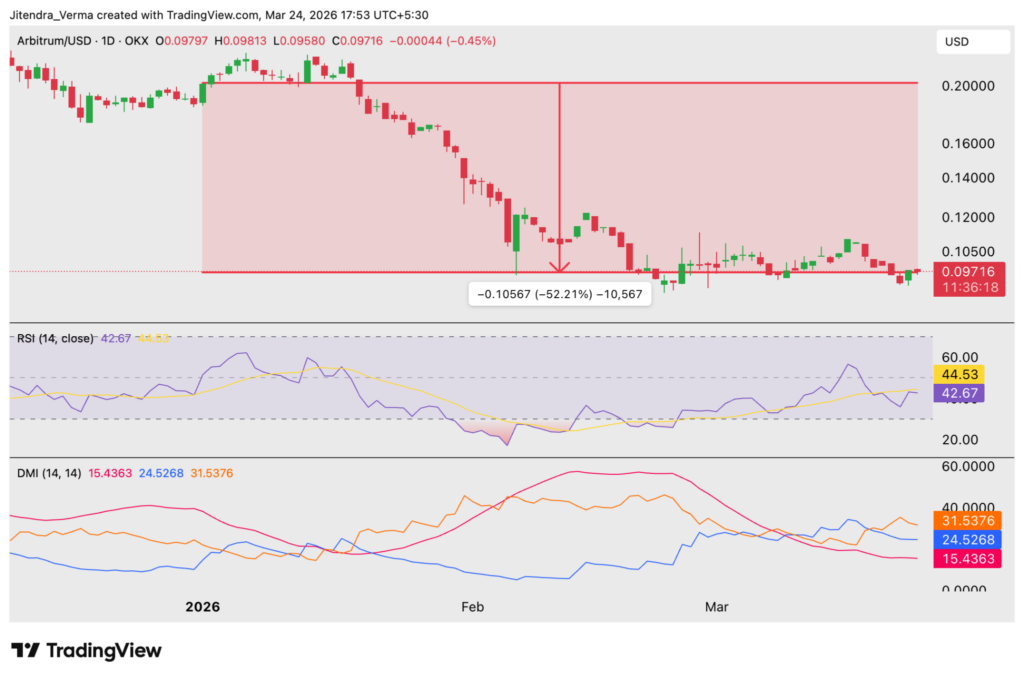
RSI at 42 means momentum is soft, and DMI shows bears still ahead with weak trend strength. Consolidation at support likely.
Yes. Consider the following before investing:
ARB may suit investors who want a high-risk portfolio slice, have a clear thesis, and can tolerate sharp volatility and long drawdowns. However, anyone with a short time horizon, low risk tolerance, or who needs income/cashflow-style tokens should avoid.
Arbitrum can be a strong ecosystem bet as an Ethereum L2 with real usage, but ARB investment success hinges on adoption, whether the token’s design strengthens value capture over time, and how dilution from unlocks impacts supply-demand.
Best thing to do is define your time horizon, track fundamentals alongside upcoming unlocks, and size your position like a high-volatility asset.
To make better crypto decisions, focus on learning fundamentals, managing risk, and staying informed. Start today with Mudrex Learn or the Mudrex YouTube channel.
It can be, but only as a small, high-risk portion. Learn L2 basics and tokenomics first.
Primarily governance and market expectations of long-term ecosystem success; direct fee capture isn’t guaranteed.
Yes. L2 competition is intense; track usage, liquidity, and developer traction over time.
They can increase supply and volatility; impact depends on market conditions and demand.
Often considered more established, but it still carries smart contract, bridge, and market risks.