

Ethereum’s [ETH] price doesn’t move in a straight line, so if it’s been falling (or going nowhere) it’s natural to wonder… Will ETH rise again?
No one can guarantee a rebound. But you can judge the odds by looking at the same conditions that have so far supported stronger ETH uptrends.

At the time of writing, the daily chart showed ETH consolidating after a drop, with price near $2,137 rather than trending strongly. The RSI was around 51, which is neutral; the market is undecided, not overheated or deeply oversold. Meanwhile, CMF is about -0.13, so there’s slightly negative money flow.
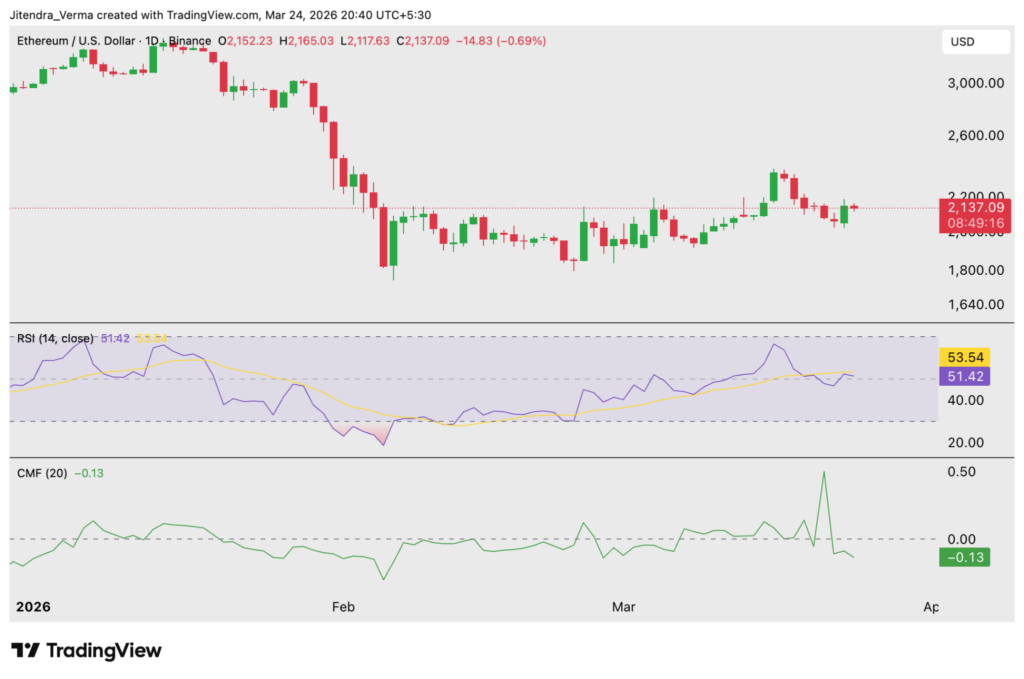
Rebound attempts haven’t yet been supported by consistently strong inflows.
A stronger outlook usually needs two forces together: utility demand (DeFi activity, stablecoin settlement, and L2-led growth that reinforces Ethereum’s role) and liquidity (risk-on macro, improving market breadth, and healthier crypto-cycle conditions).
Staking can reduce liquid supply, but it doesn’t remove sell pressure, and issuance vs burn depends heavily on fee/activity levels. That’s why the clean way to judge what moves ETH price is to track whether usage is rising and whether the backdrop is supportive.
Aggregated Open Interest is 12.186B (with the session range shown around 12.169B-12.219B), which means traders are active but not piling in aggressively.
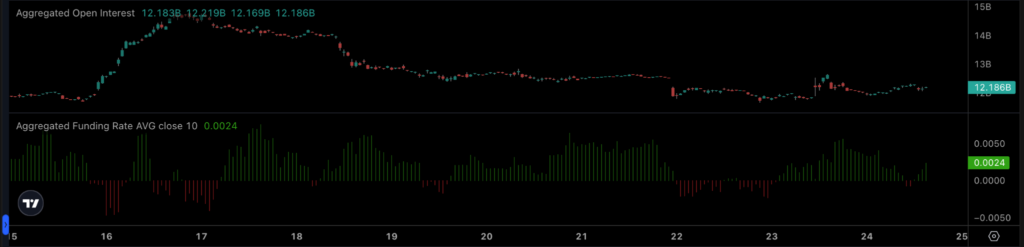
The Aggregated Funding Rate (AVG) is 0.0024, a mildly positive print. Longs are paying shorts, but it’s not extreme. For an ETH rebound thesis, this is generally constructive.
On the Exchange Reserve chart, ETH reserves trend down from roughly 16.1M in late Feb to about 15.0M after a sharp step-down around Mar 22, and then stabilize above that level.
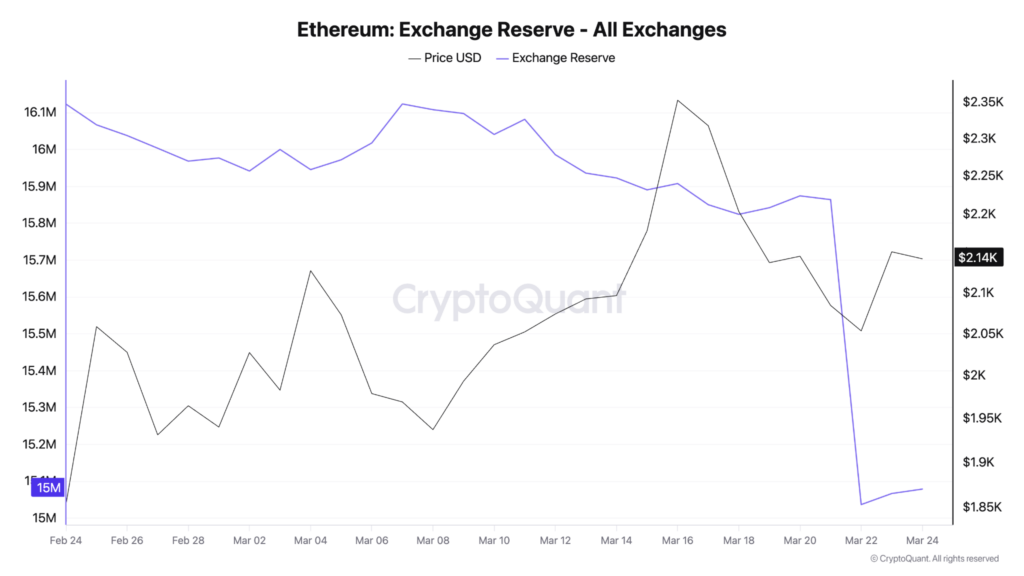
At the same time, price is shown near $2.14K. Falling reserves usually mean fewer coins sitting on exchanges. This doesn’t guarantee a pump, but it’s a classic ingredient that can support upside if demand returns.
The Exchange Netflow chart shows a very large negative spike around Mar 22 (a bar near -800K ETH), followed by smaller, mixed bars and a latest reading of +10.3K ETH. That pattern reads as: big withdrawal/accumulation event, then “back to normal” flows.
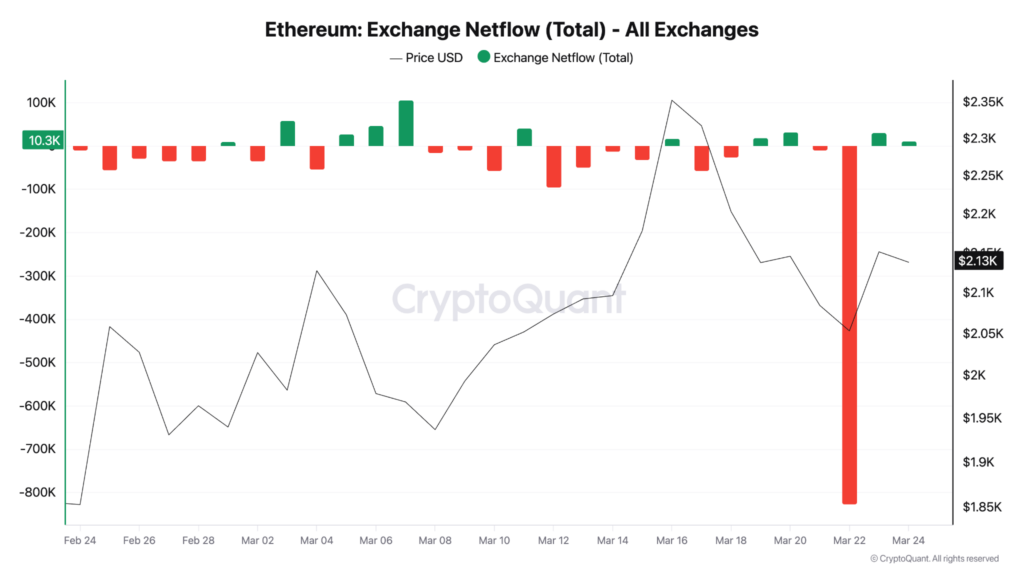
But about whether ethereum will rise again… this is a plus. Large outflows often align with investors moving ETH off exchanges to hold, while the recent small positive netflow says there’s no immediate supply shock either way.
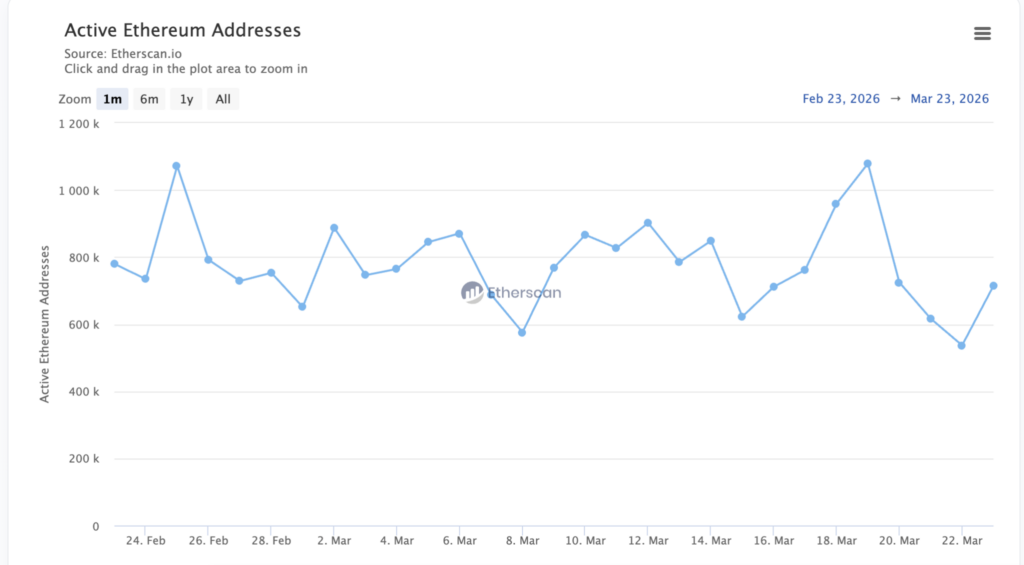
Active Ethereum Addresses over the last month swing widely: peaks near 1.1M (around late Feb and again near Mar 19) and a dip to roughly 0.55M (around Mar 22), with the latest point rebounding to about 0.72M. Usage is choppy, but the rebound from the low matters.
Even if your charts look constructive, it’s smart to think of why ethereum might not go up. ETH can still struggle if any of these risk buckets intensify:
The biggest ETH competition risk is that users and developers migrate to faster, cheaper ecosystems (often cited: Solana) when speed, UX, and low fees matter more than decentralization. If major apps or liquidity pools move away, ETH’s “settlement layer” story can weaken in the short term. There’s also L2 fragmentation. If the average user finds alternatives simpler, ETH adoption growth can slow.
A major risk factor is prolonged low-fee environments. If activity and fees remain subdued for long periods, the burn component becomes smaller, and the narrative that ETH is consistently deflationary (“ultrasound money”) loses force.
Further, Staking reduces liquid supply, but it’s not a one-way lock. Stakers can still sell rewards (and some will), which can cap upside during weak demand phases. In other words, the economics help most when demand is rising; they don’t guarantee a rally on their own.
Regulation risk is real, especially around staking and staking-as-a-service. Even without a direct hit to Ethereum itself, uncertainty can reduce institutional participation and tighten on/off-ramps. That’s bad for liquidity.
On top of that, ETH remains a risk asset: in a prolonged risk-off macro cycle, even solid on-chain signs can be overwhelmed. This is where timing matters.
High-level but important: Ethereum’s ecosystem includes complex smart contracts, bridges, and L2 infrastructure. A major exploit in a widely used protocol can spook investors and reduce on-chain activity… even if Ethereum L1 itself remains secure. Likewise, layer 2 risks can hit sentiment quickly.
ETH can still drop heavily, even in a longer-term bullish thesis. Treat ETH exposure like a high-volatility position. Size it so you can hold through turbulence, and match it to your time horizon. If your thesis depends on a quick rebound, you’re vulnerable to the exact risks above. A better approach is to define what would invalidate your outlook and build positions gradually.
It usually needs two things working together: improved liquidity and strong usage demand. That’s why price predictions are best treated as scenarios, not guarantees.
Build a simple plan instead: decide your time horizon, track a few key signals, and set clear invalidation points so you know when your thesis is wrong. Most importantly, avoid over-leverage.
To make better crypto decisions, focus on learning fundamentals, managing risk, and staying informed. Start today with Mudrex Learn or the Mudrex YouTube Channel.
Ethereum can recover, but outcomes depend on adoption, liquidity, and macro conditions.
Treat targets as scenarios. Focus on factors rather than exact numbers.
It helps, but it’s not sufficient alone.
It is considered more established, but ETH remains volatile and exposed to drawdowns.
Many prefer DCA for volatile assets. Align entries with your horizon and risk tolerance, not headlines.