Which Indicator Is Best for Crude Oil Trading? A Practical 2026 Guide
If you have ever stared at a WTI or Brent chart and asked yourself which indicator is best for crude oil trading, you are not alone. Crude oil is one of the most volatile and news-driven assets in the world, which makes choosing the right technical tool the difference between a clean entry and a painful stop-out. In this guide, we break down the best indicator for crude oil across swing and intraday setups, the best time frame to trade crude oil, and how to combine signals for higher-probability trades.
Crude oil is not equity. It reacts violently to OPEC+ headlines, inventory reports (EIA Wednesdays), geopolitical tension and dollar strength. Lagging indicators built for slow-moving stocks often misfire here. The best indicator for crude oil tends to do three things well:
Filter out noise during low-liquidity hours
Respect the asset’s tendency to trend hard and reverse fast
Adjust to volatility expansion around news events
With that lens, let us look at the indicators that actually work.
Quick Comparison: Best Indicator for Crude Oil Trading
Indicator
Best For
Time Frame
Strength
Weakness
RSI (14)
Reversals, divergence
1H, 4H, Daily
Catches exhaustion early
Lags in strong trends
MACD
Trend confirmation
4H, Daily
Filters noise well
Slow on fast reversals
Bollinger Bands
Volatility breakouts
15M, 1H
Excellent around news
False signals in chop
VWAP
Intraday bias & entries
1M, 5M, 15M
Institutional benchmark
Resets daily
ATR
Stop-loss & position sizing
All
Adapts to volatility
Not directional
Indicators Comparison
The 5 Best Indicators for Crude Oil Trading
1. Relative Strength Index (RSI)
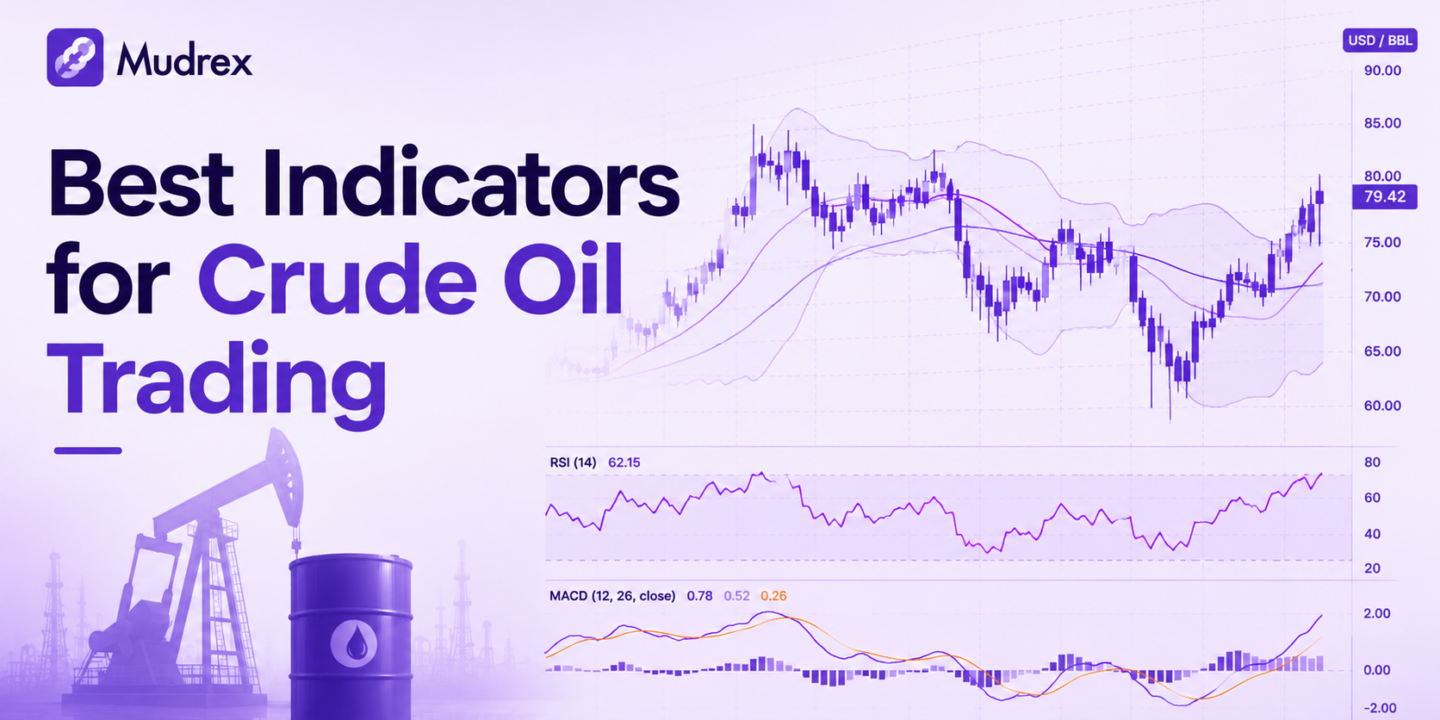
RSI (14) is a momentum oscillator measuring overbought and oversold conditions. For crude, traders often tweak the standard 70/30 levels to 80/20 because oil regularly stays “overbought” during strong trends. RSI divergence — price making a new high while RSI does not — is one of the most reliable reversal signals on crude oil daily and 1-hour charts.
2. Moving Average Convergence Divergence (MACD)
MACD shines on the 4-hour and daily crude oil charts. The crossover of the MACD line above the signal line, combined with a histogram flipping positive, has historically caught the early stage of multi-day oil trends. Pair MACD with a 50-EMA filter to avoid counter-trend signals.
Crude oil cycles between contraction and expansion. Bollinger Bands (20, 2) visualise that perfectly. A “squeeze” — bands tightening — almost always precedes a sharp move, especially right before EIA inventory data. Many crude traders trade the breakout candle out of the squeeze rather than predicting direction.
4. Volume Weighted Average Price (VWAP)
If you ask any prop desk what the best indicator for crude oil intraday trading is, VWAP comes up first. It anchors price to the day’s volume-weighted fair value. Price above VWAP = intraday bullish bias; below = bearish. Pullbacks to VWAP on the 5-minute chart are textbook intraday entries.
5. Average True Range (ATR)
ATR does not generate signals — it sizes them. Crude can move ₹150–₹300 (or $2–$5) in a single session. Using a 14-period ATR to set stop-loss distance keeps you from getting wicked out by normal volatility.
Best Indicator for Crude Oil Intraday Trading
For intraday traders, the winning combination is VWAP + 9 EMA + RSI (14) on the 5-minute chart. Here is how it works:
Bias: Price above VWAP → look only for longs. Below VWAP → only shorts.
Entry: Pullback to 9 EMA with RSI between 40–60 (resetting, not overextended).
Exit: Opposite VWAP cross or RSI hitting 75/25.
This setup respects the “trend day” behaviour crude often shows after 9:30 AM EST / 7:00 PM IST, the most active hours when US traders join the session.
The best time frame to trade crude oil depends on your style:
Scalpers: 1-minute and 5-minute charts during the New York session
Intraday traders: 15-minute chart with a 1-hour bias filter
Swing traders: 4-hour for entries, daily for trend direction
Positional traders: Daily and weekly charts
If you are asking which time frame is best for crude oil trading as a beginner, start with the 1-hour chart. It filters out 5-minute noise but gives enough setups per week to learn from. The 15-minute is the sweet spot once you are consistent — fast enough for multiple opportunities, slow enough to think clearly.
Best Trading Hours for Crude Oil (IST)
Session
Time (IST)
Characteristics
Asian
5:30 AM – 12:30 PM
Low volume, range-bound
London
12:30 PM – 6:00 PM
Moderate volatility
US (peak)
6:00 PM – 11:30 PM
Highest liquidity, biggest moves
EIA Report
Wed 8:00 PM
Spike volatility — trade with caution
How to Combine Indicators Without Overloading Your Chart
A common mistake is stacking five indicators that all measure the same thing. Instead, combine one from each category:
Trend: 50 EMA or MACD
Momentum: RSI
Volatility: Bollinger Bands or ATR
Volume: VWAP
That gives you a complete picture without analysis paralysis.
Final Verdict: Which Indicator Is Best for Crude Oil Trading?
There is no single “best” indicator — but if forced to pick one, VWAP for intraday and MACD for swing trading are the most reliable starting points on crude oil. Layer in RSI for confirmation and ATR for stops, and you have a complete framework.
The best indicator for crude oil is ultimately the one you have backtested on your own time frame, in your own market hours, with your own risk rules. Tools do not make trades profitable — disciplined application does.
Disclaimer: This article is for educational purposes only and is not financial advice. Trading crude oil involves substantial risk. Always do your own research
FAQs
Which indicator is best for crude oil trading for beginners?
RSI on the 1-hour chart — simple, visual, and forgiving while you learn.
Is MACD or RSI better for crude oil?
MACD is better for confirming trends; RSI is better for spotting reversals. Most pros use both.
Which time frame is best for crude oil trading intraday?
The 5-minute chart for entries, with a 15-minute or 1-hour chart for bias.
Can I trade crude oil with just one indicator?
Yes — VWAP alone is enough for many intraday traders, but always pair it with a stop-loss method like ATR.
What is the best time to trade crude oil in India?
Between 6:00 PM and 11:30 PM IST, when US markets are active and MCX crude sees peak volume.
Anupam has over 3 years of experience in the crypto industry, having worked with top indian crypto exchanges. He writes about Bitcoin, altcoins, AI, and emerging tech, helping readers understand what’s driving markets and where the digital asset ecosystem is headed.