For years, Indian traders wanting a piece of Apple, Tesla, or Nvidia had one real option: open an overseas trading account, move money through the RBI’s remittance route, and wait days for a trade to settle. That has changed. Tokenized US stocks in India now let you get exposure to the same companies from Mudrex, in minutes, with far less paperwork.
A tokenized US stock is a blockchain-based token that tracks or represents a real, publicly listed stock like Apple or Tesla. Indian crypto platforms are rolling these out fast as part of a bigger real-world-asset trend, and here’s what most explainers skip: they come in different structures, and knowing which one you’re using is what lets you trade them well.
This guide covers how tokenized US stocks in India are built, backed, issued, and regulated, what you actually own, and why they trade differently from a normal stock.
Key Takeaways
Tokenized US stocks in India give you fast, fractional exposure to companies like Apple, Tesla, and Nvidia, without opening a separate US brokerage account.
They come in two structures: custodial-backed tokens, backed by a real share held in custody, and synthetic tokens, which track the price through a contract.
Most tokenized stocks are built for trading price movement rather than long-term ownership, so perks like voting or dividends usually aren’t part of the deal, similar to trading a stock future.
SEBI doesn’t yet have a dedicated framework for these products, so they currently sit alongside crypto rather than inside traditional brokerage regulation.
Gains are taxed as virtual digital assets in India: a flat 30% under Section 115BBH, with 1% TDS on transfers under Section 194S.
What’s the Difference Between a Custodial-Backed and a Synthetic Tokenized Stock?
This is the single most important distinction to understand before you trade tokenized US stocks in India, and almost no beginner content covers it properly.
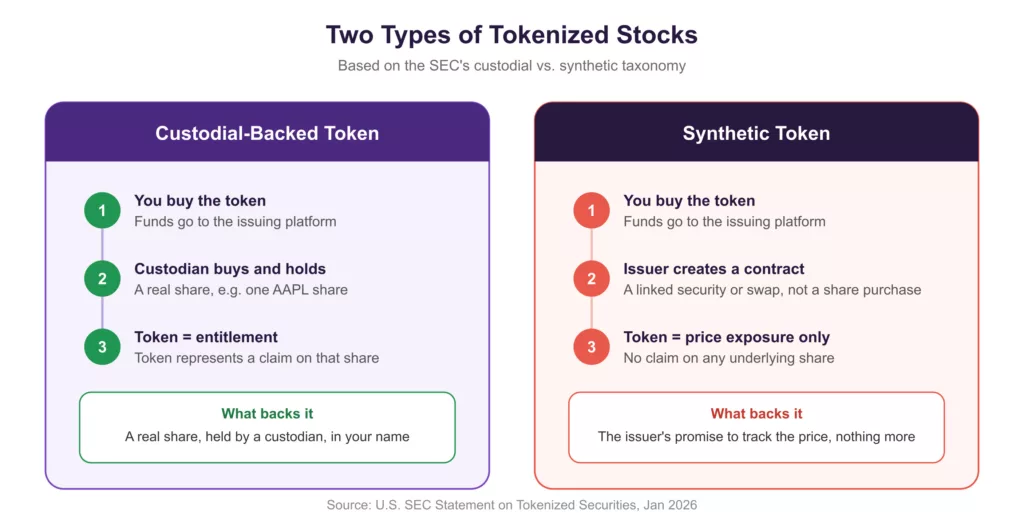
In January 2026, the U.S. Securities and Exchange Commission published a statement on tokenized securities that formally named two models third parties use to tokenize a stock: custodial tokenized securities and synthetic tokenized securities. It’s worth understanding both in plain terms.
A custodial tokenized security works through something called a tokenized security entitlement. A third party buys the real share and holds it in custody. The token you receive represents your indirect claim on that share sitting in the custodian’s vault. When you transfer the token, you’re transferring that claim.
A synthetic tokenized security works differently. The third party doesn’t buy the real share at all. Instead, it issues its own instrument, either a linked security or a security-based swap, that simply promises to pay out based on the referenced stock’s price. The SEC statement is explicit that this kind of instrument confers no rights or benefits from the actual company, and exposes you to the third party’s own solvency, since your claim is only against that third party.
The diagram below shows how the two models differ at each step.
Tokenized US Stocks in India: How They're Backed and Regulated
Neither model is automatically “better.” Custodial tokens are generally considered lower risk because there’s a real asset behind them, while synthetic tokens can be faster and cheaper to issue. Not every platform spells out which model it uses in plain language, so it’s a good first question to ask, and a genuinely useful one to know the answer to before you fund a trade.
How Are Tokenized US Stocks Issued?
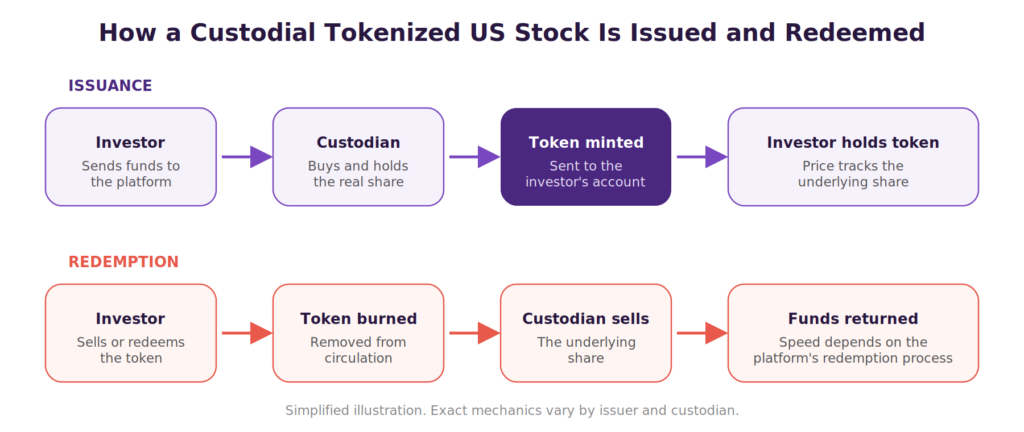
Issuance for a custodial tokenized US stock in India generally follows a fixed sequence, and understanding it explains almost everything else about how these products behave.
You send funds to the platform offering the tokenized stock.
A custodian buys the real share on a US exchange, using those funds (or pooled funds across many investors).
A token is minted on a blockchain network and credited to your account, representing your claim on that share.
You can trade, hold, or transfer the token, depending on what the platform allows.
The reverse happens on redemption: you sell or redeem the token, the token is burned (permanently removed from circulation), and the custodian sells the underlying share to release your funds.
Tokenized US Stocks in India: How They're Backed and Regulated
This “mint on deposit, burn on redemption” pattern is what keeps the token’s supply matched to the actual shares in custody, at least in theory. It’s also why the custodian’s own transparency- how often they publish proof of holdings- matters more for a tokenized stock than it ever does for a normal demat holding, where a regulated depository does that verification work for you automatically.
For issuer-sponsored tokenization, where the company itself issues the token rather than a third party, the SEC statement notes something worth knowing: the issuer can integrate the blockchain record directly into its official register of shareholders, called the master securityholder file. In that case, moving the token IS moving the security, not just a claim tied to it. This model is less common for the tokenized US stocks Indian platforms currently offer, which mostly use the third-party custodial model instead.
How Are Tokenized US Stocks Backed?
“Backed” is a word that gets used loosely, so it’s worth being precise about what it should mean.
For a genuinely custodial tokenized US stock, backing means a regulated custodian holds the actual share, typically on a 1:1 basis, meaning one token corresponds to one share (or a fraction of one, for fractional products). The custodian’s job is to make sure the number of shares held always matches the number of tokens in circulation.
Good custodial platforms make this easy to verify. A few things worth checking on any “1:1 backed” claim:
Who is the named custodian, and are they a regulated entity you can independently verify?
Does the platform publish attestations or proof-of-reserve reports, and how often?
What does the redemption process look like if you ever want to exit quickly?
We list this clearly on our own tokenized US stock offering too: you’re getting fast, liquid price exposure to the underlying company, not a transfer of the actual shares. That kind of upfront clarity is what to look for on any platform, and it’s exactly what lets you use these products for what they’re good at: quick, flexible access to global names without the overhead of a separate brokerage account.
For synthetic tokens, there is no underlying share to check at all. “Backing” simply means the issuer’s contractual promise to pay based on the referenced price. If the issuer can’t or won’t pay, there is no share sitting anywhere for you to fall back on.
What Do You Actually Own When You Buy a Tokenized US Stock in India?
This is the one thing worth understanding clearly if you’re used to demat shares, because it changes how you should think about the position, in a good way once it clicks.
Even with a custodial-backed token, where a real share genuinely sits in custody, you typically get price exposure rather than the full bundle of rights that come with owning a stock outright, similar to holding a stock derivative:
Voting rights: Absent. The custodian is the shareholder of record, not you.
Dividends: sometimes passed through as an economic equivalent, sometimes not at all. This varies by platform and needs to be checked individually.
Legal claim: an indirect entitlement against the custodian or issuer, not a direct legal claim on the company the way a demat holding gives you.
With a synthetic token, none of the above applies, because there’s no underlying share at all. You’re holding a contract that references a price, full stop.
This distinction matters more for an experienced trader than a first-time investor, because it changes what the position is actually for. A long-term investor buying Apple stock through a regulated US broker is buying ownership, with the rights that come with it. A trader using a tokenized US stock in India is buying price exposure, which is a genuinely different product even when the ticker on screen looks identical. For someone trading price moves rather than parking capital for years, that’s not a downside; it’s the point.
Why Do Tokenized US Stocks Trade Differently From Stocks on the NYSE or NASDAQ?
Three structural differences come directly from the issuance model already covered, not from any special feature the platforms are adding on top.
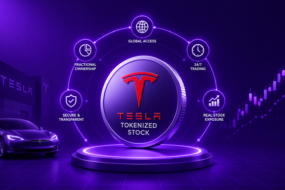
Trading hours are not limited to NYSE or NASDAQ sessions. Because the token itself lives on a blockchain network rather than an exchange’s own order book, platforms can let you trade it 24/7, including weekends, when the actual US market is closed, and no new information about the underlying stock is being priced in.
Settlement is near-instant instead of T+2. A normal US stock trade settles in two business days. A token transfer settles as fast as the underlying blockchain confirms the transaction, typically seconds to minutes.
Fractional sizing is the default, not an add-on. Since the custodian can hold a pool of shares against many token holders, platforms can issue tokens in very small fractions, letting you get exposure to a stock like Nvidia for a fraction of what one full share would cost.
The tradeoff is that none of this changes what you fundamentally own, covered in the section above. Faster settlement and round-the-clock trading are real conveniences, but they don’t turn a synthetic token into a share, and they don’t add voting rights to a custodial one.
Are Tokenized US Stocks Legal in India? What’s the Regulatory Status?
Here’s the actual regulatory picture, in plain terms, so you know exactly where these products stand.
SEBI does not currently have a framework specifically covering tokenized US stocks offered through crypto platforms. SEBI regulates traditional brokerage-based stock investing in India, including the Liberalised Remittance Scheme-based route for buying real US shares. Tokenized US stocks traded on a crypto exchange sit outside that regulatory perimeter for now. That’s not unusual for a fast-moving product category: global regulators, including the SEC, are still actively building out formal frameworks for tokenized securities too, as the statement referenced earlier shows.
Gains are taxed under India’s virtual digital asset regime, not under standard capital gains rules. Under Section 115BBH of the Income Tax Act, income from transferring a virtual digital asset is taxed at a flat 30%, with no deduction allowed except the cost of acquisition, and no ability to set off or carry forward losses against other income. Separately, Section 194S requires 1% TDS to be deducted on VDA transfers above the prescribed threshold. This tax treatment is a strong signal of how Indian tax law currently classifies tokenized stocks: as virtual digital assets, not as foreign securities.
This is a genuinely different legal route from LRS-based US stock investing, which falls under RBI’s foreign exchange rules instead. The next section covers that comparison directly, since it’s the one every experienced trader in this space eventually needs to make.
None of this makes tokenized US stocks illegal. It simply means they currently sit in a newer, evolving regulatory space, similar to where crypto itself stood a few years before dedicated frameworks caught up. Worth factoring in as you size any position, the same way you would with any emerging asset class.
How Do Tokenized US Stocks Compare to Buying US Stocks Through LRS?
For an experienced Indian trader, this is usually the real decision: tokenized exposure through a crypto platform, or actual ownership through the RBI’s Liberalised Remittance Scheme (LRS).
Under the RBI’s LRS framework, resident individuals can remit up to USD 250,000 per financial year to buy foreign securities, including US stocks, through a SEBI-registered broker or an authorised international trading platform. Any unused or unreinvested proceeds must be repatriated to India within 180 days, and once you’ve used your full annual limit, you cannot remit further under LRS that year, even if investment proceeds come back into the country.
Tokenized US Stocks (Custodial)
LRS Route (via Broker)
What you own
Indirect entitlement to a share held by a custodian
Direct ownership of the actual share
Regulator
No dedicated SEBI framework; VDA tax rules apply
SEBI-regulated brokerage; RBI governs the remittance
Minimum investment
Often as low as a few hundred rupees, via fractional tokens
Typically higher, though many brokers now offer fractional access too
Annual limit
No LRS-style cap
USD 250,000 per financial year under LRS
Settlement speed
Near-instant to minutes
Standard T+2 for the underlying US trade
Trading hours
Often 24/7
Limited to US market hours
Taxation
Flat 30% under Section 115BBH, plus 1% TDS
Standard capital gains tax rules for foreign equity
Shareholder rights
Usually none
Full rights as a beneficial owner, including dividends
Neither route is “better” in the abstract; they’re built for different goals. If you are investing for the long term and want full ownership, LRS is the established path. If you’re trading price moves and want speed, round-the-clock access, and low minimums, tokenized US stocks are built exactly for that. Many experienced traders end up using both: LRS for long-term holdings, tokenized stocks for tactical, fast-moving positions.
Trade Tokenized US Stocks With Us
If tactical, fast-moving exposure is what you’re after, you can trade tokenized US stocks like NVIDIA and Tesla directly from the Mudrex app, right alongside your existing crypto portfolio. No separate international brokerage account, no juggling multiple platforms.
Want to see how tokenized US stocks fit into a broader trading view, including around events like US earnings season? Our YouTube channel breaks down market-moving events as they happen.
FAQs
Are tokenized US stocks legal to trade in India?
There’s no law banning them outright, but SEBI doesn’t currently regulate them the way it regulates broker-based stock investing. Gains are taxed under India’s virtual digital asset rules.
Do I get dividends from a tokenized US stock?
It depends on the platform and the specific token. Some custodial tokens pass through an equivalent payment; many don’t. Check the individual product’s terms rather than assuming either way.
What happens to my tokenized US stock if the platform shuts down?
This depends on the custody structure and the platform’s redemption process, which is why choosing a platform with clear, published disclosure practices matters. It’s a good question to ask of any provider, tokenized stocks or otherwise.
Can I get voting rights with a tokenized US stock?
In almost all current models, no. The custodian remains the shareholder of record, even for custodial-backed tokens.
How are tokenized US stock gains taxed in India?
As virtual digital assets: a flat 30% tax on gains under Section 115BBH, with 1% TDS on transfers under Section 194S, and no ability to set off losses against other income.
Risk Disclaimer
Trading tokenized US stocks and other virtual digital assets carries risk of capital loss. Tokenized products may involve leverage or synthetic exposure that can amplify both gains and losses. Any examples or figures in this article are illustrative only and not financial advice. Tokenized US stocks currently sit outside SEBI’s regulatory framework, and regulations may change. Please consult a qualified financial advisor before making investment decisions.
Siri is a writer venturing into the exciting realms of blockchain technology, cryptocurrency, and decentralized finance (DeFi), eager to explore the transformative potential of these innovations. She brings a unique perspective that bridges traditional industries and cutting-edge technology, often infused with a touch of humor through memes. She has a rich background in real estate and interior design, having previously contributed to NoBroker, where she crafted blogs and assets on these topics.