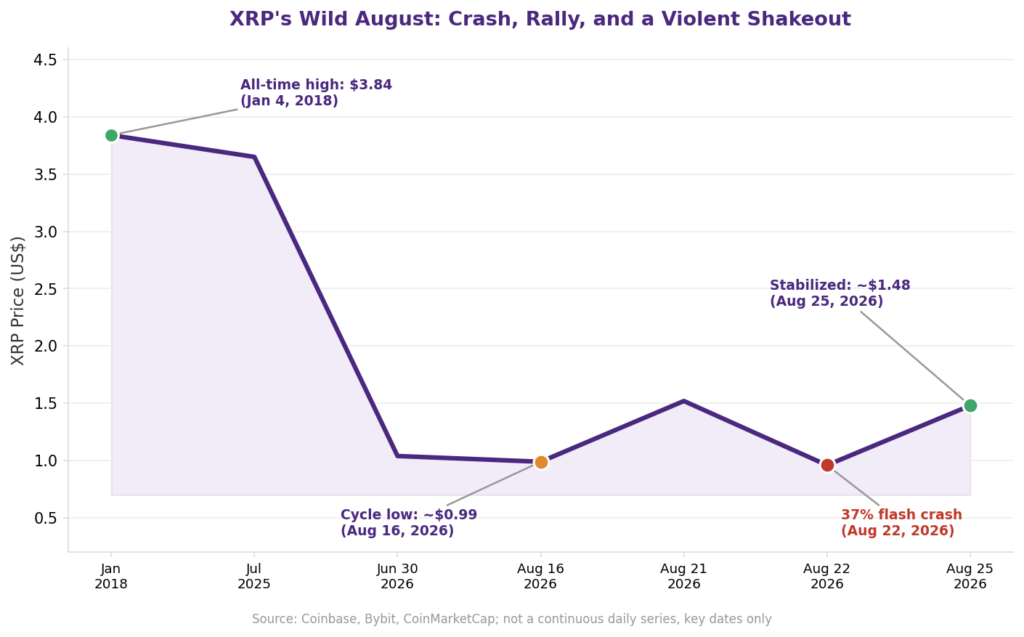
Will XRP bounce back in 2026? In a sense, it already has, and then some, all within the space of about ten days. XRP fell to roughly $0.99 in mid-August, rallied more than 60% to touch $1.52, got violently shaken out in a 37% single-day flash crash on August 22 that wiped out $500 million in leveraged long positions, and has since stabilized around $1.48.
That’s the honest starting point for this question: XRP isn’t waiting to bounce back, it’s already in the middle of trying, in real time, with all the volatility that implies. Here’s what the data says about whether this recovery has legs.
Key Takeaways
XRP has already staged a sharp recovery attempt, rallying over 60% from its mid-August 2026 low near $0.99 before a violent 37% flash crash on August 22 and a subsequent stabilization near $1.48.
XRP remains roughly 61-62% below its all-time high of $3.84 (January 2018) and about 59% below its more recent cycle high of $3.65 (July 2025).
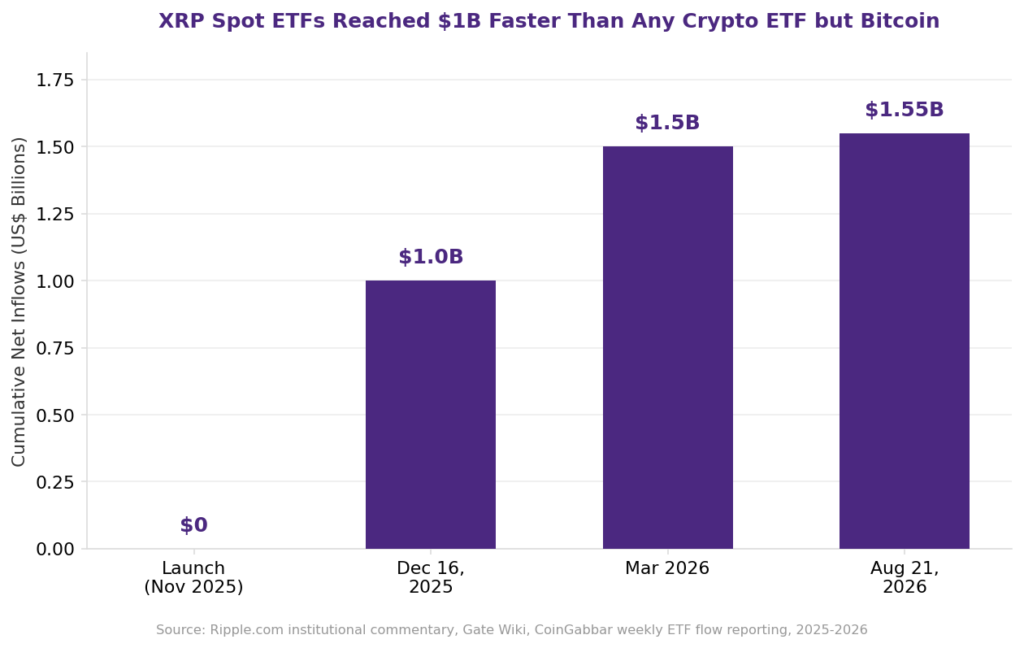
Spot XRP ETFs have pulled in $1.55 billion in cumulative net inflows since their November 2025 launch, though the pace of new inflows has slowed since March 2026.
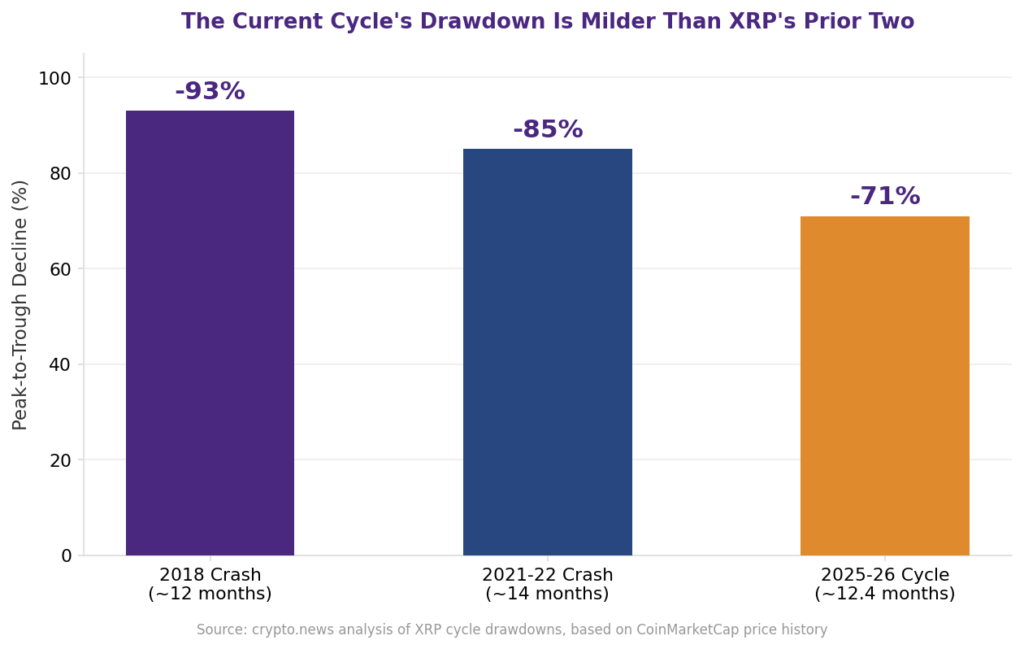
The current cycle’s drawdown (-71%) is milder than XRP’s 2018 (-93%) and 2021-22 (-85%) crashes, which could mean a shallower bottom or simply that more downside is still possible.
The CLARITY Act remains unresolved, with a Senate cloture vote scheduled for September 15, 2026; passage could unlock significantly more institutional ETF demand, while failure would extend regulatory uncertainty.
Will XRP Bounce Back in 2026?
XRP has already partially bounced back in 2026, but whether that recovery holds through year-end is genuinely uncertain, and the data supports both a cautiously bullish and a cautiously bearish read depending on which signals you weigh more heavily.
XRP rallied from a ~$0.99 low to a $1.52 high within about a week in August 2026.
A 37% flash crash on August 22 erased much of that rally within hours.
Price has since stabilized around $1.48, still up significantly from the cycle low.
The bigger question isn’t whether XRP can bounce; it clearly can and did, but whether it can sustain gains without repeating this kind of violent round trip.
Definition: Flash Crash A sudden, severe price decline that occurs within a very short timeframe, often intensified by cascading liquidations of leveraged positions, followed by a partial or full recovery once forced selling subsides.
Why Is XRP Down in 2026?
XRP is down in 2026 because it’s in the later stages of a broader cycle correction that began after its July 2025 high of $3.65, a decline that reached roughly 71% at its worst before this month’s rally began.
Will XRP Bounce Back in 2026?
This decline sits within a recognizable historical pattern for XRP specifically, though the current drawdown has been notably shallower than its two prior major crashes.
Cycle
Peak-to-Trough Decline
Approximate Duration
2018 crash
-93%
~12 months
2021-22 crash
-85%
~14 months
2025-26 cycle
-71%
~12.4 months
Will XRP Bounce Back in 2026?
A milder drawdown than history could mean XRP found support earlier this cycle, thanks to deeper institutional participation via ETFs. It could just as easily mean the correction isn’t finished, since every prior XRP cycle bottomed considerably lower in percentage terms. Both readings are consistent with the same data, which is exactly why “will XRP bounce back” doesn’t have a clean, one-sided answer.
What Happened to XRP This Week?
XRP experienced an extraordinarily volatile stretch in the week of August 18-25, 2026: a sharp rally driven by improving liquidity conditions, a violent flash crash that liquidated hundreds of millions in leveraged positions, and a partial stabilization that left price meaningfully higher than where the week began.
Price climbed from around $0.99-1.04 to a high of $1.52, a move of roughly 60% in a matter of days, coinciding with a broader crypto market rally and renewed optimism around ETF flows and easing macro liquidity conditions. That rally left the market, in the words of multiple trading desks, “dangerously overexposed.” On August 22, a flash crash of 37% hit XRP specifically as part of a market-wide deleveraging event that liquidated roughly $1.35 billion in leveraged positions across crypto, including about $500 million in XRP longs alone. By August 25, XRP had recovered to around $1.48, well above the pre-rally low but well below the week’s peak.
What Could Trigger the Next XRP Rally?
The most credible catalysts for a further XRP rally are continued ETF inflows, a successful CLARITY Act vote, and renewed institutional allocation, though each carries real uncertainty about timing and scale.
On-chain data from earlier in the correction showed several capitulation-style signals: exchange reserves fell to a seven-year low of roughly 1.7 billion XRP, suggesting reduced sell-side pressure, while whale wallets accumulated an estimated 2.8% more supply over five weeks. Historically, XRP has posted extremely large rallies, in the range of 1,000%, following each of its three prior drawdowns greater than 60%, though a sample size of three should be treated with real caution rather than as a reliable pattern.
How Could XRP ETF Inflows Help XRP Recover?
XRP ETF inflows provide a steadier, more structural source of demand than retail trading alone, and the data shows this demand has been real, if increasingly gradual, since the November 2025 launch.
Will XRP Bounce Back in 2026?
US spot XRP ETFs crossed $1 billion in cumulative inflows by December 16, 2025, the fastest crypto asset to hit that mark since Ethereum’s ETF launch. Growth continued into March 2026, aided by the SEC and CFTC’s joint classification of XRP as a digital commodity, which removed a major regulatory obstacle.
Since then, inflows have continued but at a visibly slower pace, reaching $1.55 billion by August 21, 2026. JPMorgan has forecast $4-8.4 billion in first-year inflows as a realistic range, meaning current totals sit well within that band but haven’t yet approached its upper end. Our guide to XRP ETF inflows as a signal breaks down how to track this data yourself, and our roundup of the best XRP ETFs to buy compares the specific funds available.
How Could Regulatory Clarity Affect XRP’s Price?
Regulatory clarity could meaningfully support XRP’s price by unlocking additional institutional capital that has stayed on the sidelines pending permanent legal certainty, though the key remaining step, the CLARITY Act, has not yet passed.
Definition: CLARITY Act The pending US bill that would formally divide crypto oversight between the SEC and CFTC and legally lock in which digital assets, including XRP, count as commodities rather than securities.
The March 2026 SEC/CFTC classification of XRP as a digital commodity was a meaningful step, but it’s an interpretive agency action, not legislation, meaning a future change in regulatory leadership could theoretically revisit it. The Senate recessed in early August 2026 without holding a floor vote on the CLARITY Act, and a cloture vote is now scheduled for September 15, 2026, requiring 60 votes to proceed with roughly six Democratic crossovers still needed.
A successful vote would convert today’s favorable but reversible classification into durable law; a failed vote could stall US crypto market structure legislation for the remainder of 2026.
What Risks Could Delay an XRP Rebound?
Several structural risks could delay or cap an XRP rebound independent of how sentiment or ETF flows evolve.
Monthly escrow releases: Ripple unlocks roughly 1 billion XRP from escrow most months, and while much is often re-locked, the overhang adds consistent potential supply.
Weak network-fee economics: XRP Ledger transaction fees are minimal, destroying only an estimated $29 worth of XRP daily against a market cap in the tens of billions, meaning network usage alone isn’t yet a meaningful value driver.
CLARITY Act failure risk: a failed September 15 cloture vote would extend regulatory uncertainty and could slow the institutional adoption thesis.
Historical drawdown severity: prior XRP cycles bottomed at 85-93% declines; the current 71% drawdown could still have further to run if that pattern holds.
Leverage-driven volatility: this week’s flash crash demonstrated how quickly leveraged positioning can erase gains, a risk that persists as long as futures open interest remains elevated relative to spot activity.
Can XRP Return to Its Previous All-Time High?
Returning to $3.84 is possible but would require XRP’s market capitalization to roughly triple from current levels, a significant move that would likely require sustained ETF inflows, resolved regulation, and a broader crypto bull cycle working together rather than any single catalyst alone.
At a circulating supply of roughly 62.7 billion XRP, a $3.84 price implies a market capitalization north of $240 billion, more than double XRP’s current market cap of roughly $93 billion. That’s a large gap, though not an unprecedented one by XRP’s own history, given the token’s tendency toward extreme, multi-hundred-percent moves in both directions. Our longer-term XRP price prediction for 2025-2030 walks through more realistic scenario ranges across different time horizons.
Key Support and Resistance Levels for an XRP Rebound
XRP’s most immediately relevant technical levels sit around $1.10 as a broken former resistance now acting as potential support, and the $1.45-1.52 zone as the ceiling tested and rejected during this week’s flash crash.
Short-term moving averages formed a bullish golden cross during the August rally, but the Relative Strength Index pushed above 80 at the peak, a classic overbought signal that often precedes a pullback, which is roughly what followed. A sustained close back above $1.50 would suggest the recovery has genuine follow-through; a slide back toward $1.10 or below would suggest the flash crash exposed real underlying weakness rather than just excess leverage.
Conclusion
Will XRP bounce back in 2026? It already has, partially and violently, and the more useful question now is whether that bounce sticks. The bull case rests on real, verifiable inflows (over $1.5 billion into spot ETFs), a shallower drawdown than prior cycles, and a still-pending CLARITY Act vote that could unlock further institutional demand.
The bear case rests on real, verifiable risks too: a historical pattern of deeper bottoms, weak underlying network economics, and a market that just demonstrated how quickly leverage can erase weeks of gains in hours. Both cases are true at once, which is the most honest way to describe where XRP actually stands.
XRP has already staged a sharp partial recovery in August 2026, rallying over 60% before a violent flash crash; whether it sustains further gains through year-end remains genuinely uncertain.
When will XRP recover?
There’s no reliable exact timing. XRP has already recovered significantly from its mid-August low, but sustained recovery likely depends on the September 15 CLARITY Act vote and continued ETF inflows.
Why is XRP down in 2026?
XRP is in the later stage of a broader cycle correction that began after its July 2025 high of $3.65, reaching a roughly 71% drawdown before this month’s partial rally.
What could trigger the next XRP rally?
Continued ETF inflows, a successful CLARITY Act vote, and renewed institutional allocation are the most credible near-term catalysts, alongside broader crypto market conditions.
Can XRP return to its previous all-time high?
Reaching $3.84 would require XRP’s market cap to roughly triple from current levels, a significant but not historically unprecedented move given XRP’s volatility.
How could XRP ETF flows affect its recovery?
Spot XRP ETFs have pulled in $1.55 billion in cumulative inflows since November 2025, providing steadier institutional demand, though inflow growth has slowed since March 2026.
Does Ripple adoption directly affect the XRP price?
Not strongly yet. XRP Ledger transaction fees are minimal and don’t yet generate meaningful value capture, so payment adoption hasn’t translated into direct token demand at scale.
What risks could delay an XRP rebound?
Monthly escrow supply releases, weak network-fee economics, a failed CLARITY Act vote, and XRP’s history of deeper drawdowns are the main risks that could cap or delay a rebound.
Risk Disclaimer
Cryptocurrency investments carry a high risk of loss and are volatile. Any use of leverage or futures magnifies both potential gains and potential losses. The figures, scenarios, and comparisons in this article are illustrative and for educational purposes only; they are not financial advice or a guarantee of future performance. Please consult a qualified financial advisor before making any investment decisions.
Siri is a writer venturing into the exciting realms of blockchain technology, cryptocurrency, and decentralized finance (DeFi), eager to explore the transformative potential of these innovations. She brings a unique perspective that bridges traditional industries and cutting-edge technology, often infused with a touch of humor through memes. She has a rich background in real estate and interior design, having previously contributed to NoBroker, where she crafted blogs and assets on these topics.