Current Bitcoin Cycle Position: Where Are We in 2026?
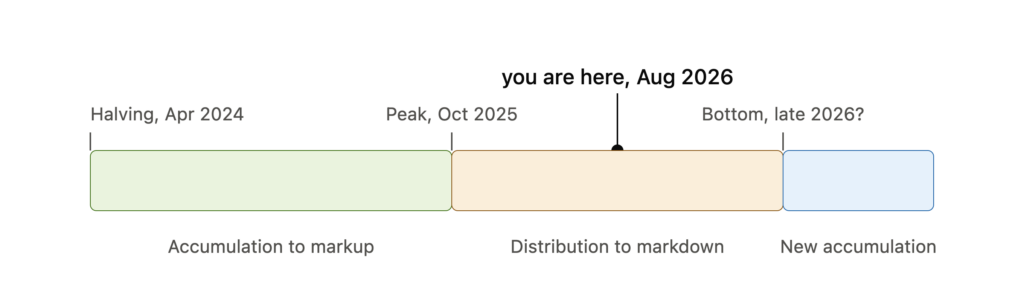
Bitcoin is about 28 months past its April 2024 halving and roughly 11 months past its October 2025 peak near $126,000. Map that onto the four year model and the current Bitcoin cycle position lands in one place: the markdown phase, the bear leg that follows every top.
So where exactly are we, and what happens next? The current Bitcoin cycle position matters because each phase behaves differently, and knowing the phase shapes how you act. This guide covers how the cycle is measured, where the on-chain data says we sit, whether ETFs have changed the pattern, and when the next phase could begin.
What Is the Current Bitcoin Cycle Position?
In one line: late-stage markdown, also called the bear phase, with a cycle bottom widely expected in late 2026.
As of late August 2026, Bitcoin trades near $78,700, roughly 38% below its record, after rebounding from summer lows in the low $60,000s. That profile, a faded peak plus a deep drawdown plus cautious sentiment, is the textbook markdown phase that has followed every prior Bitcoin top. The current Bitcoin cycle position is not the euphoric top and not yet the confirmed bottom. It sits in between, on the down slope.
Current Bitcoin Cycle Position: Where Are We in 2026?
How the Bitcoin Cycle Is Measured
Bitcoin’s cycle is anchored to the halving, which cuts new supply in half roughly every four years. Historically the market has moved through four phases after each halving:
Accumulation, months 0 to 12: price consolidates as the supply shock builds and patient buyers step in.
Markup, months 12 to 18: the bull leg, breaking to new all time highs as demand overwhelms new supply.
Distribution, then markdown, months 18 to 30: early buyers take profit, late buyers panic sell, and price corrects hard.
Bottom formation, months 24 to 40: maximum pain, capitulation, then quiet re-accumulation for the next cycle.
The April 2024 halving started this clock. The peak formed in October 2025, about 18 months in, and the market has been drifting lower since. That framing is the backbone of reading the current Bitcoin cycle position.
Where Are We Now, Phase by Phase
Line up the dates and the picture is clear. The halving was April 2024. The cycle high formed in October 2025, roughly 549 days later. As of late August 2026 we are about 320 days past that peak and about 28 months past the halving.
That places the current Bitcoin cycle position squarely in the markdown phase, edging toward the bottom formation window. The sharp August rebound of roughly 22% is encouraging, but a bounce inside a markdown is common and does not by itself confirm the bottom.
Current Bitcoin Cycle Position: Where Are We in 2026?
What On-Chain Indicators Say About the Current Bitcoin Cycle Position
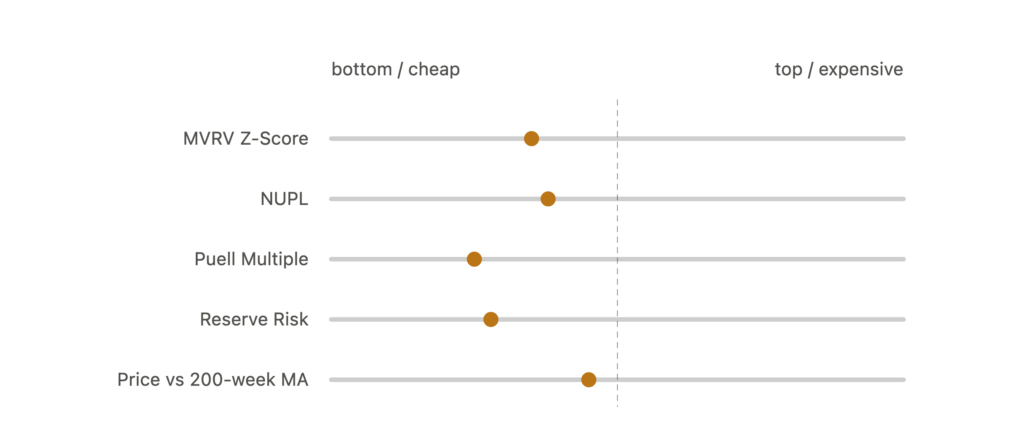
Price is only half the story. On-chain valuation tools help locate the current Bitcoin cycle position more precisely, and right now most of them point the same way: cooled well off the top, but not yet at the deep-value extremes that marked past bottoms.
Current Bitcoin Cycle Position: Where Are We in 2026?
MVRV Z-Score: elevated at the 2025 top, now pulled back toward neutral rather than the classic undervalued zone.
NUPL, net unrealized profit and loss: fallen from euphoria into the belief-to-fear band.
Puell Multiple: miner revenue has compressed toward the historical accumulation range.
Reserve Risk: sits low, which historically favors long-term accumulation.
Price versus the 200-week moving average: Bitcoin is holding above this long-term floor, a level that has anchored past bottoms.
Pi Cycle Top: flashed near the 2025 peak and is now inactive, consistent with a market past its top.
Taken together, these say the current Bitcoin cycle position is late in the down leg, not early, but the readings are not yet screaming bottom.
Is This Bitcoin Cycle Different?
This is the real debate, and it is worth understanding both sides.
The clearest structural change is the spot Bitcoin ETF, launched in January 2024. ETFs added a steady institutional bid that did not exist before, which has compressed volatility and made drawdowns milder. Profit-taking now happens at lower multiples, and dips get bought faster.
The other well documented pattern is diminishing returns. Each cycle’s gain from halving day to peak has shrunk sharply, from roughly 100 times in the 2012 cycle to about 30 times, then near 8 times, and only about 2 times this cycle. That is a natural result of a maturing, trillion-dollar asset: moving it takes far more capital than before.
From here the debate splits. The cycle-intact camp says the four year rhythm still rules, so a late 2026 bottom is due. The cycle-broken camp argues Bitcoin now follows macro liquidity and interest rates more than the halving clock, producing a longer, shallower cycle. The honest read is that both forces are at work, which is why this markdown has been milder than 2018 or 2022.
When Could the Next Bitcoin Cycle Phase Begin?
If the historical rhythm holds, the markdown gives way to bottom formation in late 2026, with some models extending into early 2027. After that comes a fresh accumulation phase, then the next halving expected around April 2028, which would set up the following markup.
So the next shift in the current Bitcoin cycle position is the move from markdown to accumulation. Confirmation would come from price reclaiming its moving-average floors, higher lows forming, and ETF flows turning steadily positive again.
What the Current Bitcoin Cycle Position Means for You
You do not need to call the exact bottom to use the cycle. Knowing you are in a late markdown, near the historical accumulation window, is already useful.
A few grounded habits:
Use a recurring buy, a Bitcoin SIP, to accumulate through the bottoming window instead of guessing one date.
Treat sharp rallies as unconfirmed until the on-chain signals and moving averages agree.
Keep some cash ready so a deeper flush is an opportunity, not a scare.
Size positions so another leg down would not force a panic sale.
This article is general information, not financial advice. Crypto is highly volatile and you can lose money. Any real decision is yours to own, ideally with a qualified advisor.
Current Bitcoin Cycle Position: The Verdict
So, what is the current Bitcoin cycle position in 2026? Bitcoin sits in the late markdown phase, about 28 months after the halving and 11 months after its peak, with a bottom widely expected in late 2026 and on-chain tools cooled from top signals but not yet at bottom extremes. ETFs and diminishing returns mean this cycle is likely milder and shallower than past ones, even if the rhythm still broadly holds.
The takeaway is not a precise date. It is a map: you are on the down slope, closer to the bottom than the top, in the zone where patient accumulation has historically paid off.
Frequently Asked Questions
What is the current Bitcoin cycle position?
As of late August 2026, Bitcoin is in the late markdown, or bear, phase of its four year cycle, about 28 months after the April 2024 halving and roughly 11 months after its October 2025 peak. A cycle bottom is widely expected in late 2026.
What stage of the Bitcoin market cycle are we in?
The markdown phase, the down leg that follows distribution. It comes after accumulation and markup and precedes the bottom formation that seeds the next cycle.
How is the Bitcoin cycle measured?
It is anchored to the halving every four years, then split into four phases: accumulation, markup, distribution and markdown, and bottom formation. Analysts also use on-chain tools like MVRV, NUPL, and the Puell Multiple to locate the position more precisely.
Does Bitcoin still follow a four-year cycle?
So far the timing has held, which is why late 2026 is the base case for a bottom. But spot ETFs and macro liquidity now play a bigger role, so many analysts expect a longer, shallower version of the old pattern.
Which indicators show whether Bitcoin is near a top or bottom?
Common ones include the MVRV Z-Score, NUPL, Puell Multiple, Reserve Risk, the Pi Cycle Top indicator, and price relative to the 200-week moving average. In August 2026 these have cooled from top signals but are not yet at classic bottom extremes.
Has institutional adoption changed the Bitcoin cycle?
Yes. Since spot ETFs launched in 2024, volatility has compressed and drawdowns have been milder, with profit-taking at lower multiples. Combined with diminishing returns, that points to a flatter cycle than in 2018 or 2022.
Anupam has over 3 years of experience in the crypto industry, having worked with top indian crypto exchanges. He writes about Bitcoin, altcoins, AI, and emerging tech, helping readers understand what’s driving markets and where the digital asset ecosystem is headed.