Is Polymesh coin a good investment right now? This depends heavily on which half of its story you weigh more. On one hand, POLYX trades roughly 95% below its March 2024 all-time high and touched a fresh all-time low of $0.0276 on August 18, 2026. On the other hand, Polymesh just shipped its biggest upgrade since launch, and its real-world asset infrastructure is now used by BitGo, Paysafe, tZERO, and a Financial Services Commission-approved consortium in Korea. Genuine institutional traction and a brutal price chart are both true at the same time.
Here are the fundamentals, the risks, and an honest read on both sides.
Key Takeaways
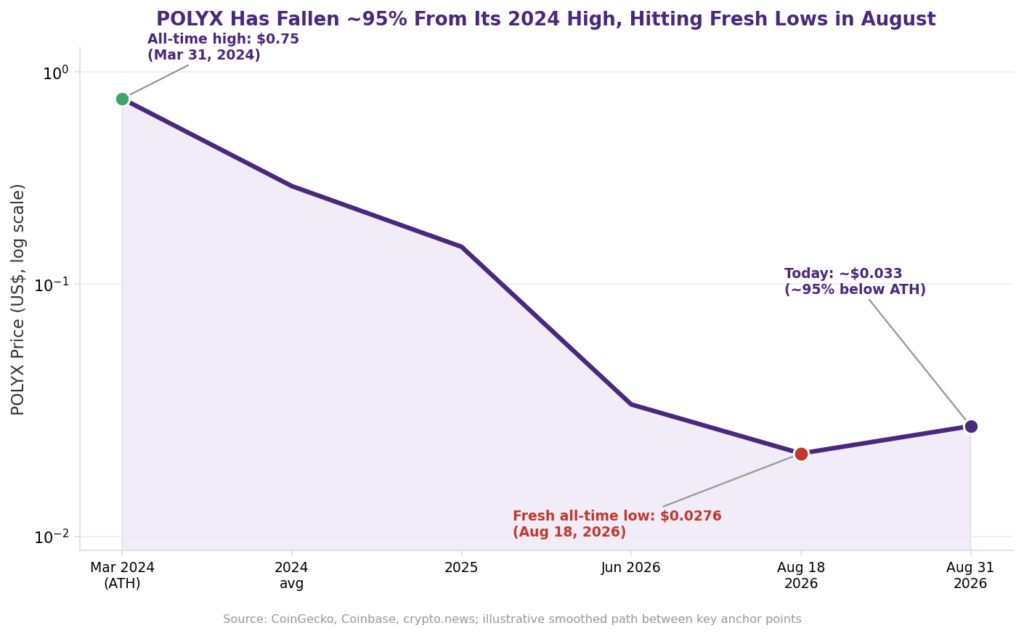
POLYX trades around $0.033, roughly 95% below its March 2024 all-time high of $0.75, having touched a fresh all-time low of $0.0276 on August 18, 2026.
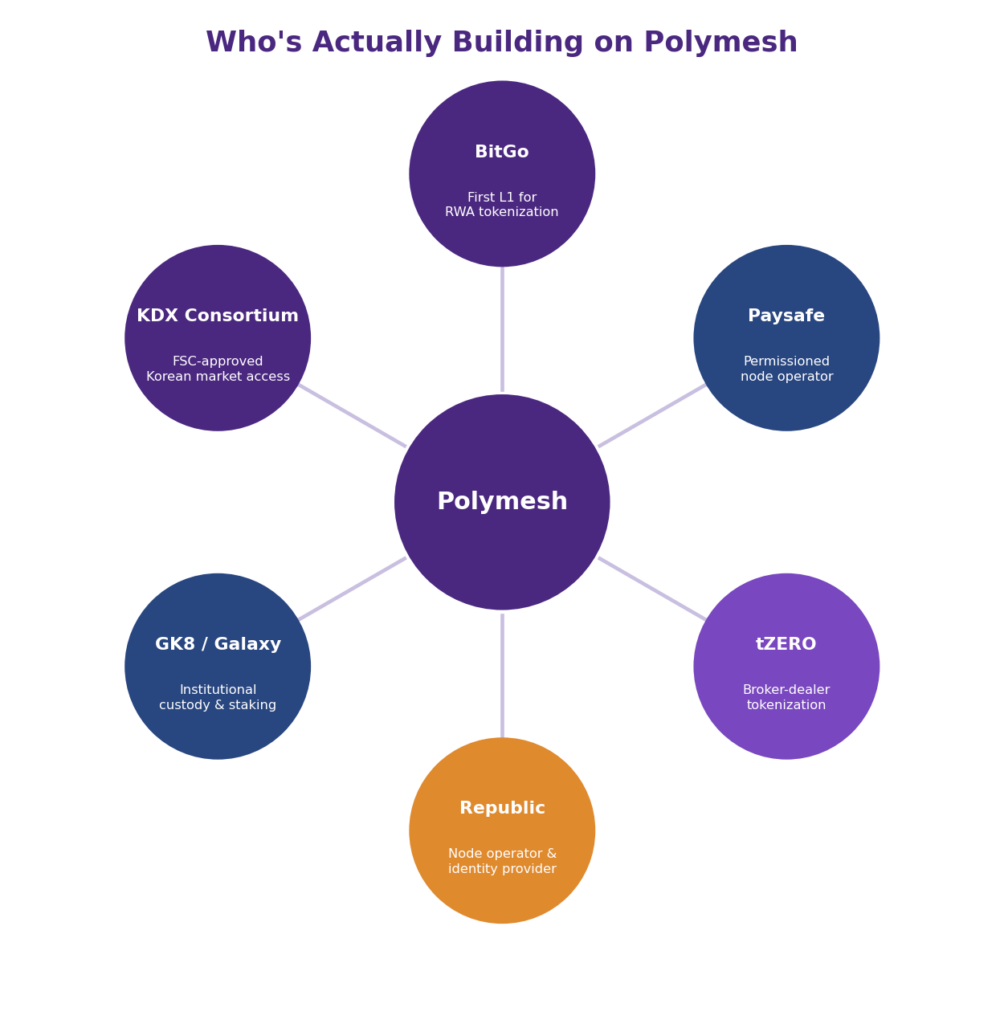
Polymesh has real, verifiable institutional partners: BitGo selected it as its first Layer 1 for RWA tokenization, alongside Paysafe, tZERO, Republic, GK8 by Galaxy, and Zodia Custody.
The v8 upgrade shipped on July 22, 2026, the largest since Polymesh’s 2021 launch, adding self-registered digital identities, EVM compatibility, and testnet-stage confidential (privacy-preserving) assets.
Trading volume remains thin, typically under $2 million daily, meaning liquidity risk is real regardless of the institutional narrative.
Polymesh has no confirmed hard cap on maximum token supply, unlike Bitcoin’s fixed 21 million, which is worth understanding before treating POLYX as a scarce asset.
What Is Polymesh?
Polymesh is a permissioned Layer 1 blockchain purpose-built for issuing and managing regulated security tokens and real-world assets, requiring identity verification for all participants, including issuers, investors, and node operators.
Unlike general-purpose blockchains that anyone can use anonymously, Polymesh was designed from the ground up to satisfy the compliance requirements institutions actually face: identity checks, governance controls, and auditability, while still operating as a public, shared network rather than a fully private one. POLYX is the network’s native token, used for transaction fees, governance voting, and staking to secure the network. Polymesh was built by Polymath, the same team behind the earlier Ethereum-based POLY token, which itself has performed far worse than POLYX, down over 99% from its own all-time high.
Definition: Real-World Asset (RWA) Tokenization The process of representing ownership of a traditional financial asset, such as a bond, private equity stake, or fund, as a digital token on a blockchain, subject to the same regulatory requirements as the underlying asset.
Is Polymesh a Good Investment?
Polymesh is a legitimate, fundamentally differentiated project with real institutional backing, but POLYX the token has performed extremely poorly, meaning “good investment” depends on whether you are evaluating the technology or the token’s price history, since the two have diverged sharply.
Polymesh has secured genuine institutional partners, not just marketing claims, including BitGo, Paysafe, and tZERO.
POLYX is down ~95% from its all-time high, with fresh lows hit as recently as August 2026.
The project shipped a real, major upgrade (v8) in July 2026, adding meaningful technical capability.
Thin liquidity and an unclear path from partnerships to token demand remain the central open risks.
What Are Polymesh’s Fundamentals?
Polymesh’s strongest fundamental case rests on two things: a major technical upgrade that shipped on schedule, and a growing list of real institutional partners actually building on the network rather than just announcing intent.
Is Polymesh (POLYX) a Good Investment? Full Analysis
The v8 upgrade, which reached mainnet on July 22, 2026, is described by the Polymesh team as the largest since the network’s 2021 launch. It introduced self-registered digital identities (removing the prior requirement for a verified claim from a licensed provider), account-level asset holding alongside the original portfolio model, an approve-and-spend allowance system familiar to anyone who has used ERC-20 tokens, and EVM smart contract compatibility through PolkaVM and Revive, opening the door to Ethereum-ecosystem developer tooling. Confidential Assets, a zero-knowledge privacy feature letting institutions transact without exposing balances publicly, launched on testnet in May 2026 but is not yet live on mainnet.
On the partnership side, BitGo selected Polymesh as its first Layer 1 for RWA tokenization following its acquisition of Brassica, a meaningful endorsement from one of crypto’s largest institutional custodians. Paysafe operates as a permissioned node operator, tZERO brings regulated broker-dealer tokenization capability, and Republic serves as both a node operator and identity provider. In February 2026, BDACS joined the KRX-led KDX Consortium in Korea as its sole virtual asset service provider, with preliminary approval from the Financial Services Commission, a genuinely significant regulatory foothold in a major Asian market.
Polymesh Price Performance: How Has POLYX Done?
POLYX has performed poorly by almost any historical measure, falling from an all-time high of roughly $0.75 in March 2024 to a fresh all-time low of $0.0276 in August 2026, a decline of roughly 95%.
Is Polymesh (POLYX) a Good Investment? Full Analysis
Metric
Value
Current price (late Aug 2026)
~$0.033
All-time high
~$0.75 (Mar 31, 2024)
All-time low
~$0.0276 (Aug 18, 2026)
Drawdown from ATH
~95%
Market capitalization
~$44 million
24-hour trading volume
Typically under $2 million
Notably, POLYX set a fresh all-time low in August 2026, meaning the token was still finding new bottoms even as the broader crypto market staged a sharp recovery elsewhere. This divergence, POLYX weakening while much of the market strengthened, is worth sitting with rather than dismissing.
What Affects the Price of Polymesh?
Polymesh’s price is shaped by a combination of broader crypto market sentiment, the pace of institutional adoption translating into actual on-chain activity, token supply dynamics, and sentiment toward the real-world asset tokenization sector specifically.
Broader crypto market conditions: as a small-cap altcoin, POLYX tends to amplify moves in the wider market rather than trade independently.
RWA sector sentiment: interest in tokenized real-world assets as a narrative can lift or drag POLYX independent of Polymesh-specific news.
Institutional adoption progress: whether partnerships like BitGo and tZERO translate into actual issued assets and transaction volume, not just announcements.
Token supply and unlocks: ongoing token issuance without a confirmed hard cap adds a structural consideration distinct from fixed-supply assets.
Liquidity conditions: thin trading volume means POLYX can move sharply on relatively modest buy or sell pressure.
What Are the Risks of Buying POLYX?
Extreme historical drawdown: a 95% decline from the all-time high, with new lows set as recently as August 2026, reflects sustained selling pressure that hasn’t yet reversed.
Thin liquidity: daily trading volume typically under $2 million means larger trades can move the price significantly, and exiting a position isn’t always easy.
Unclear demand translation: institutional partnerships are real, but there’s no clear evidence yet that they’ve translated into meaningful fee revenue or token demand for POLYX specifically.
No confirmed maximum supply: multiple data providers show Polymesh’s max supply as unconfirmed or undefined, unlike assets with a hard, verifiable cap.
Niche, competitive sector: Polymesh competes for RWA tokenization market share against other chains and platforms also courting institutional issuers.
Can POLYX Reach a New All-Time High?
Reaching a new all-time high above $0.75 would require POLYX’s market capitalization to grow roughly 17 times from its current level near $44 million, to somewhere in the range of $750 million to $1 billion depending on circulating supply at the time.
That’s a large but not unprecedented move for a small-cap altcoin during a genuine sector-wide rally, particularly if real-world asset tokenization becomes a dominant narrative and Polymesh’s institutional partnerships mature into meaningful on-chain volume. It would likely require both a broader crypto bull market and clear evidence that Polymesh’s partnerships are generating real transaction activity, rather than either factor alone.
How Does Polymesh Compare With Similar Cryptocurrencies?
Polymesh occupies a narrow, specific niche: permissioned, identity-verified infrastructure for regulated real-world assets, which differentiates it from both general-purpose smart contract platforms and its own predecessor token.
Asset
Focus
Notable Difference from Polymesh
Polymath (POLY)
Original Polymath Ethereum token
Predecessor project; down over 99% from its own ATH, performing worse than POLYX
General-purpose L1s
Broad smart contracts, DeFi, NFTs
No built-in identity/compliance layer; not purpose-built for regulated securities
Other RWA-focused chains
Tokenizing real-world assets
Varying degrees of permissioning; Polymesh’s node-operator licensing requirement is comparatively strict
Polymesh’s closest comparison is arguably its own history: it was built specifically to solve problems its predecessor, Polymath’s POLY token, couldn’t, and on that specific technical mandate, it has made more concrete institutional progress than POLY ever did.
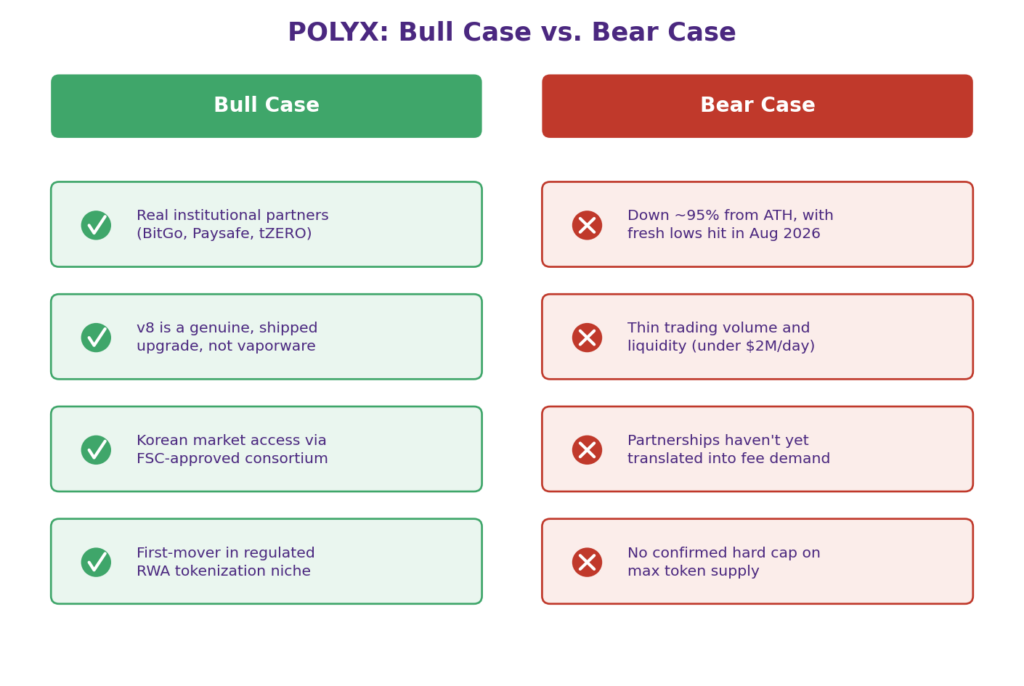
POLYX: Bull Case vs. Bear Case
Is Polymesh (POLYX) a Good Investment? Full Analysis
Weighing both sides fairly: Polymesh has done more than most small-cap altcoins to build genuine institutional infrastructure, and the v8 upgrade proves the team ships real technology on a real timeline. But the token’s price action reflects a market that hasn’t yet rewarded any of that, and there’s a meaningful difference between “institutions are building here” and “institutions are generating fee-paying transaction volume here.” Until that gap closes, POLYX’s fundamentals and its price will likely keep telling two different stories.
Is POLYX Suitable for Beginners?
POLYX is better suited to investors who already understand small-cap altcoin volatility and thin-liquidity risk, rather than a first cryptocurrency purchase, given its extreme price history and comparatively niche, technical use case.
Beginners are generally better served starting with larger, more liquid assets like Bitcoin or Ethereum before allocating to a small-cap, sector-specific token like POLYX, where both the technology and the investment thesis require more context to evaluate properly.
Is POLYX Suitable for Long-Term Investment?
POLYX could suit a long-term, high-risk allocation for investors who believe in the real-world asset tokenization thesis specifically and are comfortable holding through extended drawdowns, but it isn’t a low-volatility, buy-and-forget holding.
The honest long-term case rests on whether Polymesh’s institutional partnerships mature into real transaction volume over multiple years, a genuinely uncertain outcome that depends on regulatory developments, competitive dynamics, and broader RWA sector adoption that no single project controls alone.
Where Can You Buy POLYX in India?
POLYX is available on regulated Indian crypto platforms that support INR deposits and withdrawals, including Mudrex, where you can buy Polymesh starting from as little as ₹100.
When buying POLYX or any small-cap altcoin in India, check the platform’s liquidity for that specific token, since thin order books can mean wider spreads than more established coins like Bitcoin or Ethereum.
Conclusion
Is Polymesh coin a good investment? The technology and institutional traction genuinely stand out among small-cap altcoins; real partners like BitGo and tZERO, a shipped major upgrade, and real regulatory access in Korea aren’t common at this market cap. But POLYX’s price has told a much bleaker story, down 95% from its high with fresh lows set as recently as this month. Treat this as a high-risk, thesis-driven position rather than a core holding, size it accordingly, and watch for institutional partnerships translating into actual on-chain transaction volume as the real signal that would close the gap between Polymesh’s fundamentals and its price.
Polymesh has genuine institutional partners and a recently shipped major upgrade, but POLYX trades roughly 95% below its all-time high with thin liquidity, making it a high-risk, thesis-driven position rather than a core holding.
What is the future of POLYX?
POLYX’s future likely depends on whether its institutional partnerships (BitGo, tZERO, the Korean KDX Consortium) mature into real, fee-generating transaction volume rather than remaining announcements.
Can POLYX reach a new all-time high?
It would require roughly a 17x increase in market capitalization from current levels, plausible during a genuine RWA sector rally but not something current data supports as imminent.
A 95% historical drawdown with fresh 2026 lows, thin trading liquidity, partnerships not yet translating into clear token demand, and no confirmed maximum token supply are the main risks.
Where can I buy POLYX in India?
Regulated Indian platforms like Mudrex support buying POLYX with INR, starting from as little as ₹100.
Is POLYX suitable for long-term investment?
It could suit a long-term, high-risk allocation for investors specifically betting on real-world asset tokenization, but it isn’t a low-volatility, buy-and-forget holding.
How does Polymesh compare with similar cryptocurrencies?
Polymesh occupies a narrow niche as a permissioned, identity-verified chain for regulated securities, distinct from general-purpose blockchains and more institutionally advanced than its predecessor token, Polymath (POLY).
Risk Disclaimer
Cryptocurrency investments carry a high risk of loss and are highly volatile, and small-cap altcoins in particular carry elevated liquidity and volatility risk. Any use of leverage or futures magnifies both potential gains and potential losses. The figures, comparisons, and scenarios in this article are illustrative and for educational purposes only; they are not financial advice or a guarantee of future performance. Please consult a qualified financial advisor before making any investment decisions.
Siri is a writer venturing into the exciting realms of blockchain technology, cryptocurrency, and decentralized finance (DeFi), eager to explore the transformative potential of these innovations. She brings a unique perspective that bridges traditional industries and cutting-edge technology, often infused with a touch of humor through memes. She has a rich background in real estate and interior design, having previously contributed to NoBroker, where she crafted blogs and assets on these topics.