
Not all decentralised storage networks work the same way. Sia turns storage into a crypto-native marketplace. Filecoin focuses on verifiable storage infrastructure at scale, while Storj aims to make decentralised storage feel more like conventional cloud storage.
All three use distributed storage providers and economic incentives, but their architectures, pricing models, tokenomics and target users are different. So, which one is better?

The answer depends on what you value most: low-cost crypto-native storage, verifiable storage at scale, or a cloud-friendly developer experience.
| Feature | Siacoin (Sia) | Filecoin | Storj |
|---|---|---|---|
| Core model | Decentralised storage marketplace | Open, verifiable storage market | Decentralised cloud/object storage |
| Storage model | Renters form contracts with storage hosts | Users make storage deals with storage providers | Encrypted, erasure-coded data distributed across independent nodes |
| Native token | SC | FIL | STORJ |
| Supply model | Unlimited | Maximum 2 billion FIL | Approximately 425 million STORJ |
| Encryption | Depends on the application/client | Not universally mandated by the core protocol | Client-side encryption by default |
| Redundancy | Data is split and distributed across multiple hosts | Storage deals are backed by cryptographic proofs | Erasure-coded pieces; only a subset is needed for reconstruction |
| Primary positioning | Crypto-native storage marketplace | Verifiable decentralised storage infrastructure | Cloud-friendly decentralised object storage |
| Headline storage cost | Around $3/TB/month, including 3× redundancy | Market-driven | $7/TB/month Standard; $10/TB/month Advanced |
The simplest way to understand SC vs FIL vs STORJ is to look at what each network is trying to optimise.
Sia connects people who need storage, known as renters, with users who provide storage capacity, known as hosts.
Renters create storage contracts with hosts for a specified amount of data, duration and price. Storage prices are denominated in Siacoin (SC), while hosts earn SC for providing storage capacity and bandwidth.
This makes Sia feel more like a decentralised storage marketplace than a conventional cloud provider.
Filecoin (FIL) takes a more infrastructure-focused approach.
Users make storage deals with storage providers, while cryptographic proofs help verify that providers are actually storing the data they committed to hold.
Two important mechanisms are:
Filecoin also has the Filecoin Virtual Machine (FVM), which enables programmable applications and smart contracts on the network.
Filecoin and IPFS are complementary rather than identical technologies. IPFS provides content-addressed, peer-to-peer data transfer, while Filecoin adds an economic layer for incentivised storage.
Filecoin’s storage deals and cryptographic proofs form its core storage infrastructure, while newer capabilities such as Proof of Data Possession (PDP) and FVM extend the network into additional verifiable-storage and programmable application use cases.
Storj takes a different approach.
Instead of putting the storage architecture itself on a blockchain, Storj focuses on providing decentralised cloud storage through independent storage nodes.
Data is encrypted on the client side, broken into pieces using erasure coding and distributed across storage nodes.
Storj uses erasure coding so that only a subset of the distributed pieces is needed to reconstruct a file segment. This provides redundancy without requiring every node to hold a complete copy.
The result is designed to feel familiar to developers already accustomed to cloud storage, including compatibility with Amazon S3-style workflows.
The STORJ token is used within the ecosystem for storage-related payments and node rewards, but Storj’s storage architecture itself should not be described as a blockchain-based storage chain in the same way as Filecoin or Sia.
Imagine you want to store 1 TB of data.
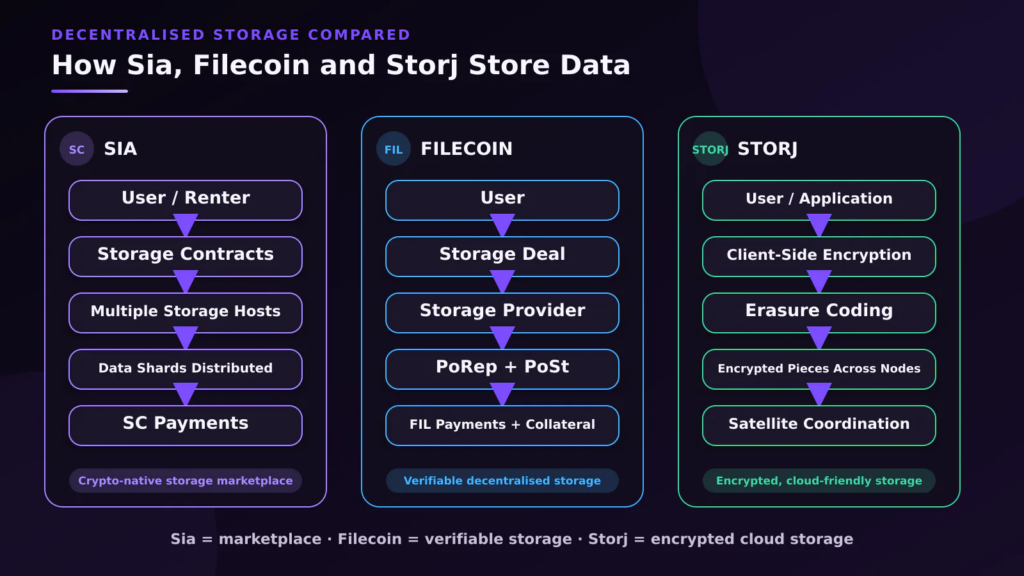
On Sia, the renter creates storage contracts with multiple hosts. The data is divided and distributed across the selected hosts. The renter pays for storage using SC, while hosts earn SC for providing capacity and bandwidth.
The model is:
Renter → Storage contracts → Multiple hosts → Distributed data → SC payments
Also Read: Is Siacoin a Good Investment?
On Filecoin, the user selects a storage provider and establishes a storage deal. The provider stores the data and generates cryptographic proofs demonstrating that the agreed storage commitments are being fulfilled.
The model is:
User → Storage deal → Storage provider → PoRep + PoSt → FIL economic system
With Storj, data is encrypted on the client before being distributed. Erasure coding then creates multiple pieces that are spread across independent storage nodes. Only a subset of those pieces is needed to reconstruct a file segment.
The model is:
User/application → Client-side encryption → Erasure coding → Encrypted pieces across nodes → Satellite coordination
This creates three distinct approaches:
Storage pricing is one of the clearest differences between the three networks, but the figures should not be treated as perfectly interchangeable.
| Network | Headline storage price | Other considerations |
|---|---|---|
| Sia | Around $3/TB/month including 3× redundancy | Contract formation and bandwidth fees can apply |
| Filecoin | Market-driven; no single universal network price | Deal terms vary by provider and workload |
| Storj Standard | $7/TB/month | $7/TB egress; 30-day minimum storage duration |
| Storj Advanced | $10/TB/month | $7/TB egress; 30-day minimum storage duration |
Sia’s published figures put its median storage price at around $3/TB/month including 3× redundancy, although contract and bandwidth fees can also apply.
Storj currently lists $7/TB/month for Standard storage and $10/TB/month for Advanced, with a $7/TB egress charge and a 30-day minimum storage duration.
Filecoin is different because storage deals are market-driven, meaning there is no single network-wide retail price that applies to every user and workload.
Therefore, among the published figures used in this comparison, Sia has the lowest headline storage price. That does not automatically make it the cheapest option for every workload because retrieval, bandwidth, contract structure and usage patterns can change the effective cost.
Adoption should not be judged by token price alone.
A storage network can have enormous theoretical capacity but relatively little customer demand. That makes network utilisation and active stored data more important than raw capacity by itself. Filecoin has a substantial infrastructure footprint and a programmable ecosystem through FVM, although capacity and active paid demand are not the same thing.
Storj is positioned more strongly around developer usability. Its client-side encryption, erasure coding and S3-compatible workflows make it closer to a conventional cloud-storage experience.
Sia remains more explicitly focused on the crypto-native storage marketplace, where renters and hosts interact through storage contracts.
That gives the three networks different adoption profiles:
| Token | Supply model | Main utility | Key consideration |
|---|---|---|---|
| SC | Unlimited | Storage and bandwidth payments; host rewards | Ongoing issuance means there is no hard supply cap |
| FIL | Maximum 2 billion | Storage economics, collateral and network fees | Emissions, vesting, collateral and burns influence supply dynamics |
| STORJ | Approximately 425 million circulating | Storage payments and node rewards | ERC-20 utility token operating on Ethereum |
SC has an unlimited supply. Sia’s block reward starts at 300,000 SC, decreases by one SC per block and eventually reaches a floor of 30,000 SC per block.
For investors, that means network growth needs to be considered alongside ongoing token issuance.
Filecoin has a maximum supply of 2 billion FIL. Its supply dynamics are more complicated than simply looking at the maximum number of tokens. Minting mechanisms, vesting, collateral requirements, network fees and token burns all influence the amount of FIL available to the market over time.
Approximately 425 million STORJ are circulating, and the token functions as an ERC-20 asset on Ethereum. Its utility is tied to the Storj ecosystem, including storage payments and node rewards.
For investors, however, lower supply alone does not guarantee better performance. Token demand ultimately depends on network utility, adoption, liquidity and market conditions.
Data snapshot: 15 September 2026
| Metric | Siacoin (SC) | Filecoin (FIL) | Storj (STORJ) |
|---|---|---|---|
| Approx. price | $0.0009 | $0.90 | $0.03 |
| Approx. market cap | $50–55 million | $740–765 million | $13–15 million |
| Relative profile | Smallest two | Largest of the three | Smallest two |
| Supply model | Unlimited | Maximum 2 billion | Approximately 425 million circulating |
These figures are a dated market snapshot rather than fixed values. Crypto prices and market capitalisation change continuously.
For live prices, market capitalisation and trading data, readers should check the relevant Mudrex market page before making a trading decision.
There is no universal winner. Each network is better suited to a different priority.
| If you prioritise | Consider | Why |
|---|---|---|
| Low-cost crypto-native storage | Sia | Competitive headline pricing and a native storage marketplace |
| Large-scale verifiable storage | Filecoin | Large infrastructure footprint and cryptographic storage proofs |
| Cloud/S3 compatibility | Storj | Designed around familiar cloud-storage workflows |
| Cryptographic storage proofs | Filecoin | PoRep and PoSt provide verifiable storage commitments |
| Client-side encryption and erasure coding | Storj | Built into its storage workflow |
| Crypto-native storage marketplace | Sia | Direct renter-host storage contracts |
Sia may be the better fit if your priority is a direct decentralised storage marketplace, competitive headline storage costs and native SC payments. Its main investment consideration is token supply. Because SC has no hard maximum supply, network adoption needs to grow sufficiently to offset the effects of ongoing issuance.
Filecoin stands out if you care about large-scale decentralised storage infrastructure, cryptographic verification and a programmable ecosystem. Its PoRep and PoSt mechanisms are central to its storage model, while FVM adds programmability.
For investors, the bigger question is whether Filecoin can continue converting its infrastructure capacity and ecosystem activity into sustainable paid demand.
Storj may be the most natural fit for developers who want decentralised storage without abandoning familiar cloud workflows. Client-side encryption, erasure coding and S3 compatibility are central to its proposition.
Its trade-off is a smaller overall infrastructure footprint than Filecoin.
Choosing the best decentralised storage coin for investment is different from choosing the best storage network.A strong storage product does not automatically mean a strong token investment.
Investors should separate network fundamentals from token performance.
| Factor | Siacoin | Filecoin | Storj |
|---|---|---|---|
| Network scale | Smaller | Largest of the three | Smaller |
| Storage model | Marketplace | Verifiable storage market | Decentralised cloud storage |
| Token supply | Unlimited | Maximum 2 billion | Approximately 425 million |
| Key investment thesis | Small-cap storage exposure | Scale + ecosystem | Product + developer adoption |
| Main consideration | Supply and liquidity | Converting capacity into paid demand | Smaller network scale |
FIL offers exposure to the largest infrastructure footprint of the three and has an ecosystem that extends beyond basic storage through FVM. The investment thesis is therefore closely tied to network utilisation, paid storage demand and the ability to monetise its infrastructure.
SC offers exposure to a smaller, crypto-native storage marketplace. Its smaller market capitalisation can create greater upside during periods of strong market interest, but that also comes with higher volatility and liquidity risk.
Its unlimited supply is another factor investors need to account for.
STORJ combines a smaller token market with a product positioned around cloud storage and developer adoption.
Its thesis depends heavily on whether Storj can continue translating its technical advantages and cloud compatibility into sustained usage.
This section is for educational purposes only and is not financial advice.
If you are comparing SC vs FIL vs STORJ for long-term investment, token price should not be the first metric you examine.
Track:
The most important question is simple:
How much data are customers actually paying to store?
That can be more informative than theoretical storage capacity alone.
Decentralised storage is competing against highly established cloud infrastructure. Major centralised providers already offer enormous capacity, mature developer tools and global distribution.
Other risks include:
A network can advertise substantial storage capacity without having equivalent customer demand.
A storage network can grow while its token fails to capture proportional economic value. Investors therefore need to understand how the token is actually used within the network.
SC and STORJ have much smaller market capitalisations than FIL in this comparison. Smaller tokens can experience larger price movements and lower liquidity.
Distributed infrastructure reduces reliance on a single provider, but it introduces other considerations, including provider reliability, software risks, economic incentives and network coordination.
SC’s unlimited supply is structurally different from FIL’s maximum supply and STORJ’s comparatively limited supply. Supply alone does not determine value, but it is an important part of token economics.
Indian investors can buy and trade Siacoin (SC) and Filecoin (FIL) directly in INR on Mudrex. Simply deposit INR using UPI or a bank transfer, find the relevant coin and place your trade. Mudrex is FIU-IND registered and ISO/IEC 27001:2022 certified, providing a secure and convenient platform for accessing decentralised-storage cryptocurrencies. Always check the latest price, fees, liquidity and asset availability before trading.
There is no single winner because Sia, Filecoin and Storj are solving decentralised storage from different angles.
Sia is the strongest fit for a crypto-native storage marketplace with competitive headline storage pricing. Its biggest tokenomic consideration is its unlimited SC supply.
Filecoin is the strongest fit for verifiable decentralised storage infrastructure at scale. Its PoRep and PoSt mechanisms give the network a distinctive approach to proving storage, while FVM expands its programmable ecosystem.
Storj is the strongest fit for users and developers who want decentralised storage with a cloud-like experience. Client-side encryption, erasure coding and S3 compatibility are central to its proposition.
For investors, the distinction is equally important:
Ultimately, the strongest long-term signal is not theoretical storage capacity or token scarcity.
It is real customer demand, paid storage, network utilisation, sustainable economics and continued developer adoption.