Candlestick Patterns: The Complete Trader’s Guide to Reading Market Psychology
Born in 18th-century Japan from rice trading records, candlestick analysis has stood the test of time. Despite modern trading algorithms and lightning-fast markets, these simple shapes still capture something algorithms can’t — emotion. In this guide, we’ll unpack how to read them, what each pattern reveals, and how you can use them to improve your timing and confidence as a trader.
The Anatomy of a Candlestick
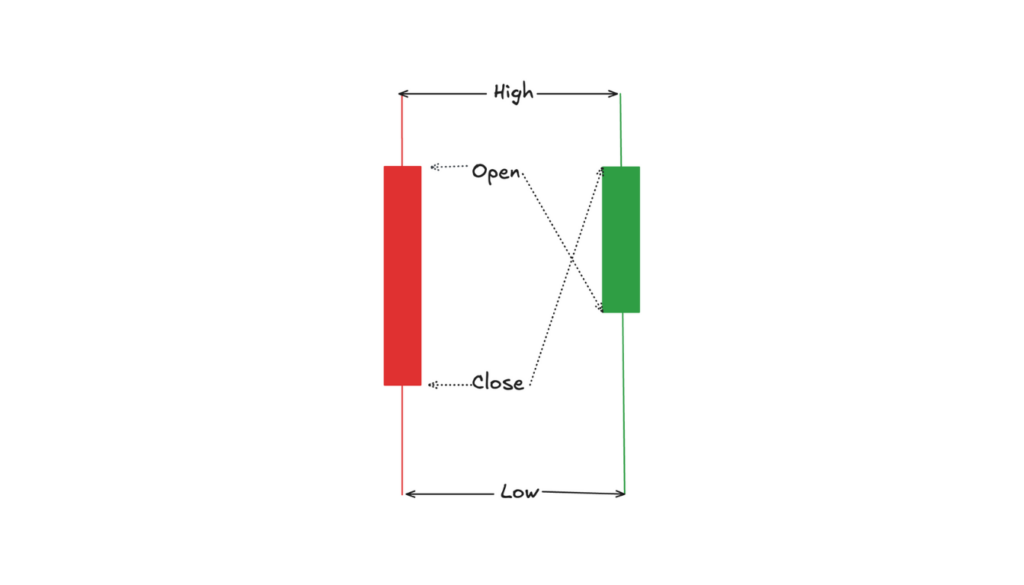
A single candlestick represents all the price action in a specific time period — whether that’s one minute, one hour, or one day. It’s built from four key prices: the open, the high, the low, and the close.
Understand the basics of candlestick patterns
The area between the open and close is called the body, while the thin lines extending above and below are called wicks or shadows.
A green (or white) candle means price closed higher than it opened — buyers dominated. A red (or black) candle means it closed lower — sellers had control. But the real insight comes from comparing body and wick sizes. A long wick shows rejection or indecision, while a large body reveals conviction.
Why Candlestick Patterns Work
Candlestick patterns work because they visualize crowd behavior.
Every pattern represents the emotional state of traders — fear, greed, indecision, or conviction. When similar emotions repeat under similar circumstances, the same price structures tend to form.
In volatile markets like crypto, this behavior becomes even more visible. Rapid reactions to news, liquidations, and sudden sentiment changes create exaggerated candlestick patterns. Recognizing these signals early helps traders understand where conviction lies and when a shift might be coming.
Candlesticks also adapt to any timeframe. A five-minute hammer on Bitcoin and a weekly hammer on Ethereum reflect the same underlying dynamic: buyers defending a level and reversing momentum. The difference is scale, not psychology.
Bullish Reversal Patterns
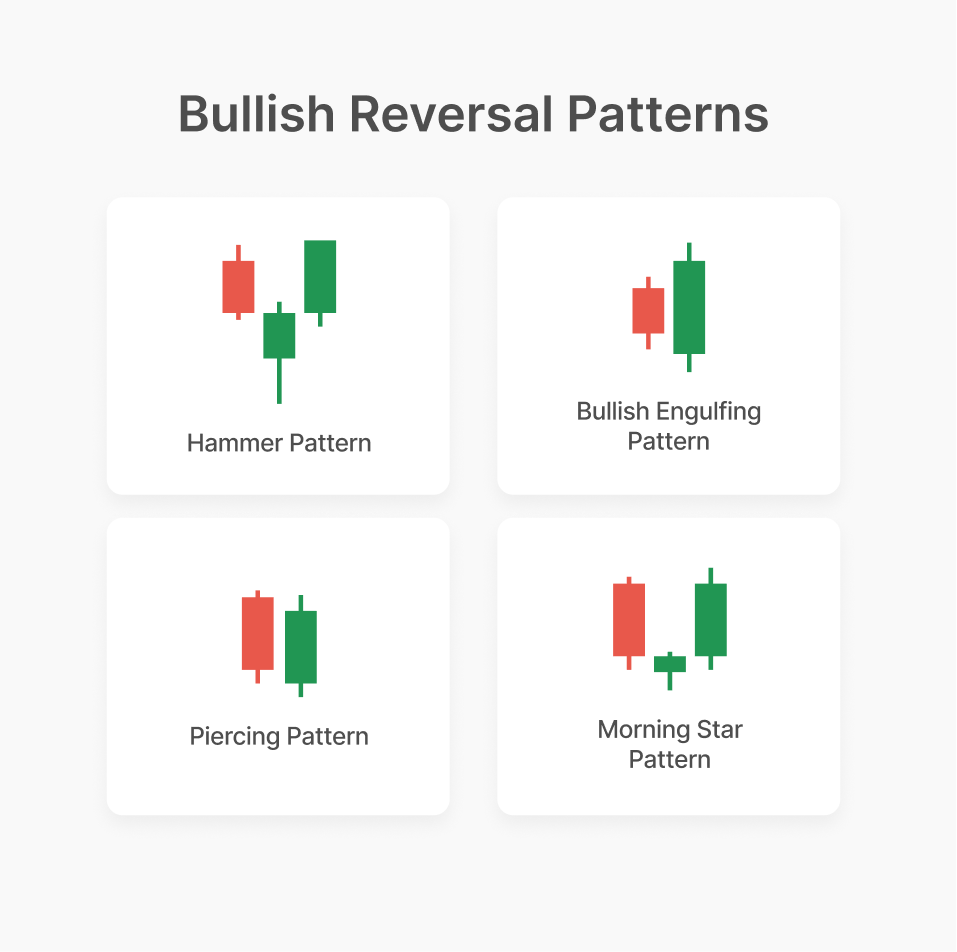
Bullish reversal patterns: Hammer, Engulfing, Piercing, and Morning Star Patterns
Bullish reversal patterns appear at the end of downtrends, signaling potential exhaustion of selling pressure and a return of buyers.
The Hammer is one of the clearest examples. It has a small body near the top and a long lower wick, showing that sellers pushed price down but were overpowered by buyers before the close. The longer the tail, the stronger the rejection.
Next comes the Bullish Engulfing pattern — a small red candle followed by a large green candle that completely covers the previous one. This engulfing move demonstrates a powerful shift from fear to confidence.
Another classic is the Morning Star, a three-candle pattern. It starts with a large bearish candle, followed by a small indecision candle (often a doji), and ends with a strong bullish candle that closes deep into the first. It’s the story of panic, pause, and then reversal.
Lastly, the Piercing Pattern occurs when a green candle opens below the prior day’s close but finishes above its midpoint — an early clue that buyers are reclaiming control.
Bullish patterns work best when they appear after extended downtrends, near key support levels, and ideally with rising volume that confirms renewed buying interest.
Bearish Reversal Patterns
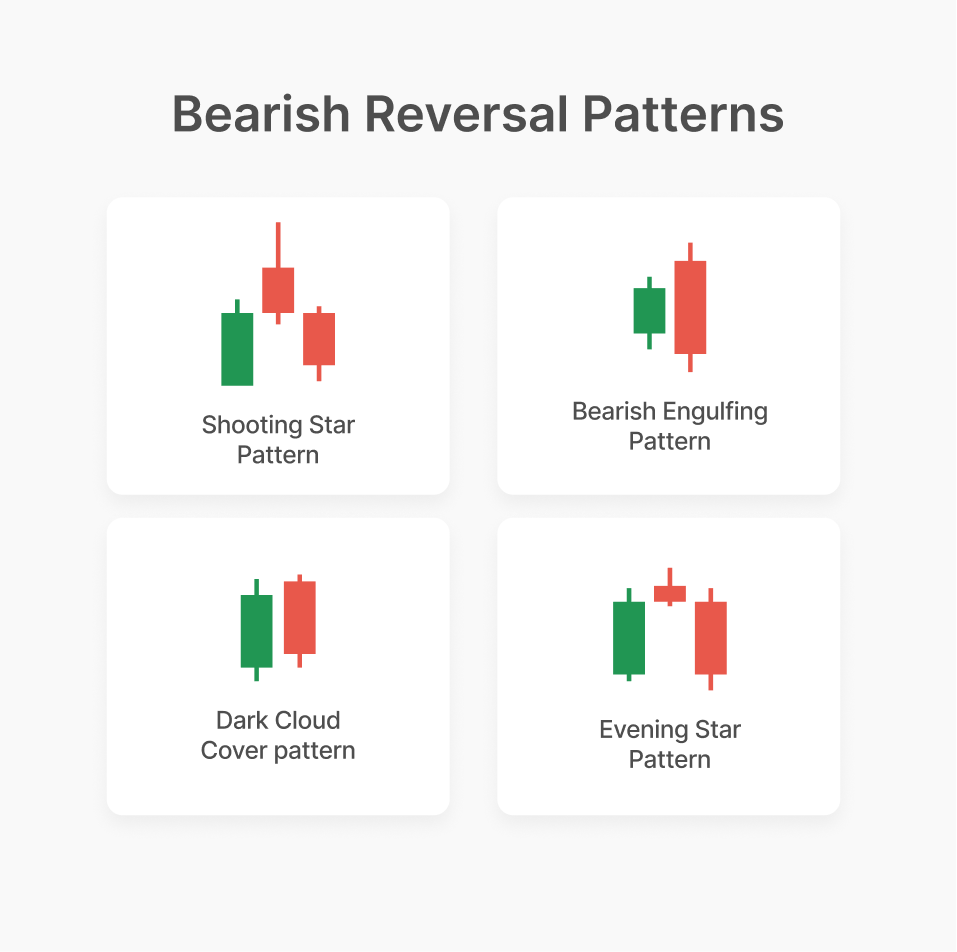
Bearish Reversal Patterns: Shooting star, Engulfing, Dark Cloud Cover, and Evening Star
Bearish reversals signal that buyers are losing control and sellers are stepping in.
The Shooting Star mirrors the hammer but in reverse. It forms after a rally, with a small body near the bottom and a long upper wick — a visual sign that buyers tried to push higher but failed, leaving trapped longs above.
The Bearish Engulfing is its opposite twin of the bullish version. A large red candle completely engulfs the previous green candle, showing an aggressive takeover by sellers.
The Evening Star mirrors the Morning Star. After a strong uptrend, it starts with a big bullish candle, then an indecision candle, and finally a large bearish candle that closes well into the first. This pattern often appears at the top of overextended rallies.
Finally, the Dark Cloud Cover pattern warns of an incoming storm. It begins with a green candle and follows with a red candle that opens higher but closes below the midpoint of the first — a sudden flip in sentiment.
These bearish patterns are most effective when they form at resistance or after long rallies, ideally alongside declining momentum or RSI divergence.
Continuation Patterns
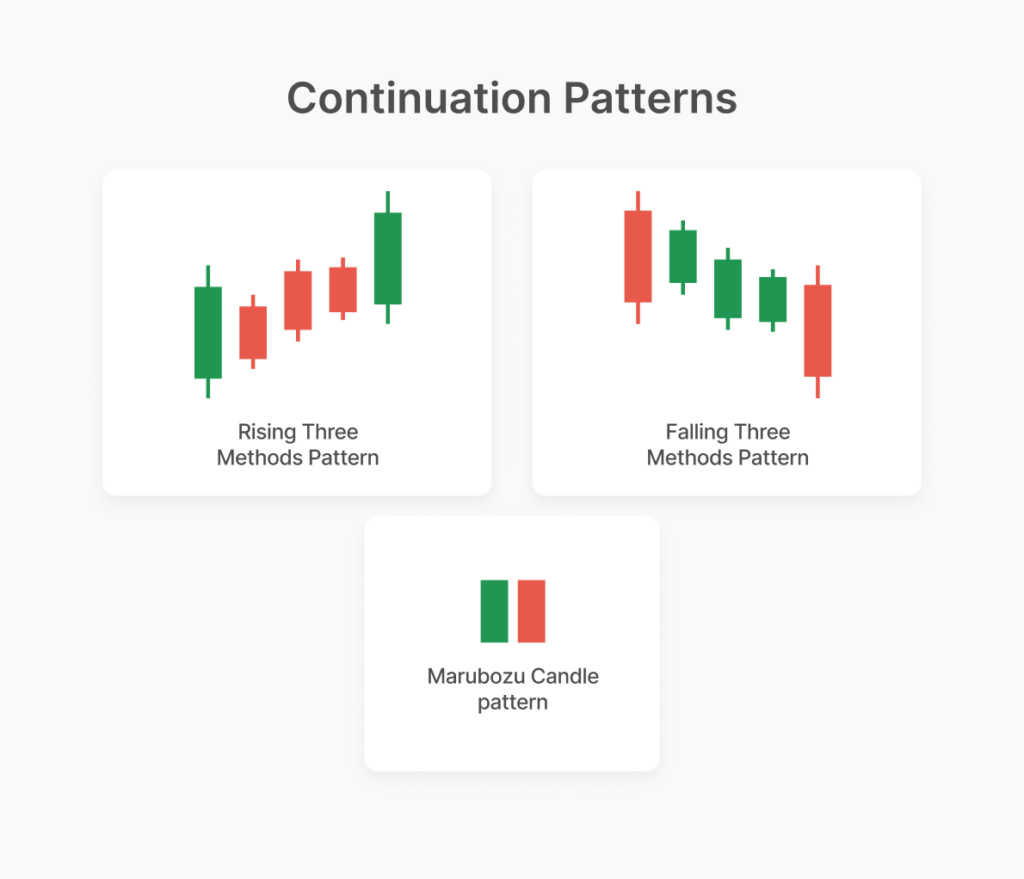
Continuation Patterns: Rising Three Methods, Falling Three Methods, and Marubozu Candles
Not every pattern marks a reversal. Some simply show that the trend is resting before continuing.
In an uptrend, the Rising Three Methods pattern appears when a large green candle is followed by several small red candles that stay within its range, then another green candle that breaks higher. It’s a pause before the next leg up.
The bearish counterpart, the Falling Three Methods, works the same way during downtrends. Between strong red candles, small green ones appear, showing temporary relief before selling resumes.
The Marubozu Candle, with no wicks at all, is the ultimate show of dominance. A green Marubozu indicates unchallenged buying throughout the session; a red one, relentless selling.
Continuation patterns help traders recognize when a trend is consolidating rather than reversing — valuable insight for managing open positions.
Indecision Patterns
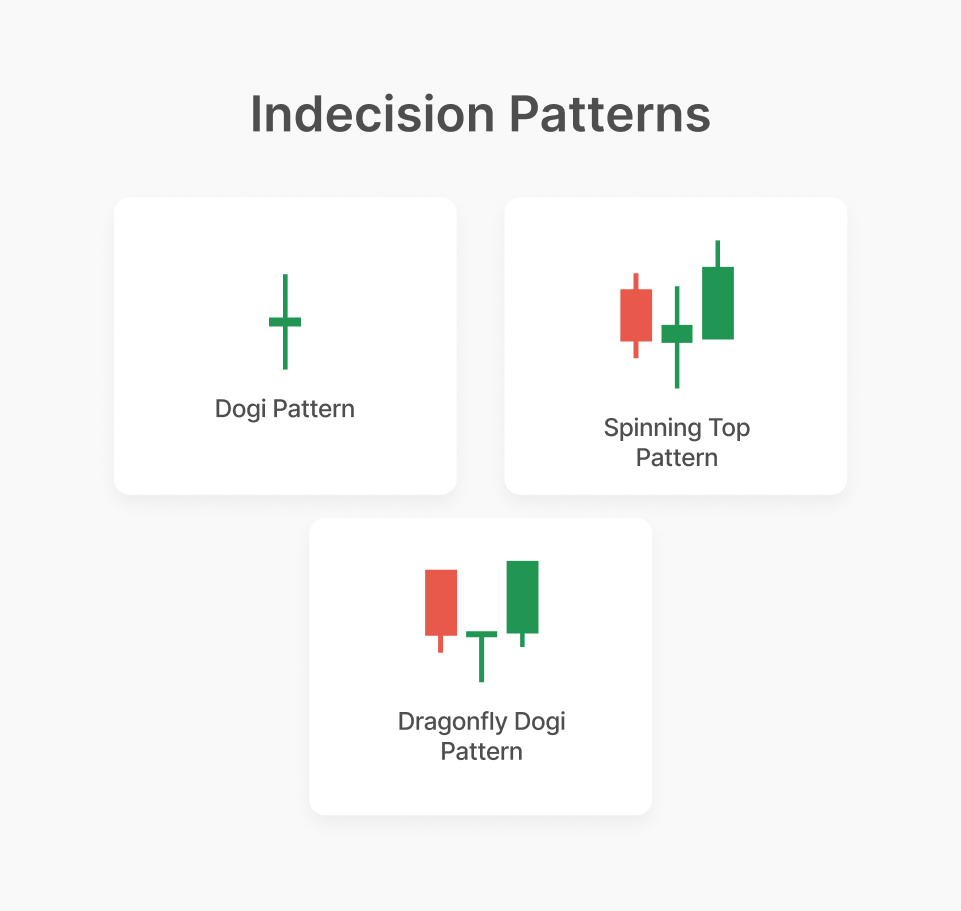
Indecision Patterns: Dogi, Spinning Top, and Dragonfly Dogi Patterns
Between conviction and reversal lies uncertainty. Indecision patterns warn traders that neither side is firmly in control.
The Doji is the simplest and most powerful of these. It forms when price opens and closes at nearly the same level, leaving only thin wicks above and below. It shows equilibrium — buyers and sellers in a standoff.
Variations like the Spinning Top or Long-Legged Doji add longer wicks, emphasizing confusion and volatility. The Dragonfly Doji, with its long lower shadow and no upper wick, often signals potential reversal after heavy selling.
While indecision patterns alone don’t predict direction, they alert traders to pay attention. The candle that follows a doji often reveals which side wins the next round.
How to Trade Candlestick Patterns Effectively
Candlestick patterns are best understood in context. A bullish engulfing pattern in the middle of a sideways range means little, but the same pattern after a month-long selloff can mark the bottom. Always consider trend direction, support and resistance zones, and trading volume before acting.
Confirmation is key. Don’t trade the pattern itself — trade what happens after it. For example, after spotting a hammer, wait for the next candle to close above the hammer’s high. That confirmation shows follow-through by real buyers.
Risk management ties it all together. Stop-losses should be placed beyond the extreme of the pattern — below a hammer’s low or above a shooting star’s high. This ensures you exit only if the pattern fails completely.
Combining candlestick patterns with other tools like moving averages, RSI, or Bollinger Bands adds further precision. When multiple indicators agree, conviction increases.
Common Mistakes to Avoid
Many beginners misuse candlestick patterns by taking every signal as a trade. Real edge comes from filtering. Avoid trading patterns in low-volume markets or against strong trends. A bearish reversal on a powerful bull run often leads to frustration, not profits.
Another mistake is ignoring the time frame. A hammer on a one-minute chart doesn’t carry the same weight as one on the daily chart. The longer the timeframe, the more meaningful the pattern.
Finally, traders often forget that candlesticks reflect probability, not certainty. They increase odds when used correctly, but don’t guarantee outcomes. A good trader treats them as clues, not commands.
Backtesting and Practice
Like any strategy, experience matters. The best way to build confidence in candlestick patterns is to backtest them on historical data. Look for setups across different assets and timeframes. Track how often they work when confirmed by volume or trend filters.
Paper trading or simulated accounts are ideal for beginners. Watch how the same pattern behaves differently in trending versus ranging markets. The goal isn’t to memorize shapes — it’s to understand their meaning in context.
Over time, you’ll begin to “see” patterns forming intuitively, just as experienced traders read emotion directly from the chart.
Don Candlestick Analysis Still Works in 2025?
Human-driven tools like candlestick patterns still matter. Algorithms may execute trades, but they’re programmed by humans who still react to fear, greed, and uncertainty.
Candlestick patterns work because they model behavior. And behavior doesn’t change. Whether it’s a trader in Tokyo or an AI model in London, the market still oscillates between confidence and caution, leaving visible footprints in price.
For crypto markets in particular, candlesticks remain invaluable. With high volatility, round-the-clock sessions, and strong emotional swings, they provide the fastest visual feedback of crowd psychology.
Conclusion
Candlestick patterns are the oldest yet most enduring trading language in the world. They compress human emotion into simple shapes that reveal who’s in control and when that control is about to change. The key is to understand what they represent: the struggle between buyers and sellers. Once you see that, charts stop looking like noise and start sounding like conversations.
So the next time you open a chart, don’t just look at price — listen to what the candles are saying.
Krishnan is a Bangalore-based crypto writer dedicated to simplifying complex crypto concepts. He covers blockchain, DeFi, and NFTs, with a focus on real-world asset tokenization and digital trust. Previously he has written on Real Estate related assets for NoBroker. Krishnan holds a B.Tech degree from the College of Engineering Trivandrum.