Chaikin Money Flow (CMF): A Complete Guide for Crypto Traders
Chaikin Money Flow helps crypto traders understand whether buyers or sellers control the market at any given moment. The indicator blends price and volume to highlight accumulation, distribution, and trend strength.
In fast-moving crypto markets where liquidity shifts quickly, CMF gives traders a clearer picture of underlying momentum. This guide breaks down how CMF works, how to interpret it, and how to use it in real trading setups.
Understanding Chaikin Money Flow in Crypto
Chaikin Money Flow shows how strongly money is flowing into or out of an asset. Traders use it to understand whether bullish or bearish pressure is building beneath price action.
The indicator looks at two things: where the price closes within its range, and how much volume accompanies that move. When the price closes closer to the high of the range on strong volume, CMF rises. When the price closes nearer the low with increased volume, CMF falls.
This relationship helps crypto traders gauge real buying or selling interest rather than reacting only to price swings.
How Chaikin Money Flow Works in Crypto Markets
Crypto trades continuously, unlike traditional markets, so volume patterns behave differently. Liquidity softens during weekends, regional trading hours, and periods of macro uncertainty. CMF captures these shifts well because it responds quickly to volume surges and dry spells.
During strong bull trends, CMF usually stays above zero for extended periods as traders accumulate. In sideways consolidations, CMF tends to hover around the zero line. In bearish markets, recurring negative readings signal persistent distribution.
How to Calculate Chaikin Money Flow
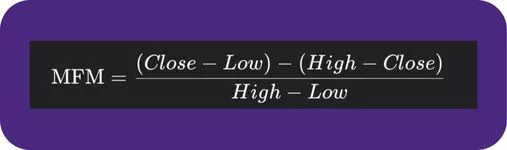
The CMF formula combines price position and volume data. It has three key components:
Money Flow Multiplier (MFM):
Money Flow Volume (MFV):
Chaikin Money Flow:
Where N is typically 20 periods.
How to Interpret CMF Values Effectively
CMF values move above and below zero. The zero line acts as a balance point between buying and selling pressure.
When CMF Is Above Zero
This signals accumulation. Buyers steadily absorb supply, often preceding price rallies. Sustained readings above +0.10 strengthen bullish conviction.
When CMF Is Below Zero
This signals distribution. Sellers dominate, and long positions face a higher risk. Persistent readings under -0.10 often precede sharp declines.
CMF Divergences
A bullish divergence occurs when the price makes lower lows while the CMF makes higher lows. A bearish divergence occurs when the price climbs but the CMF falls.
Chaikin Money Flow Signals Crypto Traders Look For
Crypto traders rely on CMF to confirm breakouts, validate trends, and avoid false signals.
CMF as Trend Confirmation
If price breaks a resistance level while CMF rises above zero, the breakout often succeeds.
CMF and Breakout Validation
When CMF drops below zero during a breakout attempt, the move may fail. Low-volume rallies frequently produce false breakouts.
Trend Exhaustion Signals
If CMF falls while price continues higher, buying pressure may be weakening.
Best CMF Settings for Crypto Trading
Most platforms use a 20-period CMF. This works well for assets with high liquidity, such as BTC or ETH.
A 10-period setting reacts faster and suits more volatile assets. A 30-period setting smooths noise for long-term investors.
Low-cap altcoins often require longer periods because their volume is irregular. Traders should test settings that align with their assets’ liquidity patterns.
Chaikin Money Flow vs Other Volume Indicators
CMF is one of several volume-based indicators. Understanding differences helps traders form stronger strategies.
CMF vs OBV (On-Balance Volume)
OBV is cumulative and does not consider price ranges. CMF incorporates price relative to its range, offering deeper insight.
CMF vs Money Flow Index (MFI)
MFI uses price and volume, but behaves like RSI. It helps with overbought or oversold conditions, not accumulation strength.
CMF vs VWAP
VWAP focuses on intraday price efficiency. CMF focuses on trend strength and accumulation.
Strategy: How to Use CMF in Crypto Trading
A practical trading strategy improves CMF reliability.
Using CMF for Trend Continuation
When CMF remains above zero during a pullback, traders look for long entries at support.
Combining CMF with RSI or MACD
RSI overbought signals combined with falling CMF often warn of weakening bullish trends. MACD and CMF alignment strengthens trend conviction.
Using CMF with Support and Resistance
CMF helps confirm whether support levels genuinely hold. Rising CMF at support often precedes trend resumption.
CMF Pitfalls and Limitations
CMF is powerful but not perfect.
- CMF can produce false signals in low-volume markets.
- Thinly traded altcoins distort CMF readings.
- CMF may lag during sudden news events with outsized volume spikes.
- Traders should confirm CMF signals with price structure and additional indicators.
Conclusion
Chaikin Money Flow helps crypto traders see the balance between buying and selling pressure. It highlights accumulation, distribution, and trend strength more clearly than price alone. CMF becomes especially valuable when combined with tools such as RSI, MACD, and support and resistance levels. When used correctly, CMF improves timing, filters noise, and strengthens conviction in fast-moving crypto markets.
Want to deepen your understanding of crypto trading? Explore more guides on Mudrex Learn and subscribe to the official Mudrex YouTube channel for actionable insights and weekly market breakdowns.
FAQs
What is the Chaikin Money Flow indicator?
Chaikin Money Flow measures buying and selling pressure using price and volume. It helps traders see whether accumulation or distribution dominates.
How reliable is CMF for crypto trading?
CMF is reliable when paired with market structure and another indicator for confirmation. It performs best with liquid assets like BTC and ETH.
What is the best CMF setting for crypto?
Most traders use the 20-period setting. Scalpers prefer 10, while long-term traders may use 30 for smoother signals.
Can CMF predict trend reversals?
CMF often highlights trend shifts through divergences, but it should not be used alone.
How does CMF differ from the Money Flow Index (MFI)?
MFI behaves like RSI by identifying overbought or oversold conditions. CMF focuses on accumulation and distribution strength.