
Is crypto legal in India? Yes. You can legally buy, sell, hold and transfer it. What you cannot do is spend it like money, skip KYC, or leave it off your tax return.
Crypto is categorised As VDAs under IT Act . Individuals can buy, sell and hold crypto assets. However, crypto is not legal tender, is not protected like a bank deposit or a regulated security, and remains subject to tax, anti-money-laundering, KYC, fraud, cybercrime and other applicable laws.

The confusion usually comes from treating three different questions as one. Is crypto legal to own? Generally, yes. Is it subject to rules? Yes, especially tax and anti-money-laundering rules. Is it official money that another person must accept? No. This guide explains what is allowed, what is taxed, where the practical risks arise and what changed in 2026.
| Question | Short answer |
|---|---|
| Can Indians buy, sell and hold crypto? | Generally, yes. There is no blanket central-law prohibition on ordinary buying, selling or holding. |
| Is crypto trading legal in India? | Crypto trading is not subject to a blanket ban, but users must follow applicable tax, KYC, platform and other legal requirements. |
| Is P2P crypto trading legal? | P2P trading is not separately banned, but it carries additional counterparty, fraud, banking and tax risks. |
| Is crypto legal tender? | No. Crypto does not have the same legal status as the Indian rupee or RBI’s Digital Rupee. |
| Is crypto fully regulated in India? | No. Tax and anti-money-laundering rules apply, but there is no comprehensive investor-protection framework for crypto products. |
| Is illegal activity involving crypto allowed? | No. Fraud, money laundering, tax evasion, cybercrime and other prohibited conduct remain illegal, regardless of the asset used. |
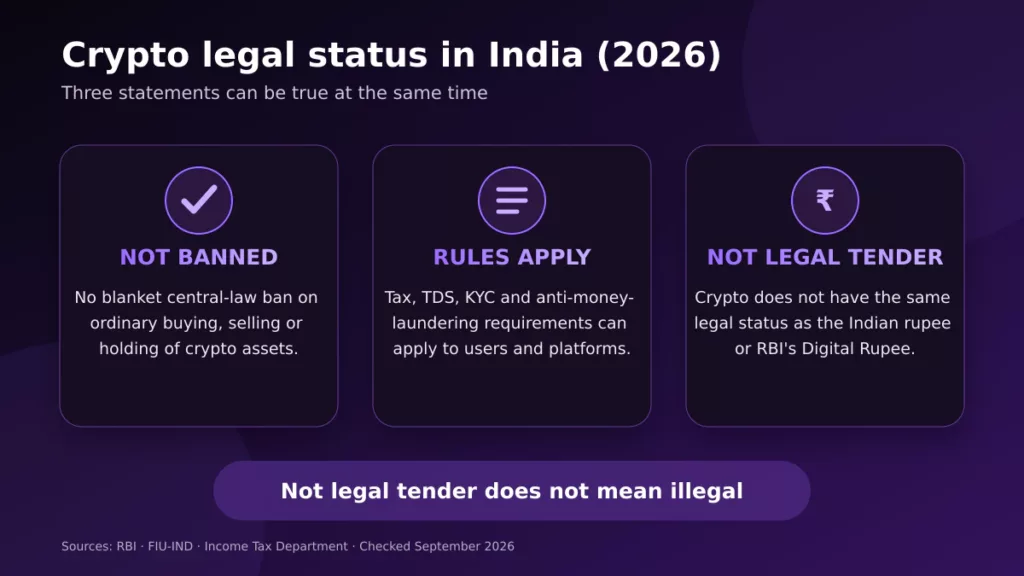
Crypto is best described as not banned, not legal tender and not comprehensively regulated.
Legal, regulated and legal tender are not synonyms. “Legal” means an activity is not prohibited. “Regulated” means specific rules and oversight apply. “Legal tender” is money recognised for settling monetary obligations. Crypto can be legal to own and subject to regulation without being legal tender.
There is no central law that imposes a blanket prohibition on individuals buying, selling or holding cryptocurrencies such as Bitcoin, Ethereum or USDT. At the same time, the government has not granted crypto the status of legal tender or the protections that apply to regulated deposits and securities.
Existing laws still apply to crypto-related activities. These include:
This distinction matters. The existence of crypto tax rules does not make crypto legal tender, amount to government approval of a token, or guarantee compensation if an investor loses money.
An October 2025 Ministry of Finance release reiterated that crypto products remain unregulated and highly risky and that regulatory recourse may be limited. The same release confirmed that covered VDA service providers serving Indian users must register with FIU-IND and comply with applicable anti-money-laundering obligations.
Crypto trading is not subject to a blanket ban in India. An individual can generally buy and sell crypto through a platform that operates in accordance with applicable Indian requirements.
However, “crypto trading is legal” should not be interpreted as an unconditional approval of every activity. The legal and compliance position can depend on:
Use of an exchange does not remove the user’s tax and record-keeping responsibilities. Similarly, registration of a service provider with FIU-IND does not amount to investment approval, a guarantee of returns or deposit insurance.
Leveraged products introduce additional liquidation, eligibility and contractual risks. See Is Crypto Futures Trading Legal in India? for the product-specific considerations.
India’s approach to crypto has developed through court decisions, tax legislation and anti-money-laundering rules rather than through one comprehensive “Crypto Act.”
| Year | Development | What it meant |
|---|---|---|
| 2018 | RBI issued a circular restricting regulated entities from providing services connected with virtual currencies | The circular made banking access difficult for crypto businesses and users. |
| 2020 | The Supreme Court set aside the RBI circular in Internet and Mobile Association of India v. RBI | The circular could no longer be used to deny banking services solely on that basis. |
| 2021 | RBI clarified that the 2018 circular was no longer valid | Banks could still conduct KYC, AML, CFT and FEMA-related due diligence. |
| 2022 | India introduced a specific tax regime for Virtual Digital Assets | VDA transfer income became subject to a 30% special tax rate, with 1% TDS rules introduced separately. |
| 2023 | Covered VDA activities were brought within the PMLA framework | Exchanges and other covered service providers became reporting entities with AML/CFT obligations. |
| 2025 | FIU-IND continued action against non-compliant offshore providers | Serving Indian users could attract obligations even without a physical office in India. |
| 2026 | FIU-IND updated its AML/CFT guidelines, and the Income-tax Act, 2025 took effect from 1 April 2026 | Service-provider compliance standards were updated, while VDA tax and TDS rules continued under renumbered provisions of the new Act. |
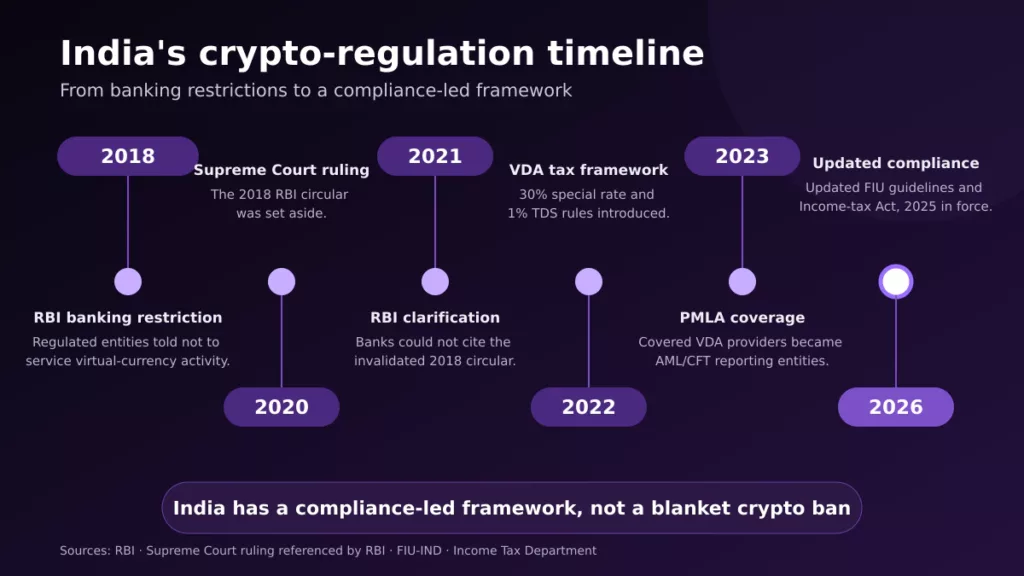
The practical result in 2026 is a compliance-led framework: crypto is not banned, but users and service providers cannot treat it as an unmonitored or tax-free activity.
India does not have a single regulator that supervises every aspect of crypto. Different authorities have different roles.
| Authority | Role relevant to crypto |
|---|---|
| Ministry of Finance and Department of Revenue | Develop tax and financial-compliance policy relating to VDAs. |
| Central Board of Direct Taxes (CBDT) | Administers income-tax and TDS requirements. |
| Financial Intelligence Unit–India (FIU-IND) | Registers covered VDA service providers as reporting entities and supervises AML/CFT reporting obligations. |
| Reserve Bank of India (RBI) | Oversees monetary and financial stability, regulates banks and payment systems, and issues the Digital Rupee. RBI is not a general licensing authority for spot cryptocurrencies. |
| Law-enforcement and cybercrime authorities | Investigate fraud, money laundering, cybercrime and other offences involving crypto. |
The FIU-IND downloads page provides the current registration circulars and the AML/CFT guidelines for VDA service providers.x
Crypto exchanges can provide services to Indian users when they comply with the laws and obligations applicable to their activities. Covered VDA service providers must register with FIU-IND as reporting entities and follow requirements relating to customer due diligence, transaction monitoring, record-keeping and suspicious-transaction reporting.
These obligations apply based on the services offered. They can also apply to offshore providers that serve Indian users, even if the provider does not have a physical office in India.
Before using an exchange, check:
Remember that FIU-IND registration is an anti-money-laundering compliance requirement. It does not mean that the government has approved every asset listed on the platform or guaranteed users against losses.
For a platform-level due-diligence checklist, see What Makes a Crypto Exchange Legal in India?.
P2P crypto trading is not subject to a separate blanket ban in India. However, it has a higher practical risk because the buyer and seller transact directly and the money received may have passed through accounts connected to fraud or other unlawful activity.
A P2P or over-the-counter trade can still be a taxable VDA transfer. The person responsible for deducting TDS depends on how the transaction is structured.
The Income Tax Department’s VDA TDS guidance explains that when a buyer and seller know each other in a direct OTC transaction, the buyer may be responsible for deducting TDS. On an exchange, contractual arrangements between the exchange, broker, buyer and seller can change who performs the deduction.
A bank account may be restricted when money received in a P2P trade is traced to a cyber-fraud complaint or suspicious transaction. This does not automatically mean every P2P trade is illegal, but it demonstrates why the counterparty and source of funds matter.
To reduce P2P risk:
These measures reduce risk but cannot guarantee that a transaction will never be questioned or an account will never be restricted.
Cash-based settlement removes much of the audit trail and increases counterparty risk. Read How to Buy USDT With Cash in India before considering this route.
Bitcoin is not subject to a blanket ban in India. Individuals can generally buy, sell and hold it, subject to applicable tax, KYC, AML and other legal requirements.
Bitcoin is not legal tender. No one is legally required to accept it in place of the Indian rupee, and it does not carry a sovereign guarantee. For Indian tax purposes, Bitcoin falls within the broader Virtual Digital Asset framework.
The same principles generally apply to other cryptocurrencies: the asset can be held or traded, but its use does not sit outside tax, fraud, cybercrime, money-laundering or foreign-exchange laws.
Read more on Bitcoin’s legality
There is no blanket prohibition on holding crypto in a self-custody wallet. A self-custody wallet gives the user control of the private keys rather than leaving control with an exchange or custodian.
Self-custody also places greater responsibility on the user. There may be no recovery process if a seed phrase is lost, stolen or disclosed. Users should:
A simple transfer between two wallets controlled by the same person does not ordinarily change beneficial ownership. However, a swap, bridge, protocol interaction or fee paid in crypto may have separate tax consequences depending on the facts.
Crypto assets covered by the statutory definition are taxed as Virtual Digital Assets. The key rules remain a 30% special tax rate on income from VDA transfers and 1% TDS on qualifying transfer consideration.
The Income-tax Act, 2025 came into force on 1 April 2026. For tax years beginning on or after that date, section 194, Table serial number 4, provides for:
For earlier periods, these rules were commonly referenced under section 115BBH of the Income-tax Act, 1961.
Suppose an investor buys Bitcoin for ₹1,00,000 and later sells it for ₹1,50,000. The simplified calculation would be:
| Calculation | Amount |
|---|---|
| Sale consideration | ₹1,50,000 |
| Less: cost of acquisition | ₹1,00,000 |
| VDA transfer income | ₹50,000 |
| Tax at 30% | ₹15,000 |
| Illustrative 4% health and education cess | ₹600 |
| Illustrative tax plus cess | ₹15,600 |
| Less: 1% TDS credit on the ₹1,50,000 consideration | ₹1,500 |
| Illustrative amount remaining | ₹14,100 |
This example assumes no surcharge and no other return-level adjustments. TDS is deducted from the transfer consideration, while the 30% special rate applies to positive VDA transfer income. The final liability depends on the taxpayer’s complete return, so the TDS amount and final tax will not always match.
For applicable payments on or after 1 April 2026, the 1% VDA TDS rule appears in section 393(1), Table serial number 8(vi), of the Income-tax Act, 2025. The no-deduction thresholds appear in section 394, Table serial number 12:
TDS is generally calculated on the transfer consideration, not only on the profit. It is a tax credit that can be reconciled while filing the income-tax return; it is not an additional final tax over and above the person’s total liability.
For payments made on or before 31 March 2026, the corresponding rule was commonly cited as section 194S.
For a broader filing guide, read Crypto Tax in India and What India’s Crypto Tax Reporting Rules Say in 2026.
Section 509 of the Income-tax Act, 2025 creates an obligation for prescribed reporting entities to furnish information about crypto-asset transactions in the prescribed form, manner and timeframe. The Act also allows rules to specify which entities must register, what records they must maintain and what due diligence they must conduct to identify crypto-asset users or owners.
Section 446 provides for a penalty of ₹200 per day for a reporting entity that fails to furnish the required statement within the prescribed time. A ₹50,000 penalty may apply to specified inaccurate-information or due-diligence failures. These are reporting-entity penalties, not automatic penalties on every investor.
The operational scope depends on the applicable rules and whether a person qualifies as a prescribed reporting entity. For users, the practical lesson is straightforward: maintain records and ensure the transactions reported in the income-tax return are complete and consistent with platform data.
| Activity | General tax position |
|---|---|
| Buying and continuing to hold crypto | A price increase alone does not create VDA transfer income. |
| Selling crypto for INR | The sale is a transfer; positive income is subject to the VDA tax rules. |
| Swapping one crypto asset for another | Both sides can involve a VDA transfer, even when no INR is received. |
| Spending crypto on goods or services | Using crypto as consideration can amount to a VDA transfer. |
| Moving crypto between your own wallets | Ordinarily, there is no change of beneficial owner, but records should establish that both wallets belong to you. |
| Receiving mining, staking, airdrop or other rewards | Tax treatment can depend on how the reward was received and later transferred; obtain professional advice for material amounts. |
Tax treatment depends on the facts of each transaction. Investors should maintain dates, INR values, cost information, wallet addresses, transaction hashes, exchange statements and TDS records.
Crypto mining is not subject to a blanket central-law ban in India. However, a mining operation can raise tax, electricity, equipment-import, business-registration and local-law questions depending on its scale and location.
Mining rewards and a later sale or swap may have different tax consequences. The receipt of tokens, the determination of their INR value and the cost available on a later transfer require fact-specific analysis; the VDA rules also restrict deductions from transfer income. Miners should record the date, quantity and INR market value of every reward, along with wallet and pool records, and obtain professional advice before claiming equipment, electricity or pool costs.
Mining is therefore better described as not generally banned but legally and tax-sensitive, rather than as automatically tax-free or subject to one universal “double-tax” formula.
Crypto is not legal tender in India. This means it does not have the same official payment status as the Indian rupee, and another person cannot be compelled to accept it as settlement.
“Not legal tender” is not the same as saying every private transfer involving crypto is automatically a criminal offence. However, using crypto as consideration can create VDA tax, contractual, accounting, GST, AML or FEMA questions. Businesses considering crypto-linked payments should obtain legal and tax advice instead of treating crypto like ordinary rupee settlement.
RBI’s Digital Rupee is different. The Digital Rupee is issued by RBI and represents legal tender, while Bitcoin and other private crypto assets are not issued or guaranteed by the central bank.
| Feature | Digital Rupee (e₹) | Bitcoin and other private crypto assets |
|---|---|---|
| Issuer | Reserve Bank of India | A decentralised network or private project, depending on the asset |
| Legal-tender status | Yes | No |
| Value | Denominated in Indian rupees | Market-determined and potentially volatile |
| Primary role | Digital form of sovereign currency and payment | Investment, transfer or protocol use, depending on the asset |
| VDA tax regime | Not treated as a private VDA merely because it is digital rupee | Covered assets can fall within the VDA tax framework |
Ordinary buying, selling or holding of crypto is not by itself a criminal offence under a blanket crypto ban, because no such blanket ban currently applies. Criminal exposure can arise when crypto is used in, obtained through or connected with conduct that is already prohibited. Legal risk therefore depends on the surrounding facts, not simply on the presence of crypto.
Examples include:
Whether a particular act can result in a penalty, account restriction or criminal proceeding depends on the evidence and the law involved. Users facing a notice, frozen account or investigation should seek advice from a qualified Indian lawyer or chartered accountant.
India’s crypto framework continues to evolve. Future changes could address licensing, consumer protection, transaction reporting, cross-border information exchange and the treatment of different types of digital assets.
However, proposals, reported policy preferences and draft discussions are not the same as enacted law. Investors should rely on notifications from the Government of India, the official Gazette, RBI, FIU-IND and the Income Tax Department rather than social-media claims about a new ban or complete legalisation.
This page should be reviewed whenever the government changes VDA tax rules, FIU-IND requirements, RBI guidance or any comprehensive crypto legislation.
Choosing a crypto platform is not only about the number of assets available. Indian users should also consider compliance, INR access, security controls, product choice and customer support. Mudrex brings these requirements together in one app:
Complete KYC, review the risks and tax implications, and choose investments that suit your financial circumstances. Crypto prices can be highly volatile, and returns are not guaranteed.
Crypto is not banned in India in 2026, but it is also not legal tender or a fully regulated investment product. Individuals can generally buy, sell and hold crypto, while covered service providers must follow FIU-IND requirements and users must comply with VDA tax, KYC and other applicable laws.
The safest practical approach is to use a compliant platform, maintain a complete transaction trail, avoid suspicious P2P payments and report crypto income accurately. For high-value, cross-border, business or complex transactions, obtain advice from a qualified legal or tax professional.
Disclaimer: This article is for educational purposes and does not constitute legal, tax or investment advice. Laws and regulatory interpretations may change. Consult a qualified professional for advice based on your circumstances.Crypto products and NFTs are unregulated and can be highly risky. There may be no regulatory recourse for any loss from such transactions.
Crypto trading is not subject to a blanket ban in India. Users should trade through a platform that complies with applicable Indian requirements, complete KYC, maintain records and report VDA income and TDS correctly.
No. India does not currently impose a blanket ban on individuals buying, selling or holding crypto. Crypto is nevertheless not legal tender or comprehensively regulated, and users must comply with applicable tax, KYC, AML, fraud, cybercrime and other laws.
Bitcoin is not banned, so individuals can generally buy, sell and hold it. However, Bitcoin is not legal tender, has no sovereign guarantee and remains subject to India’s VDA tax rules and other applicable laws.
USDT is not subject to a separate blanket ban. Like other covered crypto assets, it can generally be bought, sold or held, but it is not legal tender. Transactions involving USDT can create VDA tax, TDS, AML and cross-border compliance obligations.
Most compliant exchanges require identity verification through KYC procedures. Avoiding KYC through informal methods significantly increases the risk of scams or banking problems.
The 1% TDS deduction can reduce the available trading capital during frequent transactions. Accurate record-keeping helps traders reconcile these deductions while filing taxes.
A simple self-transfer between wallets usually does not create profit by itself, but proper documentation is still important for tax reporting and compliance.
Using reputable exchanges, maintaining a transparent bank trail, documenting transactions carefully, and filing taxes accurately are the safest ways to remain compliant.?
P2P crypto trading is not separately prohibited, but it carries elevated fraud, counterparty, banking and tax risks. Verify the counterparty, reject third-party payments, keep complete transaction records and use an on-platform dispute process.
There is no blanket prohibition on using a self-custody wallet. The user controls the private keys and is responsible for security, record-keeping and any tax or cross-border implications arising from wallet transactions.
Crypto is not legal tender, and it does not have the same settlement status as the rupee. Using crypto as consideration may create tax, accounting, GST, AML, contractual or FEMA questions, so businesses should obtain professional advice.
No. It simply means cryptocurrencies are not officially recognized as government-issued money like the Indian Rupee, which is different from whether holding or trading them is permitted.
A rise in the value of crypto generally does not create VDA transfer income while the asset remains unsold and unswapped. Tax or reporting obligations may arise when it is sold, exchanged, spent, gifted or used in another transaction.
Mining and staking are not subject to a general blanket ban. However, rewards and later transfers may have tax consequences, and mining operations can also involve business, electricity or local regulatory considerations. Material activity should be reviewed by a tax professional.
Haan—India mein ordinary crypto trading par blanket ban nahi hai. Lekin crypto legal tender nahi hai, aur trading par tax, TDS, KYC, AML aur platform-compliance rules apply kar sakte hain. Transaction records sambhal kar rakhein aur compliant platform use karein.