
Monero [XMR] has long been known for its privacy ethos, with a dedicated community and a unique place in the crypto ecosystem. But in a time of increased regulation and scrutiny, is Monero still a good investment today?

Monero is a privacy-focused cryptocurrency that launched in 2014 and built its identity around one core idea: transactions should be confidential by default. Unlike most major blockchains, Monero is designed so the sender, receiver, and transaction amount are hidden on-chain through a combination of stealth addresses, ring signatures, and RingCT.
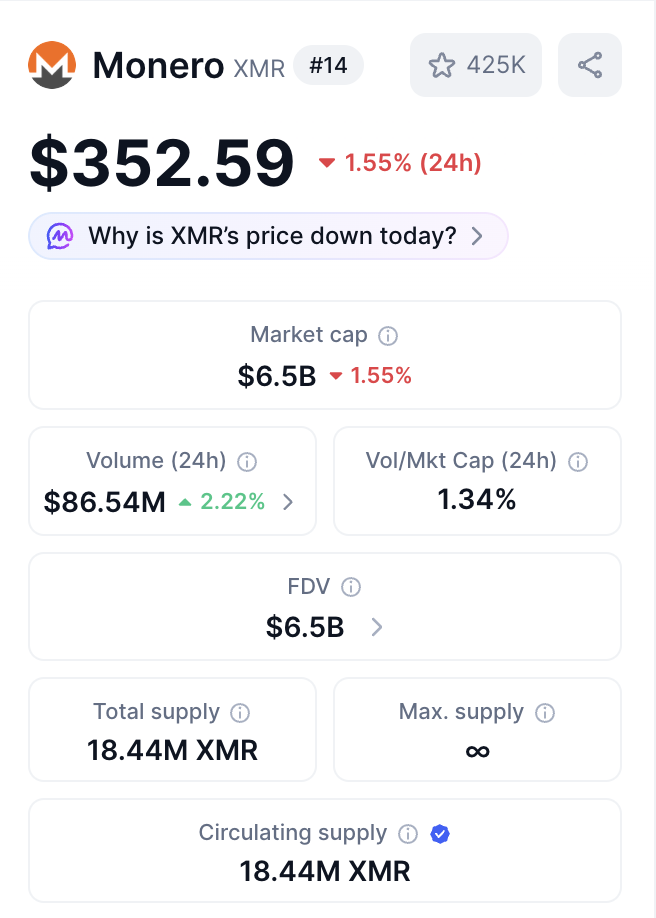
Per data from Coinmarketcap, Monero is in large-cap territory as of March 2026; with roughly $6.5 billion, a 24-hour volume near $86.5 million, and a circulating supply of about 18.44 million XMR. The same market data also shows no fixed max supply, which matches Monero’s long-running tail-emission model rather than a hard cap like Bitcoin’s.
At its core, Monero is meant to function as peer-to-peer digital money with stronger privacy than Bitcoin or Ethereum. That privacy is the product itself.
For some users, that matters because public blockchains make wallet activity easy to trace. Monero is built to reduce that visibility by default. While it may not be the biggest smart-contract chain or the fastest payments network, its value proposition makes it appealing to those that want private, censorship-resistant digital cash.
The token’s strength is also its greatest regulatory problem. Because its transactions are difficult to trace, it has faced exchange delistings and greater scrutiny in some regulated markets where AML and compliance standards are becoming stricter. Even as the sector outperforms, privacy coins still face ongoing delisting risk.
However, the coin is far from irrelevant. It just means any investment case for XMR has to account for both sides of the story.
Like most large crypto assets, Monero’s price moves with greater market sentiment. When Bitcoin and the wider market turn risk-on, XMR usually benefits from stronger capital flows. When sentiment is weak, liquidity runs out faster for privacy coins than for top-tier assets like BTC or ETH.
The numbers prove that XMR still has meaningful market depth… but not enough to stay fully immune.
Given XMR’s clear privacy stance, its price can rise when that becomes a stronger narrative in crypto. However, it can also come under pressure when regulators or exchanges tighten the noose around privacy-focused assets.
This is one of its clearest price drivers. If demand for on-chain privacy grows, Monero benefits. If exchange access becomes more limited, liquidity and participation can take a hit. XMR is relatively more exposed to policy and listing risk than many other major coins.
A less obvious factor is how governments treat crypto infrastructure overall.
Take the Trump administration’s recent cyber strategy, for example. It states that the U.S. will support the security of cryptocurrencies and blockchain technologies, placing them alongside AI and quantum computing as strategic technologies.

That does not directly change XMR regulation, but a more supportive stance toward blockchain security can improve long-term confidence in crypto as a sector. For XMR, things are still murky: stronger sector legitimacy could help, but coin-specific scrutiny may still remain.
A lot of crypto projects try to do everything at once, while Monero does not. Its long-term case is tied to its clear private digital money function.
If demand for confidential transactions continues to exist, Monero does not need to compete as a smart-contract platform, payments super-app, or AI token to stay relevant. Its investment potential comes from being useful in a very specific category that many other large cryptocurrencies do not serve well.
XMR does not need to become a mass-market coin to have long-term value. What matters more is whether it can keep a committed user base, active development, and enough liquidity to remain one of the leading privacy assets.
If that use case stays durable, Monero can remain valuable – a different kind of long-term bet – even without dominating headlines.
This is where the investment case gets more complex. Monero has a real identity, a strong niche, and a product people clearly understand. But long-term upside will depend on whether that demand can outweigh the limits created by regulation, exchange access, and a smaller institutional audience.
In that sense, XMR is not a widely-preferred crypto bet. For long-term investors, the question to consider will be whether privacy will still command premium value years from today.
XMR 2026 price action has been volatile, but it has started to stabilise after a huge January move. The token ran up to the $700+ zone in mid-January, then corrected heavily and traded around $352.15 at the time of writing. A large part of the early-year spike seems to have already been unwound, and price is now moving sideways near the mid-$300 range.
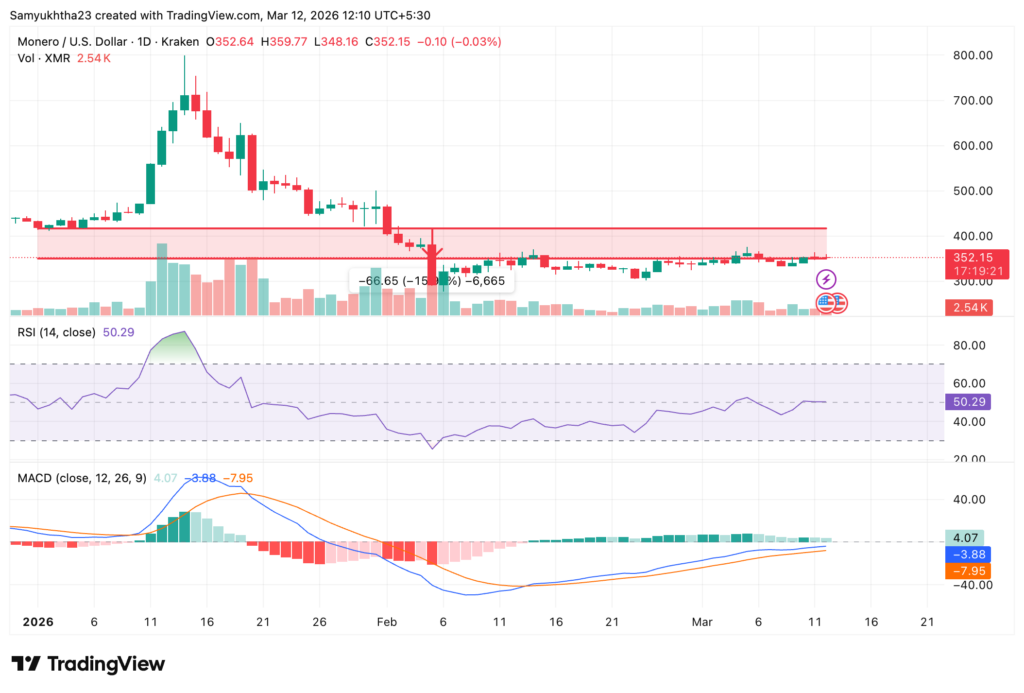
Technicals say momentum is neutral rather than extreme. MACD is positive on the histogram, but the lines are still close together; improving momentum without a strong breakout sign…yet.
![Is Monero [XMR] A Good Investment in 2026?](https://mudrex.com/learn/wp-content/uploads/2026/03/Screenshot-2026-03-12-at-12.11.24 PM-1024x248.png "Is Monero [XMR] A Good Investment in 2026?")
Aggregated open interest is about $78.08 million, well below the January peak; speculative positioning has slowed. Meanwhile, the average funding rate is still positive at 0.0113, so long positions are still paying shorts, but not at overheated levels.
Put together, XMR is more likely to continue consolidation rather than breakout.
| Coin | Ticker | Protocol | Total Supply | Privacy Mechanism | Accounts Viewable? | Transactions Viewable? | Governance |
|---|---|---|---|---|---|---|---|
| Monero | XMR | Proof of Work | 18.4M + tail emission | Ring Signatures | No | No | Dev Team |
| Zcash | ZEC | Proof of Work | 21M | zk-SNARKs | “t” addresses viewable | “t” addresses viewable | Zcash Foundation |
| Dash | DASH | Proof of Work | 18M | CoinJoin | Yes | Visible but obfuscated | Master Nodes + Dev Team |
Being well-informed and updated on the latest trends helps you manage risk better and make decent decisions. For more investment guides and detailed breakdowns, check out Mudrex Learn or the Mudrex YouTube channel!
Monero can be attractive for those who believe demand for private digital transactions will continue, but regulations and exchange restrictions cause risks.
Monero uses advanced privacy technology that hides transaction details, which makes compliance harder for regulated exchanges and has led to delistings in some regions.
Unlike Bitcoin, Monero transactions are private by default, meaning sender, receiver, and transaction amounts are not publicly visible on the blockchain.
It’s possible if privacy demand grows and liquidity improves, but future price performance will depend on market sentiment and regulation.
Monero itself is not illegal in most places, but some exchanges have restricted or removed it due to stricter compliance and anti-money-laundering (AML) requirements.