
The relationship between oil, gold, and Bitcoin is more complex than most investors realize.

With Brent crude averaging $64 per barrel and geopolitical tensions driving Murban crude past $100, we’re witnessing a critical moment for understanding how these three major asset classes interact. While traditional finance focuses on oil and gold, crypto investors need to understand how energy prices influence digital asset markets through liquidity, inflation expectations, and risk sentiment.
Bitcoin’s behavior during oil shocks differs fundamentally from gold’s response—not because one is superior, but because they serve different roles in modern portfolios. Understanding these distinct patterns isn’t about picking winners and losers. It’s about recognizing how macro forces flow through different assets and positioning yourself accordingly.
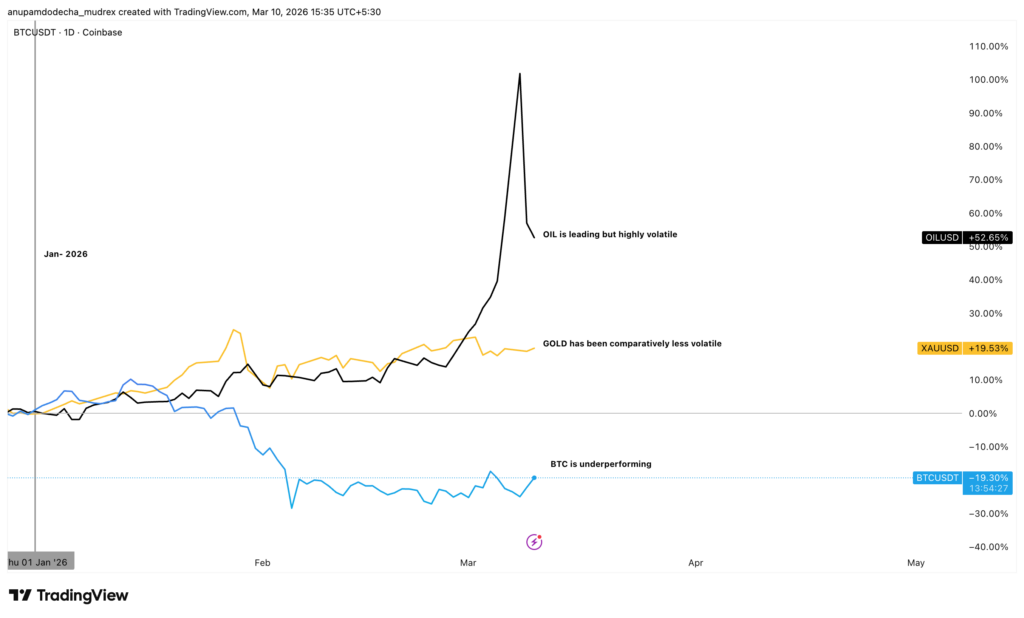
The oil market in 2026 presents a paradox. Despite major forecasting agencies like the EIA and JPMorgan predicting Brent crude to average between $53-60 per barrel for the year, recent geopolitical developments have pushed prices sharply higher. The disruption of oil flows through the Strait of Hormuz, which handles approximately 20% of global daily oil exports, has created significant supply constraints that have sent shockwave through energy markets.
According to the International Energy Agency, global oil supply is actually outpacing demand, with production exceeding consumption and driving inventory builds. The agency forecasts global oil demand growth of just 850,000 barrels per day in 2026, while supply growth remains robust. This fundamental surplus suggests that current elevated prices reflect geopolitical risk premiums rather than structural scarcity.
The recent conflict involving Iran, the United States, and Israel has introduced what analysts call a $14 per barrel risk premium. Murban crude, a key benchmark for barrels that can bypass the Strait of Hormuz, surged above $100 per barrel, signaling acute geopolitical stress. This represents more than just a price milestone—it reveals how quickly accessibility concerns can override fundamental supply-demand balances.
Historical analysis of eight major energy supply disruptions between 1979 and 2019 shows a consistent two-stage pattern. The first stage, or “hesitation period,” typically sees modest price increases of around 2% over 0-30 days. However, the current conflict saw Brent crude rise 9% in just five days, indicating markets are pricing in tail risks far more aggressively than historical norms.
Bitcoin’s relationship with oil has evolved significantly over the past year. While Bitcoin proponents have long championed the cryptocurrency as “digital gold” and an inflation hedge, its market behavior in 2026 tells a more nuanced story. Bitcoin increasingly demonstrates strong correlation with broader risk assets, particularly technology stocks, rather than acting as a pure inflation hedge.
Data from February 2026 shows Bitcoin’s correlation with the Nasdaq-100 swinging dramatically from negative 0.68 to positive 0.72 over just two weeks. More tellingly, Bitcoin has shown an 85.4% correlation with the Nasdaq-100 ETF during oil price spikes, suggesting it behaves more like a high-beta tech asset than a commodity-linked safe haven.
Interestingly, historical analysis reveals that oil price peaks often coincide with crypto market bottoms. Three key milestones illustrate this pattern:
This inverse relationship suggests that when oil-driven inflation fears peak and tighten monetary conditions, Bitcoin faces headwinds as a risk asset. However, once oil prices cool and macro pressure eases, crypto markets historically begin their next leg up.
Oil’s impact on Bitcoin operates primarily through the liquidity channel. For an asset like Bitcoin, which lacks underlying cash flows or revenues, fiat liquidity conditions play an outsized role in price dynamics. A sustained oil surge can tighten liquidity by stoking inflation fears and potentially prompting central banks to raise interest rates or delay rate cuts. Both WTI and Brent crude have already surged roughly 30% since the onset of recent conflicts, while markets have started discounting expected Fed rate cuts.
While Bitcoin struggles during oil-driven crises, gold has thrived in 2026’s volatile environment. The precious metal surged 65% in 2025, far outpacing Bitcoin’s 6% decline over the same period. Gold reached record highs of $5,600 in late January 2026 before correcting, but still trades around $5,100—demonstrating resilience that Bitcoin hasn’t matched.
Gold’s strength reflects its traditional role as the ultimate “bunker” asset during geopolitical turmoil. With central banks doubling their gold purchases, seeking a physical, non-sovereign reserve that cannot be sanctioned or technologically compromised, gold clearly wins the “flight-to-safety” trade during oil shocks.
The relationship between oil and gold operates through multiple channels. Rising oil prices directly feed into inflation metrics through transportation costs, manufacturing expenses, and consumer goods prices. Gold, with its 5,000-year history as an inflation hedge, responds to these pressures with sustained price appreciation.
However, unlike Bitcoin, gold also benefits from industrial demand and central bank reserve accumulation, providing fundamental support beyond speculative flows. The precious metal’s supply increases by only 1.5-2% annually through mining, compared to Bitcoin’s programmatic supply schedule that decreases over time through halvings.
The current oil shock introduces the specter of stagflation—the toxic combination of rising inflation and slowing economic growth. If oil prices remain elevated above $100 per barrel for an extended period, the Federal Reserve’s dual mandate becomes trapped between the increasing risk of higher inflation and rising unemployment.
In such an environment, different asset behaviors emerge:
An important nuance in the current cycle is America’s position as a net oil exporter. While global oil prices surge, the U.S. is partially insulated from immediate shocks. JPMorgan strategists note that “energy independence means there’s a lag before price increases show up at the pump, making it easier to weather short-term volatility.”
This dynamic helps explain why Bitcoin, which increasingly trades like a U.S. risk asset, has shown more resilience than expected during the recent oil spike. Trading around $70000, Bitcoin has remained relatively stable despite crude breaching $100, supported by institutional access through spot ETFs and the relative resilience of Wall Street.
The interplay between oil prices and monetary policy creates the critical transmission mechanism affecting both gold and Bitcoin. EIA forecasts suggest that if oil prices follow predicted trajectories—averaging $58 per barrel in 2026 and $53 in 2027—this could reduce inflation pressure and support a more constructive backdrop for risk assets.
However, any sustained oil shock could force the Fed to maintain higher rates longer, delaying the rate cuts that have been partially priced into markets. This scenario would benefit gold while creating headwinds for Bitcoin and other risk assets that thrive in easy money environments.
A critical development in 2026 is the maturation of Digital Asset Treasury Companies (DATCOs) from simple “HODLers” into operating businesses focused on infrastructure and staking revenue. This evolution means that even if Bitcoin’s price lags behind gold during oil shocks, the underlying blockchain ecosystem is cementing itself as permanent financial infrastructure.
MSCI’s decision to reverse a proposal excluding DATCOs from global equity indexes stabilizes passive fund flows and validates Bitcoin-related companies as legitimate operating businesses rather than mere speculative vehicles.
For investors navigating 2026’s complex macro environment, the evidence suggests a multi-asset approach:
Gold allocation makes sense for those seeking:
Bitcoin allocation suits investors who:
Oil exposure (through energy stocks or commodities) offers:
Several metrics warrant close attention for those trading these correlations:
If the geopolitical situation stabilizes and oil prices revert toward EIA forecasts of $58 per barrel, the likely scenario is:
Conversely, if oil remains above $100 due to prolonged conflict:
The 2026 market environment has shattered simplistic narratives about oil, gold, and Bitcoin moving in lockstep. Instead, we see three distinct assets responding to overlapping but different forces:
Oil operates as the primary macro driver—a real-time signal for inflation expectations, geopolitical risk, and economic growth prospects that ripples through all other asset classes.
Gold has reclaimed its role as the premier safe haven, the “bunker” asset that investors flee to when physical security and sovereign independence matter most. Its 2026 performance validates thousands of years of monetary history.
Bitcoin demonstrates distinct behavior as a digital asset—showing correlation with tech stocks and risk sentiment while maintaining unique properties as decentralized infrastructure. Its performance is closely tied to liquidity conditions and institutional adoption patterns rather than traditional safe-haven dynamics.
For sophisticated investors, the key insight is not choosing one asset over another, but understanding how they interact across different macro regimes. Oil shocks influence each asset through different transmission mechanisms. When oil prices normalize and liquidity conditions improve, Bitcoin’s position as emerging financial infrastructure could attract renewed institutional interest, potentially setting up its next growth phase.
The 2026 decoupling represents market maturation, not market failure. Each asset serves distinct purposes: gold for wealth preservation, Bitcoin for future financial infrastructure, and oil as the critical signal binding them all together through the inflation and liquidity channels that drive modern markets.
Oil prices affect inflation expectations immediately and trade continuously, allowing real-time repricing of future CPI, Fed policy, and consumer demand. CPI is backward-looking and arrives monthly, while oil can alter market expectations before the next inflation report is even released. This makes crude a more dynamic Bitcoin signal than monthly inflation prints.
Bitcoin’s relationship with market dynamics is evolving. While Bitcoin shares some characteristics with gold (scarcity, non-sovereign nature, finite supply), its 2026 price action shows it responding more to liquidity conditions and tech sector sentiment, with 85% correlation to the Nasdaq-100. This doesn’t invalidate Bitcoin’s long-term potential but suggests it serves a different portfolio role than gold—one tied to institutional adoption, technological infrastructure, and future financial systems rather than traditional safe-haven dynamics. Bitcoin’s behavior reflects its nature as emerging technology infrastructure rather than established store of value.
For proven inflation protection, gold remains superior based on 2025-2026 performance. However, Cathie Wood argues Bitcoin offers “higher returns per unit of risk” over longer timeframes due to its tighter supply dynamics (0.82% annual growth vs gold’s 1.5-2%). Consider gold for capital preservation and Bitcoin for higher-risk, higher-reward inflation hedging with multi-year horizons.
The Strait of Hormuz handles 20% of global oil exports. Disruptions there reduce oil flow from 16 million barrels/day to 4 million barrels/day, driving up prices and risk premiums. This benefits gold as a safe haven, influences Bitcoin through shifts in liquidity conditions and risk sentiment, and creates the oil shock that affects both digital and traditional assets through different transmission mechanisms. Understanding these dynamics helps investors position across asset classes during geopolitical events.
Historical data shows oil price peaks often coincide with crypto market bottoms: October 2018 (oil peaked, crypto at $100B bottomed then surged), June 2022 (oil peaked, crypto at $800B bottomed then recovered), and March 2026 (oil at $113, crypto at $2.25T). If this pattern holds, an oil reversal could ease macro pressure and trigger crypto’s next leg up.