Parabolic SAR Explained: How Crypto Traders Use It for Trend Trading
In a market as volatile as crypto, traders constantly search for a way to identify when a trend is real and when it’s about to reverse. The Parabolic SAR, short for “Stop and Reverse,” is one of the simplest yet most effective tools to do exactly that.
In this blog, we will learn how the Paraboli SAR indicator works and how you can deploy it in your crypto strategy.
Understanding the Parabolic SAR
The Parabolic SAR operates on a simple idea:
markets move in trends, and
every trend eventually ends.
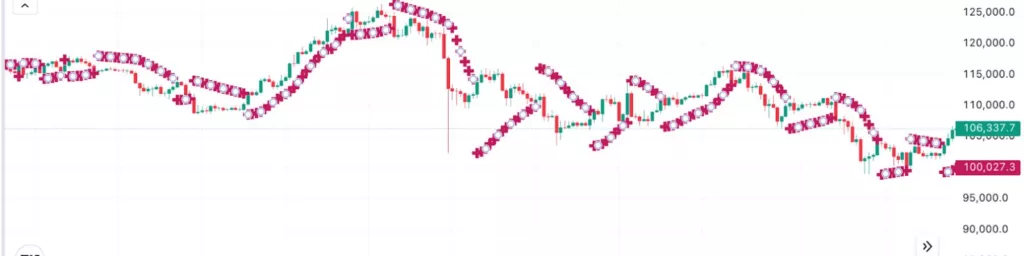
The indicator tries to capture as much of that move as possible by plotting dots that follow the price. When the dots appear below the price, the market is considered to be in an uptrend. When they appear above the price, the trend has flipped downward.
Each time the market reaches a new high in an uptrend or a new low in a downtrend, the indicator tightens its positioning, pulling closer to price and signaling that the move is maturing.
What makes the SAR unique is that it automatically adjusts itself as the market accelerates. It uses an “acceleration factor,” which increases whenever price makes a new extreme. This dynamic factor allows the dots to move closer to price the longer the trend continues, effectively creating a built-in trailing stop.
When the price finally crosses these dots, the SAR flips to the other side, signaling a potential reversal and resetting the entire calculation.
This adaptive quality is why traders value it.
The Parabolic SAR reacts faster as momentum builds, helping traders exit before profits evaporate. It also visually confirms when the market has changed direction — something that can be surprisingly hard to see in the middle of crypto volatility.
How the Parabolic SAR is Calculated
While most charting platforms do the math automatically, understanding how the Parabolic SAR is derived helps traders trust its behavior.
The calculation begins with a starting point known as the Extreme Point (EP)—the highest high during an uptrend or the lowest low during a downtrend. The indicator then measures how far current prices have moved from this extreme and multiplies that distance by a value called the Acceleration Factor (AF).
The acceleration factor is a fraction that represents how quickly the Parabolic SAR closes the gap between the indicator and the actual price during a trend. The value of it is between 0 and 0.20. You can choose the value based on how sensitive you want the indicator to be — lower values react slower and filter noise, while higher values react faster but may give more false signals.
Each new Parabolic SAR value is calculated by taking the previous SAR value and adjusting it toward the extreme point using the acceleration factor. In essence, the longer a trend lasts, the faster the SAR moves closer to price, “accelerating” as momentum builds. Once the price crosses the SAR, the direction reverses: a new extreme point is identified, the acceleration factor resets, and the dots flip to the opposite side.
Parabolic SAR Indicator: Important Strategies for Crypto Trend Trading
This dynamic structure makes the Parabolic SAR self-correcting. It adapts to both trending and reversing markets, which is why it’s often described as a “trend-following stop-and-reverse system.”
Reading Parabolic SAR Signals in Crypto
In practice, interpreting the SAR is straightforward, but context matters.
1. When the dots shift below the price
it’s a sign that buyers are in control and the market’s bias is upward. Traders who are already long can stay in the trade, tightening their stops along the rising SAR dots.
2. When the dots flip above the price
This means that sellers have regained control, suggesting that it may be time to take profits or even consider short exposure. However, this simplicity can also mislead. In a clean trending market, the SAR can ride waves beautifully, giving timely signals and clean exits.
In a sideways or choppy environment, it tends to whipsaw: flipping back and forth as prices move within a range. Many traders lose money by taking every flip literally instead of considering whether the broader market is actually trending.
That’s why combining the SAR with broader market context, such as a moving average or trend strength indicator, can help filter out false reversals.
The Parabolic SAR performs best when the market shows clear direction. In crypto bull runs, when coins climb relentlessly for weeks or months, it becomes a superb companion for trend-following strategies.
Traders can simply follow the dots upward, letting the market decide when the move is over. It’s also powerful as a trailing stop mechanism: as long as the trend continues, the dots rise or fall with price, protecting gains automatically.
Its main limitation is the opposite scenario — when the market drifts sideways. Crypto is notorious for range-bound phases between strong directional moves.
In such cases, the SAR may flip too frequently, forcing traders into unnecessary trades and eroding capital through small losses. The indicator also lags slightly, since it waits for price confirmation before signaling a reversal. That delay can occasionally cause late exits during fast crashes or spikes.
Despite these drawbacks, most professional traders don’t discard the SAR. Instead, they use it selectively: applying it when volatility expands and price breaks away from consolidation zones.
Optimizing the Settings for Crypto Markets
By default, the SAR uses an acceleration factor of 0.02 that increases up to 0.20 as the trend develops.
In fast-moving assets like Bitcoin or Solana, these defaults can be too aggressive, leading to premature signals. Swing traders who work on daily charts often reduce the acceleration slightly, using values around 0.01 to smooth out the indicator. Day traders, on the other hand, might increase it slightly to make the SAR more responsive on short-term timeframes.
Each coin has its own rhythm — Ethereum’s volatility differs from XRP’s, and both differ from Bitcoin’s — so backtesting on the chosen asset is critical. Crypto markets trade 24/7, meaning trends can shift overnight, and adjusting SAR parameters to reflect that rhythm can make a visible difference in accuracy. Rather than applying a universal setting, treat the SAR as a living tool that needs tuning for each instrument and timeframe.
Most traders use the SAR not as a standalone entry signal, but as a companion that guides position management. One popular approach is to wait for the dots to flip before entering in the new direction. If price has been trending downward and dots suddenly appear below the candles, that’s a sign of potential reversal. Traders might open a small position there and trail their stop-loss just below the new SAR value. As the trend continues, each new dot automatically suggests a new stop level, locking in more profit.
Another common use is to combine SAR with other indicators. For example, pairing it with a moving average helps determine whether to trust the signal. If the SAR flips upward but the price remains below a long-term average, the move might be short-lived. On the other hand, if both confirm an uptrend, it gives stronger conviction. Some traders also combine SAR with RSI or ADX readings to ensure that momentum supports the signal.
How to Use the Parabolic SAR in Trading:
Do you often struggle with knowing when to enter or exit a trade? The market can be unpredictable, but the Parabolic Stop-and-Reverse (Parabolic SAR or PSAR) gives traders a systematic way to spot trend direction and potential reversals.… pic.twitter.com/tueld6OYTT
For those trading reversals, the SAR’s closeness to price can be telling. When the dots start hugging the candles tightly, it often means that the trend is tiring and volatility is compressing. In those moments, traders prepare for a potential flip and manage exposure carefully. When the flip happens and other indicators agree, it often marks the early phase of a reversal.
Managing Risk with Parabolic SAR
One of the biggest advantages of the Parabolic SAR is its built-in discipline. It forces traders to define exit points automatically.
In crypto, where emotional decision-making often causes bigger losses than bad analysis, that discipline is invaluable. By moving stops along the SAR dots, traders effectively turn the indicator into an objective risk manager that adjusts with market pace.
That said, the SAR should never be used blindly. In highly volatile moments, especially around major news or liquidation events, price can spike through multiple dots before normalizing.
Treat SAR signals as a roadmap, not as absolute instructions. Pair it with volume analysis, trend confirmation, and clear trade management rules. The goal is not to follow the dots mechanically, but to use them as a framework for controlling risk.
For several cycles, and especially this one, the Weekly Parabolic SAR has been a pretty accurate #Bitcoin bottom indicator with each bearish flip.
The Parabolic SAR dots flip to the upside or downside once price passes their mark.
Many beginners misuse the Parabolic SAR by treating every dot flip as a trade signal. This leads to overtrading in sideways markets and mounting losses from false reversals.
Others keep default settings across all coins, ignoring the differences in volatility. Some even use SAR without considering the overall market context — for example, shorting a minor SAR flip in a powerful bull market and getting trapped as the rally resumes.
A wiser approach is to think of SAR as a coach, not a commander. It tells you when the market’s rhythm might be changing, but it doesn’t demand action every time it does. Understanding its purpose — to identify momentum, not predict tops and bottoms — transforms how effectively it’s used.
The Real Value of Parabolic SAR in Crypto
When viewed correctly, the Parabolic SAR is less of a magic formula and more of a structure for disciplined trading. It keeps traders aligned with prevailing trends, helps define exits objectively, and offers visual clarity in a market that often feels chaotic.
The indicator’s simplicity makes it accessible, yet its behavior encapsulates deep market truths: trends persist until momentum fades, and reversals happen when confidence runs ahead of value.
Crypto markets amplify those dynamics, making SAR one of the few classic indicators that still perform well in this new age of round-the-clock volatility. It may not be perfect, but when combined with thoughtful strategy, it can provide the consistency and emotional control that separates professional traders from impulsive ones.
Conclusion
The Parabolic SAR is a powerful ally for trend traders in crypto. It simplifies complex momentum behavior into a series of visual cues that are easy to read but deeply informative. Used correctly, it enhances timing, safeguards profits, and injects discipline into trading decisions. Yet it demands respect — understanding its strengths, acknowledging its weaknesses, and applying it within the right context.
Looking to learn more practical tips on how to apply crypto indicators? You are in the right place. Expand your understanding of technical indicators on Mudrex Learn, where you’ll find detailed guides on RSI, MACD, and volume-based strategies.
And once you feel that you are ready to trade, download the Mudrex app and start your crypto trading journey. Mudrex brings to you all the essential tools that you need to start your trading journey packed into a neat super app for crypto trading which has spot trading and crypto futures trading. If you are more into crypto investing, Mudrex has features like Crypto staking, Crypto SIP(DCA) and thematic coinsets which you can use to diversify your portfolio in a single click.
The Parabolic SAR (Stop and Reverse) is a technical indicator that helps identify potential trend direction and reversal points by plotting a series of dots above or below price bars. When dots appear below, it signals an uptrend; when above, it signals a downtrend.
2. Is the Parabolic SAR a good indicator?
It’s highly effective in trending markets where prices move consistently in one direction, helping traders spot entry and exit points early. However, in sideways or choppy markets, it can produce false signals, so it’s best used alongside other indicators like moving averages or RSI.
3. Which timeframe is best for Parabolic SAR?
The Parabolic SAR works on any timeframe, but it’s most reliable on higher ones like 4-hour, daily, or weekly charts, where short-term market noise is reduced. Scalpers or intraday traders may still use shorter timeframes but should pair it with volume or trend confirmation tools.
4. Is Parabolic SAR leading or lagging?
It’s considered a lagging indicator because it reacts to price movements that have already occurred, but its accelerating nature makes it respond faster than many other trend-following tools once a direction is established.
Krishnan is a Bangalore-based crypto writer dedicated to simplifying complex crypto concepts. He covers blockchain, DeFi, and NFTs, with a focus on real-world asset tokenization and digital trust. Previously he has written on Real Estate related assets for NoBroker. Krishnan holds a B.Tech degree from the College of Engineering Trivandrum.