

The question on every crypto investor’s mind right now: Has Bitcoin bottomed, or is there more pain ahead?

After reaching a spectacular peak of $126,000 in October 2025, Bitcoin has been in correction mode. As of March 20, 2026, BTC is trading around $70,000—down roughly 44% from its all-time high.
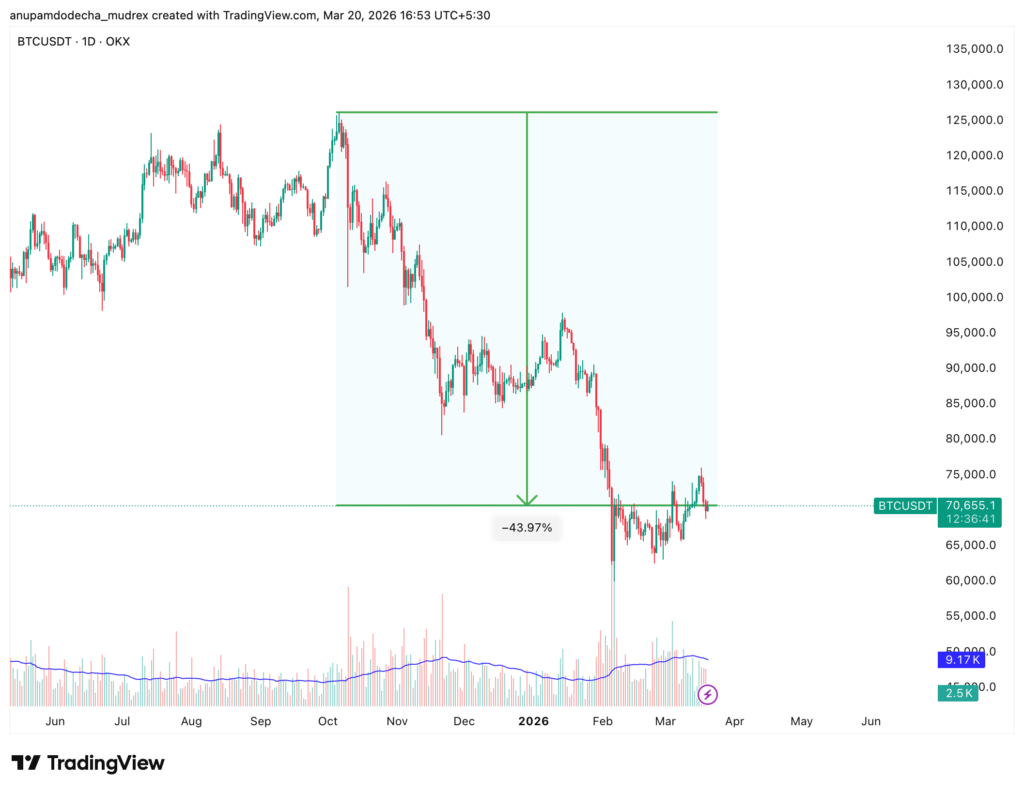
Here’s the bullish signal many are watching: Bitcoin already tested $60,000 and bounced back. This recovery from lower levels suggests underlying strength, but does it mean the worst is over?
To answer this question, we need to look beyond daily price action and examine the bigger picture: Bitcoin’s predictable 4-year halving cycles, historical patterns, and what on-chain data is telling us about where we are in this cycle.
Before diving into cycle analysis, here’s an important development: Bitcoin briefly dipped to $60,000 in recent weeks before recovering to current $70K levels.
This is actually a bullish sign for several reasons:
Strong buyer support: The $60K level attracted aggressive buying, suggesting institutional and smart money see value at these prices. When Bitcoin tests a level and bounces quickly, it often indicates that level as strong support.
Higher lows pattern: If $60K holds as a low and Bitcoin consolidates above $70K, we’re forming a higher-low structure—the first sign of a potential bottom formation.
Reduced volatility: The fact that Bitcoin stabilized after touching $60K rather than cascading lower suggests panic selling has subsided and accumulation may be beginning.
However, one successful bounce doesn’t guarantee the bottom is in. Historical cycles suggest more testing may be needed before a sustainable recovery begins.
Bitcoin doesn’t move randomly. Its price follows a remarkably predictable pattern driven by a programmed scarcity event called the halving.

Every four years (precisely every 210,000 blocks), Bitcoin’s protocol automatically cuts the mining reward in half. This means:
Most recent halving: April 2024
This isn’t theory—it’s hardcoded into Bitcoin’s DNA. And for over a decade, this event has triggered remarkably similar market cycles.
Phase 1 – Post-Halving Accumulation (Months 0-12) After the halving, price typically consolidates or rises modestly as supply shock begins building. Smart money accumulates quietly.
Phase 2 – Bull Market Explosion (Months 12-18) The supply squeeze kicks in. Price breaks to new all-time highs. Media coverage explodes. Retail FOMO peaks. ✓ We experienced this in 2024-2025, peaking at $126K in October 2025
Phase 3 – Bear Market Correction (Months 18-30) Post-euphoria reality check. Early buyers take profits. Late buyers panic sell. Price corrects 60-80%. ← We are here now in March 2026
Phase 4 – Bottom Formation & Recovery (Months 24-40) Maximum pain. Capitulation. “Bitcoin is dead” headlines. Then slowly, quietly, smart money returns. The next cycle seed is planted.
Based on historical halving cycles, on-chain analytics, and analyst consensus across the industry, here’s the most probable scenario:
The data overwhelmingly points to late 2026 for Bitcoin’s cycle bottom. Here’s why this timeline makes sense:
Historical Pattern Match
From Peak to Trough
Analyst Consensus Major on-chain analytics firms and cycle experts (CryptoQuant, Glassnode, Benjamin Cowen, PlanB) independently converge on Q4 2026 as the highest-probability bottom window.
Seasonal Patterns December has historically marked capitulation points:
Summer 2026 Bottom (Lower Probability)
Bitcoin could bottom sooner if:
This would represent a paradigm shift—Bitcoin’s first mature-market cycle where institutional ownership prevents traditional 70%+ corrections. Possible, but unprecedented.
Q1 2027 Bottom (Lower Probability)
Extended bear market into early 2027 if:
This would extend the cycle beyond historical norms but remains within possibility if external conditions deteriorate significantly.
Predicting exact price levels is impossible, but we can identify high-probability zones based on technical analysis, historical drawdowns, and market structure.
This is where the smart money is watching. Here’s why this range makes sense:
The Math:
Technical Support:
Market Structure: This cycle marks Bitcoin’s first as a mainstream institutional asset. Spot ETFs from BlackRock, Fidelity, and others create a permanent bid that didn’t exist in previous cycles. This structural change could prevent traditional 80% bloodbaths.
Think of $50K-$55K as the “value zone” where long-term holders should be accumulating aggressively.
The battle between these forces will determine whether we see $50K or $40K—or if $60K really is the bottom.
1. Bitcoin ETF Structural Bid Spot ETFs aren’t momentum traders—they’re long-term allocators. When Bitcoin drops, rebalancing creates automatic buying pressure. BlackRock, Fidelity, and others represent permanent capital that didn’t exist in previous cycles.
2. Corporate Treasury Adoption Companies like MicroStrategy have proven the playbook: buy Bitcoin as treasury reserve, use as collateral, never sell. More corporations following this model removes supply from circulation permanently.
3. Supply Shock Reality Post-halving, miners produce 50% fewer bitcoins. Combined with long-term holders refusing to sell, available supply for purchase shrinks dramatically. Basic economics: less supply + steady demand = price support.
4. Sovereign Nation Interest Countries exploring Bitcoin reserves (El Salvador led, others watching) represent new demand category that could absorb selling pressure.
5. Federal Reserve Pivot If inflation cools and the Fed cuts rates in 2026, risk assets including Bitcoin typically rally. Lower rates = more liquidity = higher asset prices.
1. Profit-Taker Overhang Everyone who bought Bitcoin between $70K-$126K is either underwater or barely breaking even. As price approaches their entry, many will sell to escape—creating resistance and selling pressure.
2. Miner Capitulation Smaller mining operations with high costs may be forced to sell Bitcoin holdings to stay operational. This creates supply waves that can accelerate downtrends.
3. Macro Recession Risk If the economy enters recession, investors flee to cash and safety. Bitcoin, despite its store-of-value narrative, still trades as a risk asset during panics.
4. Regulatory Uncertainty Government crackdowns, unfavorable legislation, or exchange restrictions can trigger fear-based selling. Regulatory clarity remains Bitcoin’s biggest unknown.
5. Leverage Liquidations Over-leveraged traders getting liquidated creates cascading selling pressure. As price drops, more margin calls trigger, forcing more selling, creating death spirals.
The Current Tug-of-War: Right now these forces are balanced around $70K. The $60K bounce suggests bulls have support, but breakdown below could quickly cascade lower as bearish factors dominate.
These aren’t just numbers—they’re psychological and technical battlegrounds where buying and selling decisions happen en masse.
If $69K holds for 2-3 months: Increased probability current levels are the bottom If $69K breaks down: Expect quick move to $60K-$65K retest If $60K breaks: Panic selling likely drives to $50K or lower If $50K breaks: All bets off—deeper capitulation toward $40K territory
Smart investors track blockchain data for bottom signals:
Understanding past cycles provides valuable perspective:
2011-2012 Cycle:
2013-2015 Cycle:
2017-2018 Cycle:
2021-2022 Cycle:
Pattern: Drawdowns have been decreasing as market matures (94% → 87% → 84% → 77% → potentially 60-70% this cycle)
Whether you’re a trader or long-term holder, here are strategies to consider:
Spread purchases across the expected bottom period (May-December 2026) to average entry price regardless of exact bottom timing.
You may place limit orders at major support levels: $60K, $55K, $50K, $45K, $40K. Scale position size based on confidence.
Buy/Trade $BTC using INR on Mudrex
Conservative approach: Wait for bottom confirmation signals like:
Historical patterns suggest the post-bottom recovery unfolds in phases:
Phase 1: Accumulation (Bottom to +6 months)
Phase 2: Markup (6-18 months post-bottom)
Phase 3: Euphoria (18-30 months post-bottom)
If the bottom occurs in Q4 2026, we might see:
Also Read: Bitcoin 2026 Price Outlook
While no one can predict exact bottoms with certainty, the confluence of historical patterns, halving cycles, and current market structure points to a late 2026 bottom (October-December) in the $50,000-$55,000 range as the most probable outcome.
The current price around $70K likely isn’t the final bottom—expect more volatility and potential downside through mid-2026. However, any level between $40K-$60K represents historically attractive long-term value for patient investors.
Key Takeaways:
Important Disclaimer:This analysis is for educational purposes only and does not constitute financial advice. Cryptocurrency markets are highly volatile and unpredictable. Past performance does not guarantee future results. Always conduct your own research (DYOR), understand the risks, and never invest more than you can afford to lose completely. Consider consulting with licensed financial advisors before making investment decisions.
Bitcoin’s most probable bottom price range is $50,000-$55,000, representing a 50-60% correction from the $126,000 peak. This range aligns with the 200-week moving average (currently around $50K-$55K) and institutional support levels.
While Bitcoin’s dip to $60,000 and recovery to $70,000 is a bullish sign showing strong support, it’s unlikely to be the final bottom based on historical patterns. Bitcoin typically requires 12-15 months of correction from peak to bottom. Since the October 2025 peak, only 5 months have passed as of March 2026. Previous cycles (2017-2018, 2021-2022) needed full capitulation phases before sustainable recovery began.
The optimal strategy for most investors is dollar-cost averaging (DCA) rather than trying to time the exact bottom. Start accumulating Bitcoin gradually between now and December 2026, with larger purchases at key support levels: $65K, $60K, $55K, and $50K. Current levels around $70,000 represent better value than the $126,000 peak, but historical cycles suggest more downside is possible. Set limit orders at multiple price points and scale your position. Never invest more than you can afford to lose, and consider that Bitcoin could still drop 20-40% from current levels before forming the final bottom.
Bitcoin bottoms are confirmed through multiple signals: (1) On-chain metrics – MVRV ratio below 1.0, negative funding rates, and miner capitulation indicators; (2) Technical analysis – Higher lows and higher highs forming on weekly charts, breaking above resistance levels; (3) Volume patterns – Increasing volume on up-moves, decreasing volume on down-moves showing accumulation; (4) Time – Historically 24-28 months post-halving (October-December 2026 this cycle); (5) Sentiment – Extreme fear, “Bitcoin is dead” headlines, and retail capitulation. No single indicator confirms the bottom—convergence of multiple signals provides highest confidence. Conservative investors should wait for 2-3 months of confirmed uptrend before committing significant capital.