XRP vs Bitcoin: Differences, Use Cases, Performance & Outlook (2026)
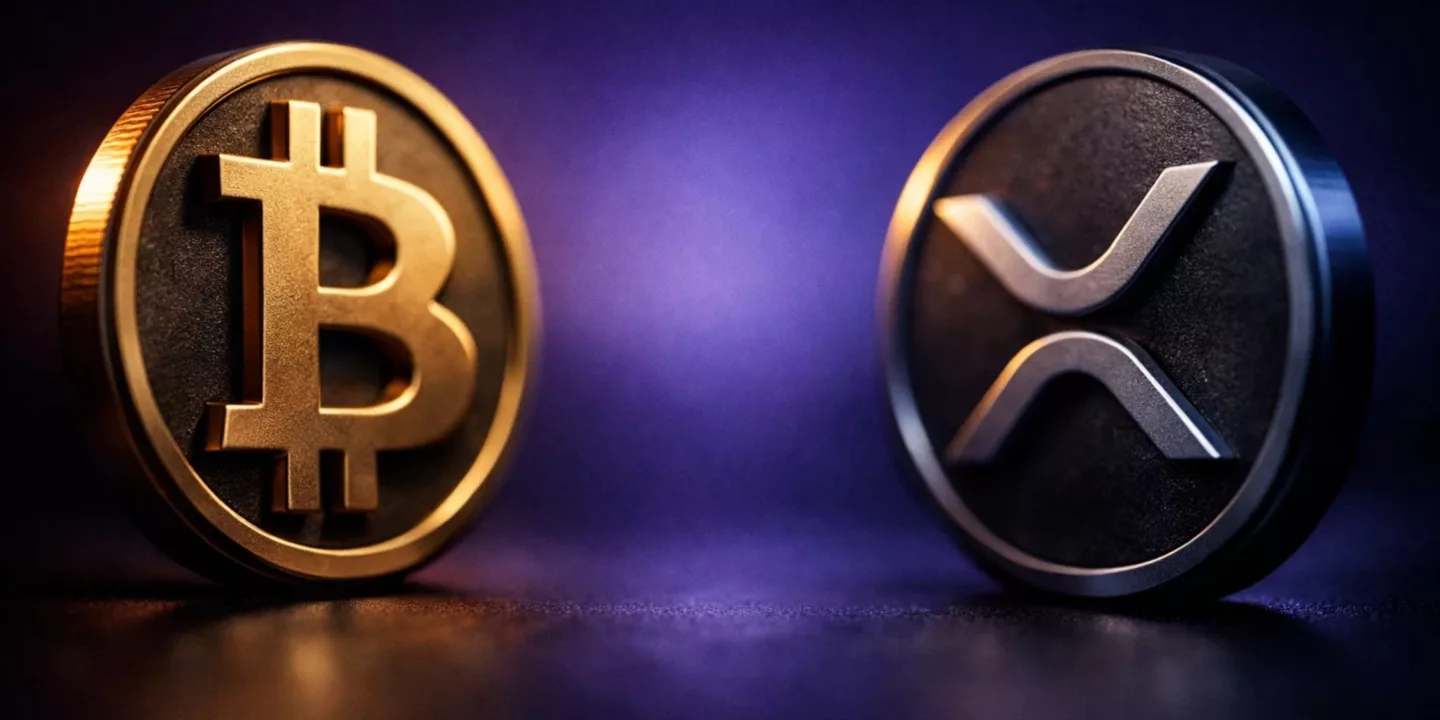
XRP vs Bitcoin is one of the most frequently looked-up crypto comparisons because it pits two of the oldest crypto assets against each other. However, XRP vs Bitcoin is not a comparison of similar technologies. Bitcoin was designed as a decentralized store of value, while XRP was built as a fast settlement asset for payments.
This guide explains XRP and Bitcoin across technology, use cases, performance, risk, and long-term outlook to help investors make informed decisions heading into 2026.
XRP vs Bitcoin at a Glance: Key Differences in 30 Seconds
XRP vs Bitcoin compares a payments-focused asset with a store-of-value asset
Bitcoin prioritizes decentralization, security, and scarcity
XRP prioritizes speed, efficiency, and low-cost settlement
XRP vs Bitcoin volatility profiles differ significantly
Bitcoin historically offers lower relative risk
XRP offers higher potential upside with higher uncertainty
Which makes more sense?
Choose Bitcoin for long-term value preservation
Consider XRP for higher-risk exposure to payments adoption
XRP vs Bitcoin Comparison Table: Purpose, Supply, Speed, and Risk
Feature
Bitcoin (BTC)
XRP
Primary role
Store of value
Payments and settlement
Network architecture
Proof-of-work blockchain
XRP Ledger
Maximum supply
21 million BTC
100 billion XRP
Circulating supply model
Gradual mining issuance
Mostly pre-issued
Transaction speed
~10 minutes per block
3–5 seconds
Transaction fees
Variable
Extremely low
Level of decentralization
Very high
Moderate
Adoption drivers
ETFs, institutions, macro hedge
Payments, remittances
Key risks
Regulation, energy narrative
Adoption pace, governance concerns
XRP vs Bitcoin: What are these tokens?
Bitcoin Explained: Digital Gold and Long-Term Value Storage
Bitcoin is the first decentralized cryptocurrency, launched in 2009. In the XRP vs Bitcoin discussion, Bitcoin represents the digital gold thesis. It is secured by proof-of-work mining and governed by a strict supply cap of 21 million coins.
Bitcoin’s value comes from scarcity, decentralization, and censorship resistance. Over time, it has evolved from a payment experiment into a long-term store of value, increasingly adopted by institutions and long-horizon investors.
XRP Explained: A Settlement Asset for Global Payments
XRP is the native token of the XRP Ledger, designed for fast and inexpensive transfers of value. XRP represents the payments and settlement use case. It uses a validator-based consensus model rather than mining.
XRP is positioned as a bridge currency that enables cross-border payments and remittances, focusing on efficiency rather than long-term value storage.
XRP vs Bitcoin Use Case Comparison: Store of Value vs Payments Network
The fundamental difference lies in what each network is optimized to do.
Bitcoin is optimized for holding value over long periods. Security, decentralization, and predictability matter more than transaction speed.
XRP is optimized for moving value quickly. In payments and remittances, settlement speed and low fees are critical.
This is why XRP vs Bitcoin is not a replacement debate. Each asset targets a different economic function.
Technology and Decentralization: How XRP vs Bitcoin Networks Differ
Bitcoin uses proof-of-work mining, making it one of the most decentralized and censorship-resistant networks in existence. This gives Bitcoin a structural advantage in trust minimization.
XRP uses a validator consensus system, enabling speed and efficiency but introducing governance trade-offs. Decentralization is one of the most important philosophical distinctions.
For users and investors, decentralization affects long-term resilience and trust assumptions.
XRP vs Bitcoin Tokenomics: Supply Structure and Market Cap Math
Bitcoin’s capped supply of 21 million coins underpins its scarcity narrative. Issuance decreases over time through halving events, reinforcing long-term supply constraints.
XRP has a maximum supply of 100 billion tokens, most of which were created at launch. This larger supply often leads to unrealistic price expectations.
Understanding market cap is essential. Token price alone does not reflect valuation or upside potential.
Transaction Speed and Fees: What Actually Matters in XRP vs Bitcoin
XRP transactions typically settle within seconds at negligible cost. Bitcoin transactions settle more slowly, and fees vary based on network demand.
In XRP vs Bitcoin, speed matters primarily for payments. For long-term holders, speed is largely irrelevant.
This distinction explains why faster transactions do not automatically make XRP superior, nor do slower transactions weaken Bitcoin’s investment case.
Adoption and Price Catalysts Shaping XRP vs Bitcoin in 2026
Bitcoin Catalysts: Institutional Access and Macro Demand
In the XRP vs Bitcoin debate, Bitcoin’s price is driven by institutional adoption, spot ETFs, macro liquidity cycles, and its role as a hedge against currency debasement.
Bitcoin upside requires:
Continued institutional inflows
Favorable regulatory treatment
Sustained confidence in scarcity
XRP Catalysts: Payments Adoption and Regulatory Clarity
XRP’s price is more sensitive to real-world usage.
XRP upside requires:
Growing payments and remittance volumes
Expanding ecosystem activity
Clear and stable regulation
Historical Performance Analysis: XRP vs Bitcoin Returns, Volatility, and Drawdowns
Historically, XRP vs Bitcoin performance shows a clear risk distinction.
Bitcoin has delivered strong long-term returns with relatively lower volatility. XRP has experienced sharper rallies but significantly deeper drawdowns.
Bitcoin has historically provided more stable compounding, while XRP has offered episodic but volatile upside.
XRP Price Targets Explained: Can XRP Reach $10 or $100?
Evaluating XRP price predictions requires basic market cap math.
For XRP to reach $10, its market cap would need to approach the largest assets in crypto. A $100 XRP would imply a valuation exceeding most global financial markets.
Bitcoin requires far less incremental capital to reach new highs than XRP does to reach extreme price targets.
XRP vs Bitcoin Investment Framework: How to Choose Between Them
XRP vs Bitcoin is best viewed as a portfolio allocation decision.
Choose Bitcoin if:
You want lower relative risk exposure
You believe in the digital gold narrative
You have a long-term investment horizon
Choose XRP if:
You accept higher volatility
You believe in payment infrastructure growth
You are seeking asymmetric upside
Time horizon, risk tolerance, and position sizing are critical in XRP vs Bitcoin decisions.
Conclusion
XRP vs Bitcoin is not a competition for dominance but a comparison of economic roles. Bitcoin remains the leading store-of-value asset in crypto, while XRP focuses on settlement efficiency and payments.
Understanding both allows investors to set realistic expectations, manage risk, and align investments with long-term beliefs.
To gain deeper clarity on comparisons like XRP vs Bitcoin, explore educational resources on Mudrex Learn. For simplified explanations, market insights, and long-term crypto perspectives, subscribe to the Mudrex YouTube channel and stay informed through every market cycle.
FAQs
Is XRP better than Bitcoin?
Neither is universally better since they serve different purposes.
Will XRP replace Bitcoin?
No. Bitcoin is designed as a store of value, while XRP is built for fast payments and settlement. Their roles are different, not competitive.
Is XRP a good investment?
XRP can offer higher upside but carries higher risk.
Will XRP hit $10 in 2025?
It is possible, but only with strong adoption, regulatory clarity, and a favorable market cycle. It should be seen as an aggressive scenario, not a base case.
Will XRP hit $100 soon?
Highly unlikely. A $100 price would require an extremely large market capitalization that current adoption levels do not support.
Will I become a millionaire from XRP?
That depends on entry price, investment size, and market timing. XRP carries high volatility, and large gains are not guaranteed.
Where will XRP be in 5 years?
XRP’s future depends on payment adoption and regulatory clarity.
Siri is a writer venturing into the exciting realms of blockchain technology, cryptocurrency, and decentralized finance (DeFi), eager to explore the transformative potential of these innovations. She brings a unique perspective that bridges traditional industries and cutting-edge technology, often infused with a touch of humor through memes. She has a rich background in real estate and interior design, having previously contributed to NoBroker, where she crafted blogs and assets on these topics.