Bitcoin is famous for its booms and busts. Investors often wonder: if the market crashes, just how low could Bitcoin’s price go? The answer depends on historical precedents, market psychology, macroeconomic conditions, and Bitcoin’s growing institutional adoption.
A History of Bitcoin Market Crashes
Bitcoin has survived multiple severe downturns. Each cycle provides valuable context for future price predictions:
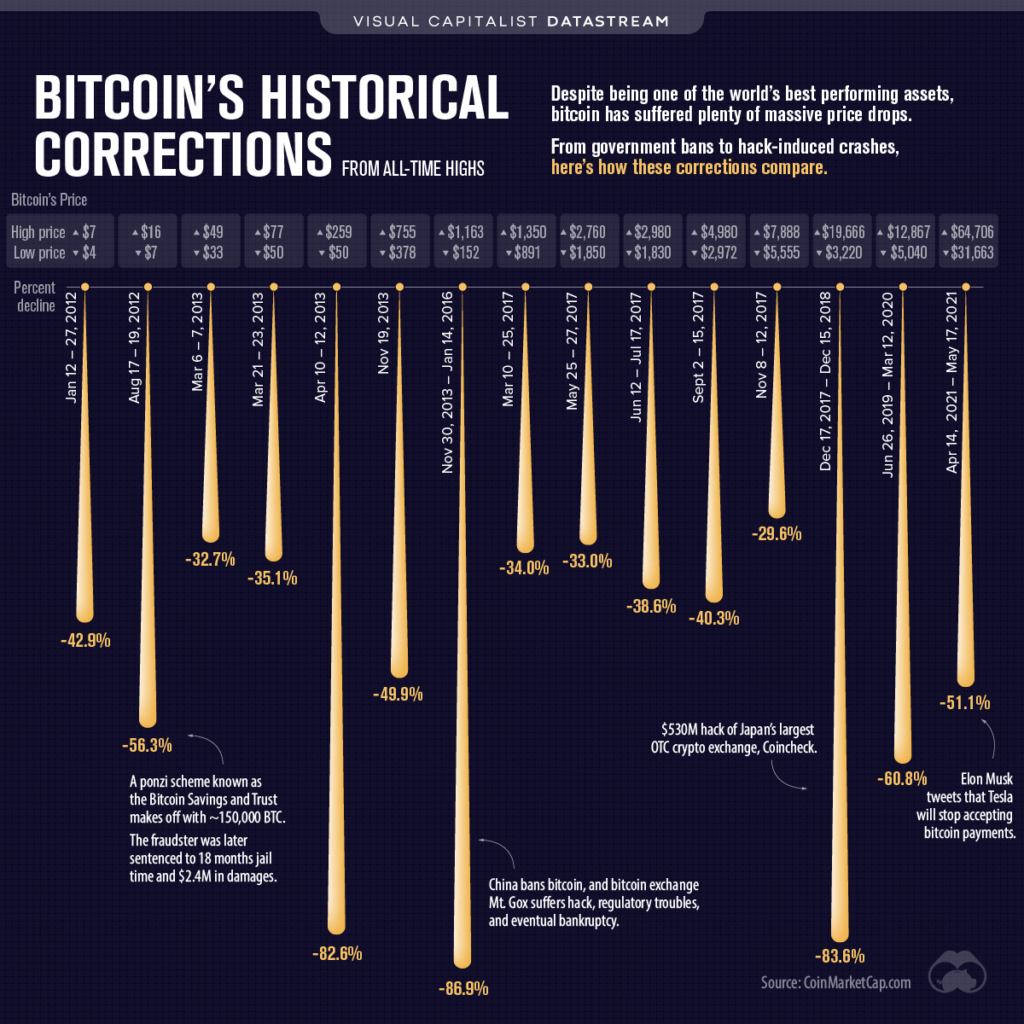
2011 Crash: Bitcoin fell from $32 to $2 — a 94% drop.
2013–2015 Crash: From $1,150 to $200, down 83%.
2017–2018 Crash: From $19,700 to $3,200, down 84%.
2021–2022 Crash: From $69,000 to $15,700, down 77%.
Historically, Bitcoin has seen drawdowns of 77–94% during bear markets.
Several macro and crypto-specific forces influence how low Bitcoin could go:
1. Macroeconomic Conditions
Rising interest rates, recession fears, and dollar strength typically hurt risk assets.
Correlation between Bitcoin and Nasdaq suggests Bitcoin may act like a high-beta tech stock during downturns.
2. Crypto-Specific Risks
Exchange collapses (e.g., FTX) can trigger forced liquidations.
Regulation uncertainty may spook institutional investors.
Leverage in derivatives markets can amplify downward moves.
3. Investor Psychology
Panic selling often accelerates downturns.
“Capitulation phases” in past cycles created extreme oversold conditions.
What does the Crypto Fear and Greed Index Say?
The CMC Crypto Fear and Greed Index currently sits at 44 (Neutral), showing a steady sentiment compared to last week (45) and last month (52). Despite recent market dips, the index has stabilized, suggesting investors are regaining balance after volatility.
Importantly, the yearly range: from Extreme Greed (88) in November to Extreme Fear (15) in March—shows crypto’s resilience in bouncing back from extremes.
A neutral reading is often a healthy sign in crypto markets, as it reflects consolidation and room for growth. With Bitcoin volume showing steady support, this could set the stage for the next bullish phase once confidence strengthens.
Realistic Price Prediction Models in a Crash
Analysts often use past drawdowns and technical levels to forecast downside potential.
Historical Drawdown Range
A repeat of the 77–94% historical drawdowns could place Bitcoin anywhere between $4,000 and $16,000, depending on the cycle peak.
On-Chain Data Levels
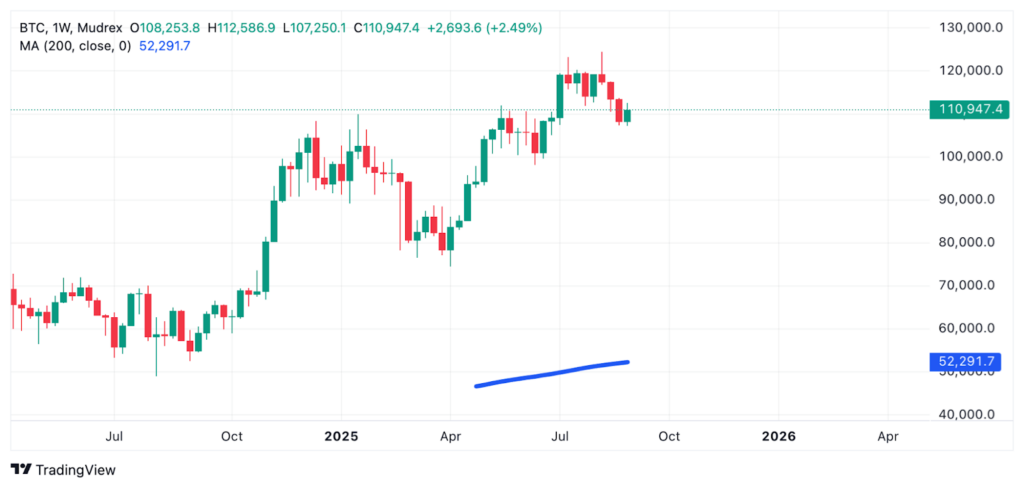
Bitcoin price vs 200-week SMA
Bitcoin’s 200-week SMA currently sits near $52K, reflecting Bitcoin’s long-term growth trend and serving as the widely tracked base level for institutional and long-term investors.
This confluence shows that while realized price highlights historical accumulation zones, the market’s long-term floor has moved up substantially. As long as BTC trades well above the 200W SMA, the broader bullish structure remains intact.
This seems to suggest that the worst-case downside in a major bear cycle is $50K–$55K, aligned with the 200W SMA. Anything deeper would require black-swan style capitulation.
If BTC were to crash toward the 200W SMA, that would imply a drawdown of about -52% from current levels. Historically, this matches the deepest bear-cycle retracements (~70–85%), though in absolute terms the SMA tends to act as the “floor.”
So the realistic crash numbers are:
Scenario
Target Level
Drawdown from $111K
Basis
Mild correction
$90K–95K
-15% to -20%
Local support zones
Major retrace
$52K (200W SMA)
-52%
Historic cycle floor
Black Swan
$46K (below SMA)
-58%
Overshoot risk, rare events
Bottom line: the 200W SMA around $52K is the logical “worst-case floor” unless a black swan event drags price slightly below it.
A collapse to the old realized price floor ($20K–$22K) would mean an -80%+ crash, which is statistically less likely in this cycle.
Why Bitcoin Might Not Fall as Low as Before
Despite risks, several factors suggest Bitcoin’s floor may be higher in future cycles:
Institutional Adoption: Major firms (Tesla, MicroStrategy, BlackRock) hold Bitcoin on balance sheets.
ETF Approvals: Spot Bitcoin ETFs increase mainstream exposure and demand.
Scarcity Effect: With halving cycles, new Bitcoin issuance shrinks every four years, historically leading to higher lows.
Risk Management for Investors
Bitcoin remains volatile, but risk can be managed:
Diversify portfolio across assets.
Use dollar-cost averaging (DCA) to smooth volatility.
Hold long-term with conviction in Bitcoin’s scarcity-driven model.
Avoid overexposure to leverage or single exchanges.
Bitcoin’s realistic floor sits near the 200-week SMA around $52K, with extreme dips only stretching toward $46K. Each cycle has set higher bases, and every crash has fueled a rebound.
The smart move is not just holding, but hedging with crypto futures—using leverage to manage downside risk while keeping upside exposure. With Mudrex’s low fees, futures trading becomes an efficient way to stay protected and positioned.
Krishnan is a Bangalore-based crypto writer dedicated to simplifying complex crypto concepts. He covers blockchain, DeFi, and NFTs, with a focus on real-world asset tokenization and digital trust. Previously he has written on Real Estate related assets for NoBroker. Krishnan holds a B.Tech degree from the College of Engineering Trivandrum.