Prices in crypto don’t move randomly; they move because of people buying and selling. Behind every pump or crash lies one simple truth: when demand is stronger than supply, prices rise. When supply overtakes demand, prices fall.
That’s where supply and demand zones come in. These zones are like invisible magnets on a chart, showing where big players buy and sell. For beginners, learning to spot these zones is a game-changer. It helps you avoid chasing pumps and instead trade with confidence.
Let’s break it down step by step.
What Are Supply and Demand Zones?
Think of a busy fruit market. At some stalls, sellers lower prices to attract buyers, which creates a demand zone. At other stalls, too many sellers raise their prices and buyers pull back; that’s a supply zone.
In crypto, the same thing happens on charts:
Demand zones are areas where buyers step in and push prices up.
Supply zones are areas where sellers step in and push prices down.
Support and resistance lines are single levels, but supply and demand zones are broader areas. They represent real-world buyer and seller clusters rather than just price lines.
In fast-moving markets like Bitcoin or Ethereum, these zones are powerful because they reflect collective behavior, not just random price points.
⚠️ SUPPLY & DEMAND ZONES⚠️
Supply and Demand trading focuses on identifying areas in the market where institutional players have previously bought or sold large positions. The strategy involves entering trades when the price revisits these zones, aiming to align with the… pic.twitter.com/z0aCyXSkAR
A supply zone is where sellers are stronger than buyers. Prices rise to a certain area, sellers dump their holdings, and the price falls again.
Supply zones often form after strong downward moves or near previous highs. Traders look at them as “sell areas.”
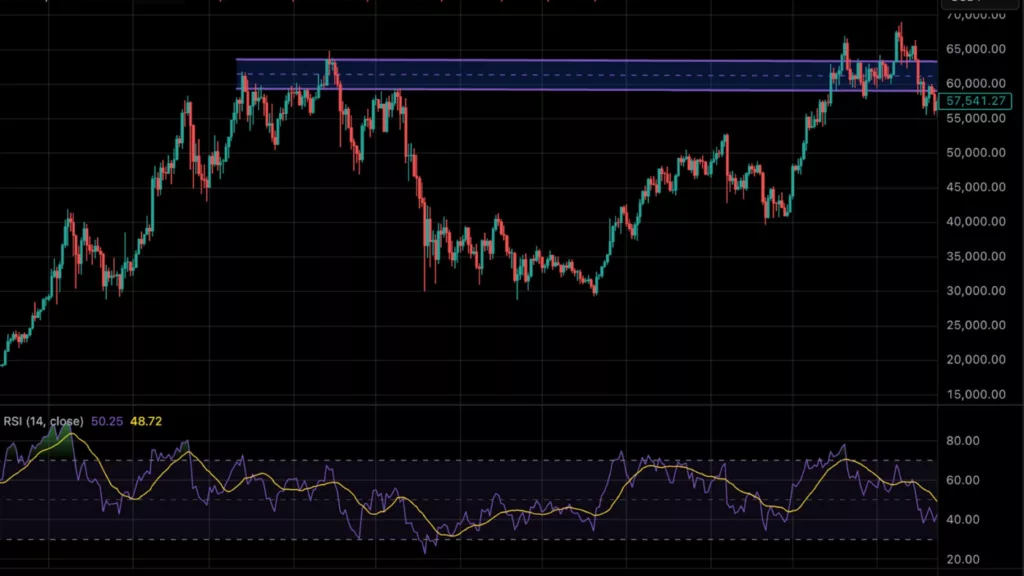
Example: In 2021, Bitcoin touched $64,000. Many early investors sold at this peak, creating a major supply zone. Every time BTC revisited that level later, selling pressure increased.
Psychology also plays a role. People think, “If BTC hits $64k again, I’ll sell before it drops.” That’s how supply zones become self-fulfilling.
Bitcoin chart at 2021 ATH, highlighting the supply zone around $64k.
A demand zone is the opposite. It’s where buyers dominate sellers, and prices shoot up.
These zones often form after strong upward moves or near market bottoms. Traders see these as “buy areas.”
Example: During the 2018-2019 bear market, Ethereum hovered around $100-$120. This was a demand zone. Investors saw ETH as “cheap,” leading to heavy accumulation. Later, ETH skyrocketed past $4,000.
Here too, psychology is clear: people believe, “If ETH drops back to $100, I’ll buy as much as I can.”
Spotting these zones is easier than you think. Here’s a beginner-friendly method:
Look for strong moves: Identify areas where the price quickly shot up (demand) or crashed down (supply).
Spot the base: Find the consolidation (sideways candles) just before that move. That base is the zone.
Mark the range: Highlight the high and low of the base area.
Check volume: A spike in volume confirms strong buyer/seller interest.
Watch retests: Zones tested multiple times lose strength; “fresh” zones work best.
Trading Strategies Using Supply and Demand Zones
Once you mark these zones, you can plan trades more smartly:
Buying at demand zones: Enter long trades when the price revisits a demand area.
Selling at supply zones: Take profit or short when the price nears a supply zone.
Stop-loss placement: Always put your stop just outside the zone (below demand or above supply).
Position sizing: Don’t risk more than 1-2% of your capital per trade.
Different styles of traders use zones differently:
Swing traders hold for days or weeks, buying near demand and selling near supply.
Scalpers look at smaller time frames and grab small profits around zones.
For higher accuracy, combine zones with indicators like RSI (for overbought/oversold signals) or MACD (trend confirmation).
Case Study: Bitcoin 2020-2021 Bull Run
Let’s connect this to real history.
In late 2020, BTC built a demand zone around $10,000-$12,000. Institutions like MicroStrategy accumulated here. When BTC broke out, it never looked back.
In 2021, supply zones appeared near $64k and $69k. Every rally near those levels faced massive selling.
Traders who recognized these zones took profits near supply and re-entered near demand zones during pullbacks.
This shows how zones aren’t just “lines on a chart”; they reflect real market behavior by whales, funds, and retail traders.
Drawing zones too wide or too narrow: A zone should cover the base of candles before the move, not the entire chart.
Ignoring market context: A demand zone in a strong downtrend may fail.
Overtrading around zones: Not every test of a zone means a trade.
Blind trust: Always wait for confirmation signals (like reversal candlesticks).
Remember: supply and demand zones are tools, not magic wands.
Advanced Tips to Master Supply and Demand Zones
Once you’re comfortable with the basics, try these advanced strategies:
Multiple Time Frame Analysis: Check zones on weekly, daily, and 4-hour charts. Bigger timeframes = stronger zones.
Order Book Insights: Platforms like Binance or Bybit show order book clusters. These often match supply/demand zones.
Liquidity Hunts: Big players sometimes push prices just beyond zones to trigger stop-losses before reversing. Be cautious.
Portfolio Strategy: Long-term investors can use demand zones for dollar-cost averaging (DCA) into assets.
Why Supply and Demand Zones Are Powerful in Crypto
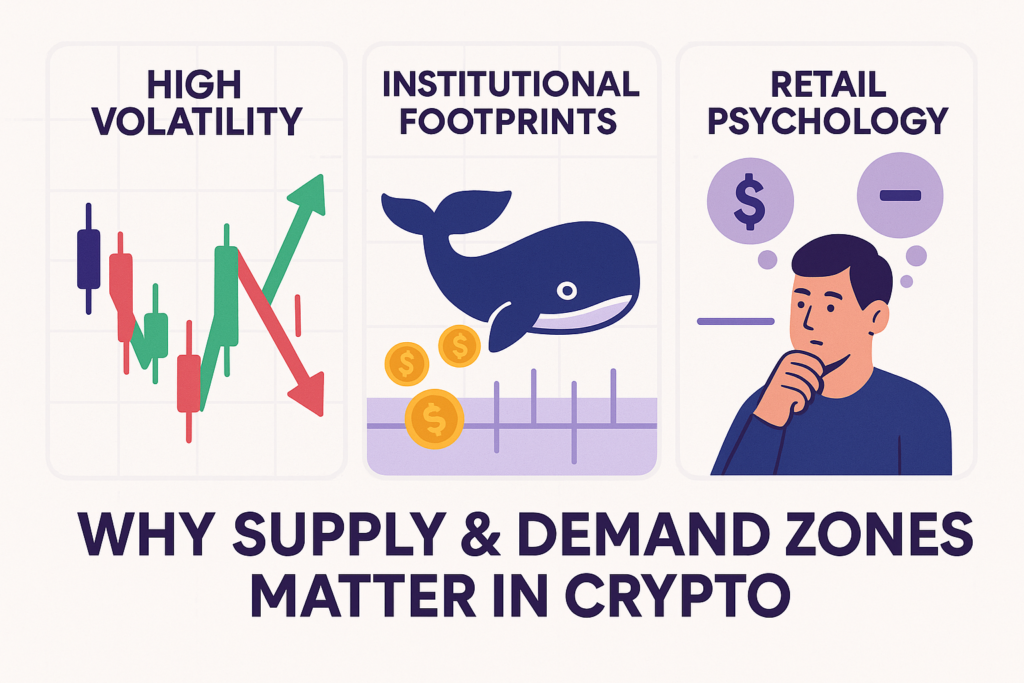
One of the reasons supply and demand zones work so effectively in the crypto market is the nature of the asset class itself. Unlike traditional markets such as equities or forex, crypto is known for its high volatility, fast-paced movements, and significant participation from both retail traders and large institutional players.
These factors combine to make supply and demand zones more visible and more impactful in crypto trading.
High Volatility Creates Sharper Moves Crypto prices often swing more aggressively compared to stocks or currencies. This means that when the market reacts to a strong buying (demand) or selling (supply) level, the resulting moves are usually sharper and more defined. As a result, supply and demand zones in crypto tend to stand out clearly on the chart, making them easier for traders to spot and trade.
Institutional Footprints Are Easier to See Large investors, often referred to as “whales,” play a huge role in crypto markets. When these big players enter or exit positions, they leave behind visible footprints on the chart in the form of demand or supply zones. For example, if a whale buys a large amount of Bitcoin at a certain price, that area becomes a strong demand zone that the market is likely to respect in the future.
Retail Psychology Reinforces Zones Retail traders, who make up a large share of crypto participants, tend to remember the price levels where they made significant gains or losses. If many traders experienced buying success at a certain level, they are likely to buy again when the price revisits that zone, reinforcing its strength as a demand zone. Similarly, areas where traders suffered losses can become strong supply zones, as traders sell quickly when prices return to those levels.
Supply and Demand Zones in Crypto Trading: Proven Strategy for Beginners
Smart traders don’t just chase pumps; they wait at demand zones, where risk is low and reward is high.
Conclusion
Supply and demand zones help you understand why prices move, not just where. For beginners, it’s a way to trade with patience and discipline instead of emotion.
If you’re starting out:
Practice drawing zones on demo accounts.
Combine them with simple indicators.
Always use stop-loss and proper risk management.
In the long run, traders who respect supply and demand don’t just survive crypto volatility; they thrive in it.
Ready to truly dive into the world of crypto? Start exploring our blogs on Mudrex Learn and download the Mudrex app to take your first step towards confident, disciplined crypto trading today!
FAQs
1. Are supply and demand zones the same as support and resistance?
Not exactly. Support/resistance are lines. Supply and demand zones are wider areas showing where real buying/selling pressure exists.
2. Which timeframe is best for finding zones in crypto?
Daily and 4-hour charts are best for beginners. Higher timeframes = stronger zones.
3. Can supply and demand zones fail?
Yes. Zones can break if market sentiment changes or big players push through them.
4. Do professional traders use these zones?
Absolutely. Many institutional strategies revolve around identifying supply and demand imbalances.
Siri is a writer venturing into the exciting realms of blockchain technology, cryptocurrency, and decentralized finance (DeFi), eager to explore the transformative potential of these innovations. She brings a unique perspective that bridges traditional industries and cutting-edge technology, often infused with a touch of humor through memes. She has a rich background in real estate and interior design, having previously contributed to NoBroker, where she crafted blogs and assets on these topics.