Bitcoin in 2026: Key Drivers, Price Scenarios, Risks & Strategic Outlook
Bitcoin enters 2026 at a fascinating intersection of institutional maturity, macroeconomic sensitivity, and post-halving supply dynamics. The asset is no longer a fringe experiment — it is a macro-reactive, institutionally integrated financial instrument with global relevance.
Let’s break it down clearly and strategically.
2026 Bitcoin Drivers at a Glance
1. Institutional Adoption – Strongly Positive
Spot ETF inflows, expanding corporate treasury allocations, and regulated custody infrastructure continue to create a structural demand floor for Bitcoin. Unlike previous cycles, capital channels are now more permanent and scalable.
2. Regulatory Developments – Positive Bias
Incremental regulatory clarity across major economies supports broader participation from traditional finance institutions. Clearer market structure frameworks reduce uncertainty and encourage long-term capital deployment.
3. Macroeconomic Conditions – Mixed Influence
Potential interest rate cuts and liquidity expansion favor risk assets like Bitcoin. However, persistent inflation, economic slowdown, or restrictive monetary policy could pressure prices.
Layer-2 development and scaling solutions improve Bitcoin’s utility beyond simple store-of-value narratives, slowly expanding real-world use cases and adoption.
5. Geopolitical & Fiat Currency Dynamics – Variable
Currency instability in select regions can drive safe-haven flows into Bitcoin. However, global crises often introduce short-term volatility and risk-off behavior.
The 2024 Bitcoin halving continues to constrain new supply entering the market. With steady or rising demand, reduced issuance remains a supportive long-term factor.
Bitcoin in 2025: Price Action vs Fundamentals
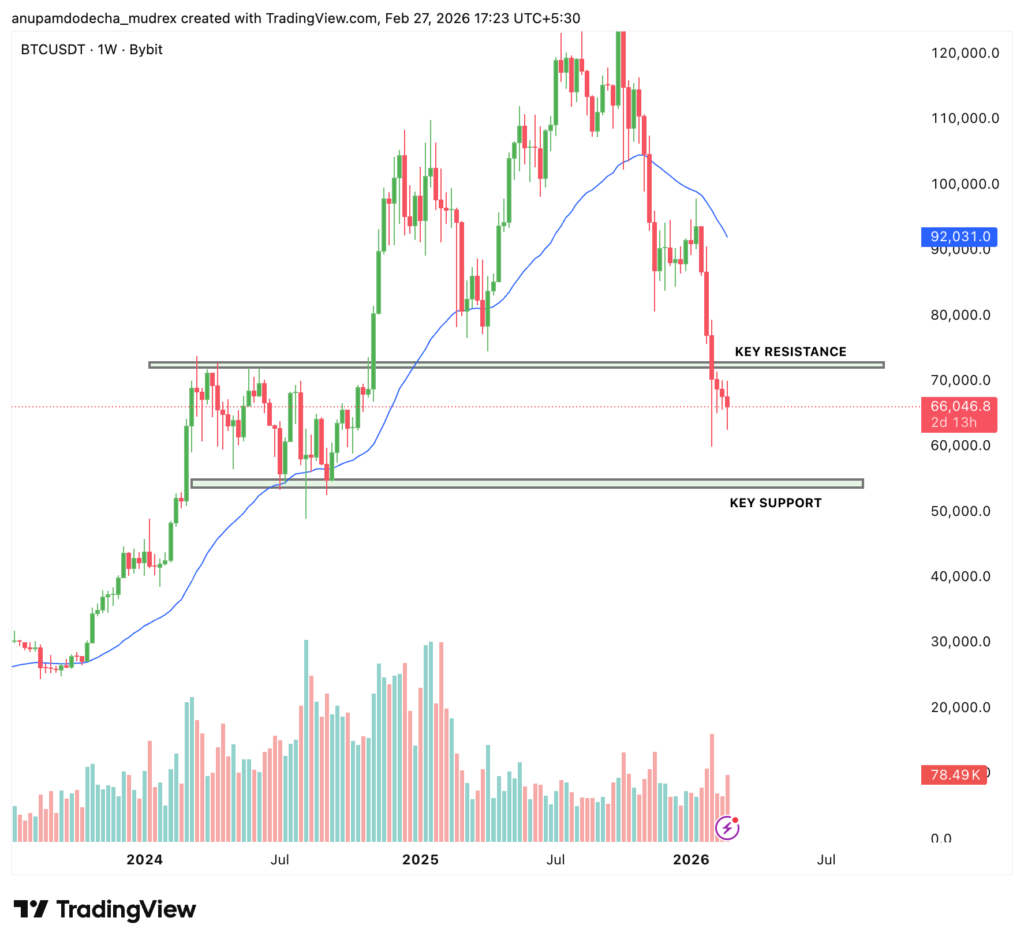
Bitcoin began 2025 near $94,000, fueled by late-2024 ETF momentum.
It rallied to a cycle high around $126,200 before experiencing a significant mid-year correction. Despite multiple 30–40% drawdowns, the asset recovered partially due to:
Institutional buying
Whale accumulation
Strong network resilience
Bitcoin ETF Net Flows
By year-end, Bitcoin posted a strong net gain. Importantly, core fundamentals remained robust:
Record hash rate highs
Strong long-term holder behavior
Continued ETF AUM growth
Price volatility persisted, but underlying network health did not deteriorate.
What Makes Bitcoin in 2026 Different?
Bitcoin’s market structure has evolved.
Institutional infrastructure is significantly more developed compared to prior cycles. Regulated ETFs, improved custody solutions, and growing corporate treasury adoption provide stronger and more durable capital inflows.
At the same time, Bitcoin now exhibits higher macro beta — meaning it reacts more sharply to:
Interest rate expectations
Inflation data
Equity market direction
Global liquidity signals
Bitcoin is no longer isolated from macro conditions. It is deeply intertwined with them.
Bitcoin Price Scenarios for 2026
Bitcoin 2026 Outlook: Price Scenarios, Key Catalysts, and Risks to Watch
Base Case: Most Probable Outcome
Bitcoin trades between $70,000–$100,000 through year-end.
Moderate ETF and corporate inflows continue
Macro conditions remain uneven but stable
Network fundamentals provide structural support
This scenario assumes no major new catalysts or severe breakdowns.
Bull Case: Strong Upside Potential
Bitcoin reaches $100,000–$150,000 if multiple tailwinds align:
Meaningful regulatory progress unlocks new institutional capital
Accelerating corporate treasury adoption
Soft macro landing with rate cuts and controlled inflation
Retail participation returns gradually
On-chain activity and Layer-2 adoption accelerate measurably
Bear Case: Downside Risks
Bitcoin falls into the $50,000–$70,000 zone (or briefly lower during panic events) if:
A deeper macroeconomic slowdown or recession materializes
Practical Frameworks for Bitcoin Investors in 2026
Long-Term Investor Strategy
Use dollar-cost averaging (DCA) to minimize timing risk. Maintain a multi-year perspective, treating Bitcoin as a portfolio diversifier and potential inflation hedge. Prioritize secure self-custody solutions such as hardware wallets or multisignature setups to eliminate counterparty exposure.
Active Trader Strategy
Identify the prevailing volatility regime (range-bound vs trending). Risk no more than 1–2% of total portfolio capital per trade. Use strict stop-loss levels and avoid excessive leverage. Monitor funding rates and on-chain metrics for regime shifts.
New Investor Strategy
Begin with modest exposure (1–5% of portfolio). Avoid leverage entirely during early participation. Study Bitcoin’s historical four-year cycles, halving dynamics, and accumulation/distribution patterns before scaling allocation.
Final Outlook: Bitcoin’s Structural Evolution Continues
Bitcoin in 2026 is not the speculative experiment of earlier cycles. It is a macro-sensitive, institutionally integrated asset with expanding infrastructure and constrained supply dynamics.
Volatility remains part of its DNA. Structural maturation, however, continues.
Markets will oscillate. Narratives will shift. But the deeper story remains one of gradual integration into the global financial system — one cycle at a time.
FAQs
Will Bitcoin go up in 2026?
Possibly. If ETF inflows, institutional buying, and macro easing continue, upside remains likely. Liquidity is the key driver.
Can Bitcoin hit $150,000 in 2026?
Maybe — It can only if strong catalysts align: rate cuts, regulatory clarity, and renewed institutional momentum.
Anupam has over 3 years of experience in the crypto industry, having worked with top indian crypto exchanges. He writes about Bitcoin, altcoins, AI, and emerging tech, helping readers understand what’s driving markets and where the digital asset ecosystem is headed.