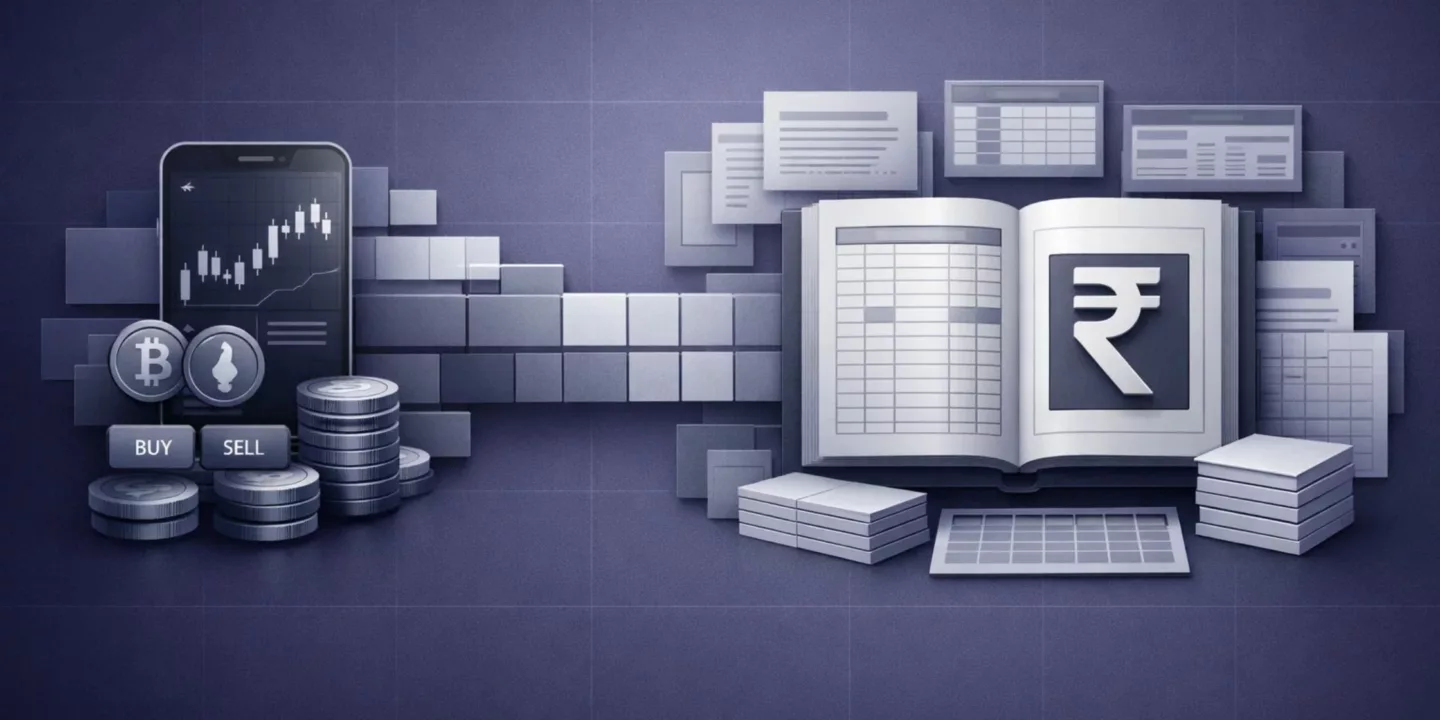

INR settlement is becoming one of the most important shifts in crypto futures trading for Indian traders. Instead of settling contracts in USDT or BTC, exchanges now allow futures contracts where profits, losses, and margin balances are handled directly in Indian Rupees.
This makes reporting much simpler, but it also changes how traders should track P&L, margin, liquidation, and even tax records.

Before using INR-margin futures, it is important to understand the key reporting impacts that come with INR settlement.
| Reporting Area | Crypto-Settled Futures | INR-Settled Futures |
| Settlement Currency | BTC / USDT | Indian Rupees (INR) |
| Profit & Loss Display | Shown in crypto terms | Shown directly in INR |
| Daily P&L Updates | Depends on conversion | Clear mark-to-market in INR |
| Portfolio Valuation | Requires INR conversion | Single-currency clarity |
| Tax Reporting Complexity | Higher | Lower |
| Liquidation Loss Recording | Crypto deduction | INR wallet deduction |
| Funding & Fees Tracking | Often ignored | Easier in INR terms |
| Margin Accounting | Crypto volatility exposure | INR-based clarity |
| Best For | Global crypto-native traders | Indian retail traders |
This table gives an instant snapshot of why INR settlement improves reporting clarity for Indian traders.
INR settlement means futures contracts are settled in Indian Rupees instead of crypto assets like USDT or BTC. Even though the underlying asset might be Bitcoin or Ethereum, the final profit or loss is credited in INR.
The settlement currency decides what you actually receive in your wallet, while the underlying asset decides what price movement your contract tracks.
In INR-margin contracts, traders post margin in rupees instead of crypto. Your trading capital stays INR-based, and your P&L is adjusted in INR after every trade.
This is attractive for Indian retail traders because it avoids constant conversion between crypto and fiat for reporting.
The biggest difference is that crypto-settled futures expose traders to crypto-denominated balances, while INR settlement keeps reporting and balances rupee-based.
Crypto settlement affects wallet exposure because your collateral itself fluctuates with crypto prices, while INR settlement keeps margin stable in fiat terms. This also changes the balance sheet treatment for accounting purposes.
With INR settlement, realized profit is recorded when you close a trade, and unrealized profit is shown while the position is still open.
The key difference is that both are displayed directly in INR terms, which makes performance tracking easier for Indian traders.
Most INR-margin futures exchanges use daily mark-to-market settlement. This means P&L is recalculated daily based on market price.
Even if you do not close your trade, your INR equity changes every day, which impacts reporting and margin availability.
Suppose you enter a BTC futures trade at ₹50,00,000 and exit at ₹52,00,000 with 10x leverage.
Your actual exposure is much larger than your margin, so even a 4% move creates amplified INR profit. The final credited P&L will appear directly as INR gain in your futures wallet.
One of the biggest benefits is that portfolio valuation becomes straightforward. Traders do not need to convert crypto profits into rupees for reporting.
Everything is tracked in one currency, which improves clarity for long-term performance measurement.
Margin allocation works like blocked capital. When you open a trade, INR margin is reserved. After closure, the unused margin is released back into your available balance.
This cash flow movement becomes easier to track compared to crypto-denominated collateral shifts.
Unrealized gains increase your equity, which increases available margin. However, traders often confuse equity growth with withdrawable profit.
Dashboards separate “used margin” from “available margin,” which is important for accurate reporting.
Since profits are settled in INR, realized gains are already recorded in rupee terms. This reduces complexity compared to crypto-to-crypto settlements.
It becomes easier to report taxable income because settlement happens in fiat currency.
Annual compliance depends heavily on accurate statements. Traders should regularly download trade history, funding fee reports, and liquidation records.
Exchange dashboards alone are not enough for full reconciliation.
Daily settlement changes margin balances constantly. Profitable trades increase equity, while losing trades reduce margin immediately.
This is why leverage must be monitored carefully under INR settlement.
Equity acts as the real-time health indicator of your futures account. Under INR settlement, equity swings are easier to interpret because they are shown directly in rupees.
This improves risk monitoring for Indian traders.
Liquidation appears as a forced closure. The reported loss is final and recorded in INR terms.
Traders must treat liquidation as a realized loss event, not just a temporary drawdown.
When trading INR-settled futures, margin mode does not just affect liquidation risk — it also affects how your profits, losses, and overall equity are reported. Because all settlements are reflected directly in rupees, reporting differences become clearer and more psychologically impactful.
Understanding how cross and isolated margin differ from a reporting perspective helps traders maintain better risk visibility and cleaner performance tracking.
In cross margin mode, all open positions draw from a shared collateral pool. This means your entire available balance supports every trade simultaneously. If one position begins to incur losses, it reduces the total equity backing other trades.
Under INR settlement, this effect is immediately visible in rupee terms. A single losing trade can shrink your overall wallet balance, affecting margin availability across your portfolio.
Cross margin creates portfolio-level profit and loss swings rather than isolated trade-level outcomes. Gains in one position can offset losses in another, but losses can also compound across multiple trades.
This makes performance tracking more complex. Instead of evaluating individual trade efficiency, traders must monitor total equity fluctuation. For beginners, this can blur accountability and make it harder to identify which trade caused the drawdown.
Isolated margin separates collateral for each position. Each trade has its own defined margin allocation, and losses are capped to that specific amount.
With INR-denominated reporting, this creates cleaner accounting. Traders can clearly see how much each position gained or lost without affecting the entire portfolio’s equity structure.
Isolated margin prevents spillover risk from one trade to another. If a position performs poorly, only the margin assigned to that trade is impacted.
From a reporting standpoint, this improves transparency and discipline. It allows traders to evaluate strategy performance more accurately and maintain clearer risk boundaries within their INR-settled futures account.
| Feature | Cross Margin | Isolated Margin |
| Collateral Sharing | Shared across all trades | Separate per position |
| Reporting Style | Portfolio-level P&L swings | Trade-level clarity |
| Risk Exposure | Higher systemic risk | Risk limited to one trade |
| Best For | Advanced traders managing multiple positions | Beginners needing cleaner accounting |
Cross margin impacts reporting because one losing trade affects total equity, while isolated margin keeps accounting cleaner per position.
Many traders see large notional exposure and assume profits will match. In reality, only margin-based returns matter.
Understanding this avoids major reporting misinterpretation.
Daily settlement means P&L changes every day. Traders who ignore this often get confused during monthly reconciliation.
Tracking daily equity movement is essential.
Available margin is not profit. It includes unrealized gains and released collateral.
Only realized P&L should be treated as withdrawable profit.
Funding fees reduce net returns silently. Many traders report gross profits without accounting for these costs.
Accurate reporting must always include funding and trading fees.
Most retail traders stop at basic profit and loss tracking. But futures trading becomes much more manageable when you understand deeper reporting concepts like effective leverage, drawdowns, and compounding.
With INR settlement, these advanced metrics become easier to interpret because everything is reflected directly in rupee terms, not crypto conversions.
This is where serious traders gain an edge; not by trading more, but by tracking smarter.
Many traders assume leverage is only the number they select, like 10x or 20x. But in reality, your effective leverage depends on your total equity compared to the size of your open position.
For example, if you use 10x leverage but your account balance drops, your effective leverage automatically increases, making liquidation risk higher. INR settlement makes this easier because you can directly see how much INR equity is supporting your position.
Tracking effective leverage helps traders avoid overexposure without realizing it.
Most traders track drawdowns only in percentage terms, but INR-based drawdowns are often more psychologically real.
A 15% drawdown may sound manageable in percentage terms, but the real impact becomes clearer when translated into absolute numbers. For example, if your trading capital is ₹2,00,000, a 15% drawdown equals a ₹30,000 loss. To recover from that loss, you now need approximately a 17.6% gain just to break even not 15%.
If your capital were ₹5,00,000, the same 15% drawdown would mean a ₹75,000 reduction in equity. At ₹10,00,000, it becomes ₹1,50,000. Seeing these figures in rupees makes the psychological impact much more real and reinforces why position sizing and risk limits matter.
INR-settled futures make this especially visible because your P&L is directly reflected in rupees rather than fluctuating token balances. Your equity curve is already rupee-denominated, so losses are immediately felt in tangible monetary terms — strengthening accountability and discipline.
| Drawdown | Capital After Loss (On ₹2,00,000) | Required Gain to Break Even |
| 10% | ₹1,80,000 | 11.1% |
| 15% | ₹1,70,000 | 17.6% |
| 20% | ₹1,60,000 | 25% |
| 30% | ₹1,40,000 | 42.9% |
| 50% | ₹1,00,000 | 100% |
Interpretation:
Losses compound faster than gains recover. A 50% drawdown requires a 100% return to break even, which is why preventing deep losses is far more important than chasing high returns.
Raw profit alone is not enough to evaluate futures trading performance. Traders should also understand metrics like ROI and ROE.
ROI measures return on the margin you invested, while ROE measures return on your total account equity. Both matter because leverage can inflate ROI even when overall equity growth is weak.
More importantly, risk-adjusted performance consistent returns with lower volatility is far more sustainable than occasional big wins.
Compounding is one of the most powerful forces in trading, but it works both ways. Small daily gains can grow steadily over time, especially when profits remain in your INR equity balance.
However, losses also compound downside quickly. A large drawdown requires an even larger recovery gain, which is why risk control is critical.
INR settlement makes compounding easier to visualize through rupee-based equity curves, helping traders stay grounded in real capital growth.
| Concept | What It Means in Futures | Why INR Settlement Helps |
| Effective leverage | Real leverage based on equity vs position size | Easier INR equity-based calculation |
| Drawdowns | Peak-to-bottom loss in account value | Rupee drawdowns feel more real than % |
| ROI vs ROE | Margin returns vs full equity returns | Clearer reporting without conversions |
| Compounding | Gains and losses stacking over time | INR equity curves show compounding clearly |
Clean recordkeeping is one of the most underrated but essential skills in INR-margin futures trading. Most traders spend all their energy focusing on entries, exits, and leverage, but very few track what happens after the trade is over.
In reality, long-term success depends on understanding exactly where your money is going, including profits, losses, fees, funding charges, and liquidation events. Without proper records, traders often believe they are profitable when their net returns tell a different story.
Since INR settlement keeps everything rupee-based, tracking becomes easier. But it still requires discipline, because futures trading involves many small adjustments that add up over time.
A monthly profit-and-loss reconciliation means reviewing all your closed trades at the end of every month and matching them with your actual INR wallet balance changes.
This is important because dashboard P&L is often shown before deducting hidden costs like funding payments, trading fees, and slippage. Many traders assume they made ₹20,000 in profit, but after reconciliation, the real net gain might be much lower.
Doing this monthly prevents long-term confusion and helps you stay realistic about your trading performance instead of relying only on exchange summaries.
Gross profit is never the full story in futures trading. Exchanges charge maker-taker fees, perpetual contracts include funding payments, and trades often face slippage during fast market moves.
For example, even if your trade shows a ₹5,000 profit, your net profit might become ₹4,200 after fees and funding charges. Over dozens of trades, these costs can significantly reduce returns.
That is why professional traders always track fees and funding separately, so they can understand whether their strategy is truly working or just breaking even after costs.
One of the best habits for clean reporting is keeping your trading capital separate from your personal savings. When deposits, withdrawals, and daily expenses mix with trading funds, it becomes impossible to measure real performance.
A dedicated futures wallet ensures that any increase or decrease in capital reflects actual trading results, not additional money added from outside.
Professional traders treat trading like a business account, separate capital leads to better discipline, cleaner reporting, and stronger emotional control.
| Habit | Why It Matters | Outcome for Traders |
| Monthly reconciliation | Confirms real net profit after all costs | Prevents false confidence |
| Tracking fees & funding | Shows true profitability of strategy | Better performance evaluation |
| Separate trading wallet | Keeps trading results measurable | Stronger discipline and clarity |
Even though exchanges provide dashboards, serious traders maintain their own tracking system. A simple spreadsheet can help you record trade entry, exit, leverage, fees, funding, and final INR profit.
This becomes extremely useful during tax reporting season or when reviewing long-term performance. It also helps you identify patterns, such as whether most of your losses come from overleveraging or from trading during high volatility.
Portfolio tools can automate this process, but even basic manual tracking builds stronger awareness and improves decision-making over time.
Intraday traders benefit because daily INR settlement provides immediate clarity on profits and margin usage.
This improves fast decision-making.
HFT-style traders need constant reporting accuracy. INR settlement reduces conversion noise and simplifies reconciliation.
For traders prioritizing compliance, INR settlement makes tax reporting easier because gains are already rupee-denominated.
Beginners often struggle with crypto-denominated reporting. INR settlement offers a cleaner learning curve with straightforward INR dashboards.
INR settlement is more than just a convenience feature it fundamentally changes how futures traders report profits, losses, margin, and tax outcomes.
For Indian traders, INR-margin contracts provide clearer accounting, easier reconciliation, and simpler compliance. However, traders must still track liquidation events, funding costs, and effective leverage carefully.
To learn more about safer futures trading and smarter reporting, explore our educational resources on Mudrex Learn and the Mudrex YouTube channel, and trade responsibly with structured risk management.
Yes, because profits are already recorded in INR, reducing conversion complexity.
Exchanges mark positions to market daily and update INR equity accordingly.
No, the underlying asset still moves, but settlement happens in INR.
Liquidation appears as a forced closure with realized INR loss in trade history.