
Every price you see is the result of buyers and sellers constantly placing/cancelling orders, reacting to news, managing risk, and taking positions across spot and futures markets.
This process is called price discovery.
In simple terms, price discovery in crypto futures is the process through which the futures market helps determine what traders believe a cryptocurrency should be worth now and in the near future.
It matters because crypto futures are often highly liquid, fast-moving, and heavily used by professional traders. That means futures markets can sometimes react faster than spot markets, especially during volatility.
Here’s a clear look.
Price discovery in crypto futures means finding the fair market price of a crypto asset through futures trading activity. In a futures market, traders do not always buy or sell the actual coin. Instead, they trade contracts linked to the price of that coin.
For example, in Bitcoin futures, traders are not necessarily buying Bitcoin directly. They are taking a position on where Bitcoin’s price may go.
The price is influenced by:
When thousands of traders place long and short positions, the futures market starts reflecting what the market expects from the asset.
Price discovery works through constant interaction between buyers and sellers. Here’s the simple version.
A trader who expects Bitcoin to rise may open a long futures position.
A trader who expects Bitcoin to fall may open a short futures position.
The exchange matches these orders through an order book. When a buyer and seller agree on a price, a trade happens. Each trade adds fresh information to the market.
Over time, these trades create a live market price. But futures price discovery is not just about the last traded price.
Crypto futures markets can sometimes move before spot markets. This happens because futures are built for active trading. Traders can use leverage, short the market, hedge positions, and react quickly to market changes.
That makes futures useful for:
Because of this, large traders, market makers, and institutions often use futures markets to take positions before the same move becomes obvious in spot prices.
So, which market leads price discovery? Spot or futures? The answer depends on liquidity and market conditions.
When futures volume and open interest are high, futures can lead. When spot markets are more liquid or driven by actual buying demand, spot can lead.
Crypto futures affect spot prices mainly through expectations and arbitrage.
Let’s say Bitcoin futures start trading much higher than the spot price. This may mean that traders expect Bitcoin to rise. Spot buyers may enter the market, pushing the spot price upward.
Now take the opposite case. If futures prices fall sharply, it may mean bearish sentiment. Spot sellers may react, causing the spot market to drop too.
But the biggest link between spot and futures is arbitrage. Arbitrage traders look for price gaps between the two markets.
For example:
If the gap is large enough, traders may buy spot Bitcoin and sell Bitcoin futures to capture the difference.
This activity helps bring both prices closer together.
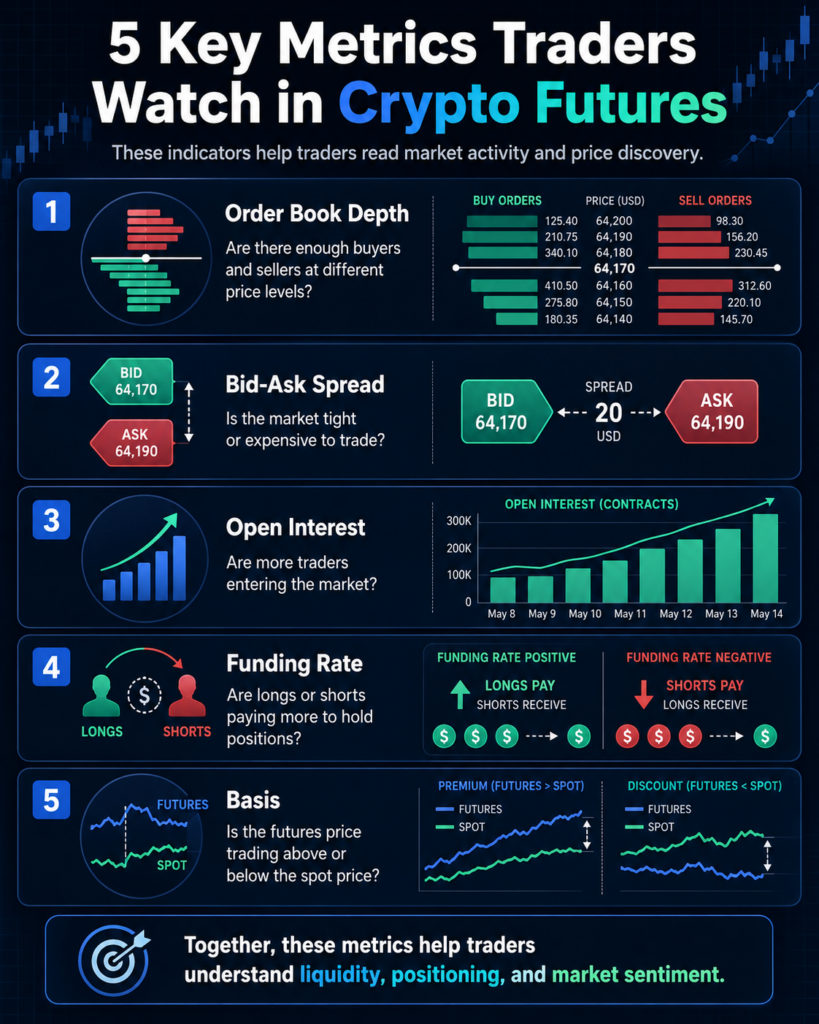
To understand price discovery properly, you need to know the main metrics traders watch.
Open interest shows the total number of active futures contracts that have not been settled or closed. Rising open interest means more money is entering the market.
The funding rate is a periodic payment between long and short traders in perpetual futures.
A very high positive funding rate may show that the market is crowded with long positions. A very negative funding rate may show that many traders are short. Funding rates help traders understand whether sentiment is stretched.
Basis is the difference between the futures price and the spot price.
If futures trade above spot, the market may be pricing in optimism or demand for leverage.
If futures trade below spot, the market may be pricing in caution or bearish expectations.
Basis helps explain whether futures are trading at a premium or discount.
Trading volume shows how much activity is happening.
High volume means more participation and usually stronger price signals.
Low volume means price moves may be easier to manipulate or reverse.
The bid-ask spread is the difference between the highest price buyers are willing to pay and the lowest price sellers are willing to accept.
A tight spread usually means better liquidity.
A wide spread may mean trading is expensive or the market is thin.
Order book depth shows how many buy and sell orders exist at different price levels.
A deep order book can absorb large trades better.
A shallow order book may see sharper price swings.
The order book is where price discovery becomes visible. It shows pending buy and sell orders.
When aggressive buyers keep accepting higher ask prices, the market moves up. When aggressive sellers keep hitting lower bid prices, the market moves down.
This is why traders watch order books closely. A strong order book can show where demand and supply are sitting. For example:
But order books are not perfect. Orders can be cancelled. Large traders may place and remove orders quickly. So the order book should be used with other indicators like volume, open interest, and funding rate.
Perpetual futures are one of the most popular futures products in crypto. Unlike traditional futures, they do not have an expiry date. This makes them active almost all the time. But because there is no expiry, perpetual futures need a mechanism to stay close to the spot price.
That mechanism is the funding rate.
When perpetual futures trade above spot, funding usually turns positive. This makes long positions more expensive and encourages shorts. When perpetual futures trade below spot, funding may turn negative. This makes short positions more expensive and encourages longs. This helps pull perpetual futures prices closer to spot prices.
So in perpetual futures, price discovery depends heavily on:
Spot and futures markets both contribute to price discovery, but in different ways.
Spot markets are important because they show real asset demand. Futures markets are important because they show where active traders expect price to move. In a calm market, both may move closely together. In a volatile market, futures may move faster because traders can take leveraged long or short positions quickly.
This is why serious traders usually watch both markets. Only looking at spot price can hide what is happening in futures. Only looking at futures can ignore actual asset demand.
The best picture comes from studying both.
Futures markets can sometimes lead spot markets because they allow faster positioning, leverage, shorting, and hedging. But spot markets still matter because they reflect actual buying and selling of the asset.
The smartest approach is to watch both.
Before investing or trading, always understand the product, fees, risks, and your own risk appetite. To learn more about US stocks, crypto, trading strategies, and market trends, explore more guides on Mudrex Learn and watch beginner-friendly explainers on the Mudrex YouTube channel.
Price discovery in crypto is the process through which the market finds the fair price of a cryptocurrency. It happens when buyers and sellers trade based on demand, supply, news, sentiment, liquidity, and market expectations.
Bitcoin’s price is determined by buying and selling across spot and futures markets. Demand, supply, liquidity, trading volume, order books, macro news, investor sentiment, and futures positioning all influence Bitcoin’s price.
Yes, futures markets can influence spot prices. When futures prices move, spot traders may react. Arbitrage traders also help reduce gaps between futures and spot prices by buying one market and selling the other.