
Spot vs futures trading in crypto comes down to one question: do you want to own the asset, or just bet on its price? Spot trading means buying and holding the actual cryptocurrency; you own it outright, and profit only if the price rises.
Futures trading means entering a contract that tracks the asset’s price, without owning it, which lets you use leverage and profit whether the price rises or falls. This guide covers the real differences between the two, their advantages and disadvantages, how they compare across major platforms, and whether it makes sense to trade both at once.
The core difference between spot trading and futures comes down to ownership and settlement. Spot trading settles immediately; you pay, you own the coin, done. Futures trading settles against a contract price, with no coin changing hands at all.
In spot trading, you buy a cryptocurrency at today’s market price and hold it in your wallet or exchange account. Gains depend entirely on price appreciation, and there’s no leverage, no expiry, and no liquidation risk. It’s the more straightforward of the two, which is why most beginners start here.
Futures trading uses a contract to speculate on price without owning the underlying coin. Most crypto exchanges today offer perpetual futures (contracts with no expiry date, often just called “perps”) rather than traditional futures that settle on a fixed date.
The CFTC’s own explainer on futures market basics covers how this contract structure works in traditional markets, and the same core idea carries over to crypto perpetuals.
Perpetual futures use a funding rate mechanism to keep the contract price anchored to the spot price, since there’s no expiry date to force convergence.
READ MORE: Perpetual Futures vs Delivery Futures: Key Differences
Spot trading’s advantages are simplicity and safety: you can’t lose more than you put in, there’s no margin call, and no funding cost eating into a long-term hold. Its disadvantage is that gains are capped by direct price movement; no leverage means no multiplier if you’re right, and no way to profit if the price drops.
Futures trading’s advantages are leverage and the ability to short. You can control a larger position with less capital, and you can profit in a falling market by going short. The disadvantages are real: liquidation risk if the market moves against a leveraged position, ongoing funding costs, and a mechanism complex enough that mistakes are common for beginners.
A quick worked example: put ₹10,000 into spot BTC and the price rises 10%, you gain ₹1,000. Put the same ₹10,000 into a 5x leveraged futures position, and the same 10% move gains roughly ₹5,000; but a 10% move against you at that leverage can wipe out the position entirely.
| Factor | Spot Trading | Futures Trading |
|---|---|---|
| Ownership | You own the asset | No ownership, just a contract |
| Leverage | None | Available, often high |
| Profit if price falls | No (long only) | Yes, via short positions |
| Liquidation risk | None | Yes, with leverage |
| Ongoing costs | One-time trading fee | Funding rate + fees |
| Complexity | Low | Higher |
Futures vs spot trading differences, risks, and advantages all shift slightly depending on where you trade. Some platforms specialise in spot only; others, including Binance, Bybit, and Mudrex, offer both spot and futures from the same account.
DeFi protocols like dYdX and GMX offer perpetual futures on-chain, using the same funding-rate mechanics as centralized exchanges, just without a custodian holding your funds.
What differs across platforms is leverage caps, margin requirements, available trading pairs, and fee structures; all of which change over time and by jurisdiction, so it’s worth checking current terms rather than assuming they match a competitor.
On Mudrex, spot and futures both are on the same app; that’s part of why combining the two is straightforward in practice.
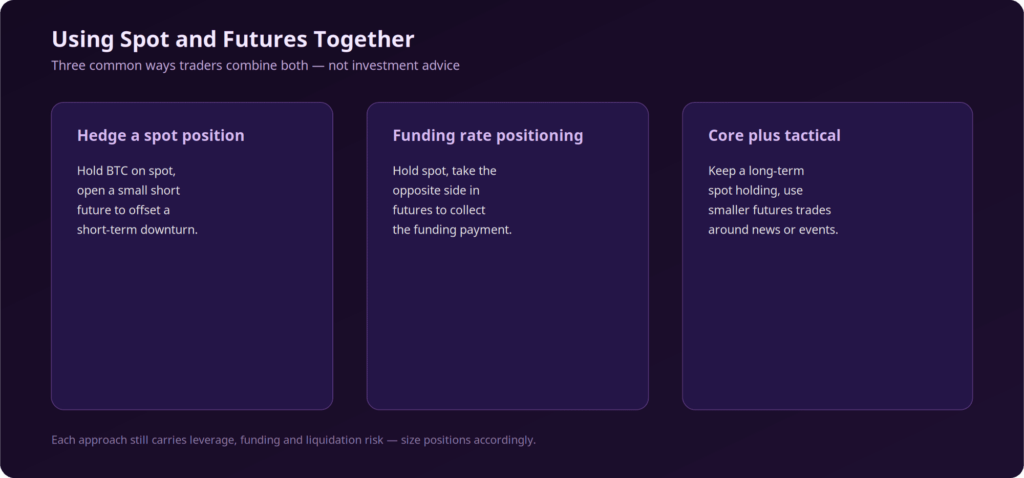
Yes, and it’s a common approach rather than an edge case. If you’re looking for a strategy to trade spot and futures simultaneously for profit, here are three that traders actually use:
None of this eliminates risk; a hedge still carries funding costs, and a futures leg still carries liquidation risk if it’s not sized correctly. “How to make money trading spot and futures at the same time” doesn’t have a formula; it depends on position sizing and how closely you manage both legs.
Spot trading is profitable when the asset you hold appreciates; profit is a direct function of price movement, nothing more exotic than that. It is generally safer than futures in the sense that matters most to most people: there’s no leverage, so there’s no way to lose more than you invested.
No liquidation event can force you out of a position at the worst possible time, either. That safety comes with a trade-off: spot trading can’t profit from a falling market, and it can’t amplify a move the way leveraged futures can. “Safer” here means lower variance, not necessarily a higher expected return.
In a rising market, spot trading lets you participate in the trend with a straightforward buy-and-hold approach, minimal fees, and no liquidation risk to manage. It suits beginners and anyone prioritising capital preservation over maximum upside.
Futures trading, with leverage, can amplify gains during the same bull run, and can also be used to hedge a spot portfolio if you expect a temporary pullback within the broader trend. It suits traders comfortable with margin management and the very real possibility of losses that exceed a simple price decline.
What is the difference between spot and futures trading?
Spot trading means buying and owning the asset directly, with settlement immediately. Futures trading means holding a contract that tracks the asset’s price, without owning it, typically with leverage available.
Which is better, spot or futures?
Neither is universally better. Spot suits long-term holders who want simplicity and no liquidation risk. Futures suits traders who want leverage, the ability to short, or a hedging tool, and who are comfortable managing margin.
Is spot trading profitable?
It can be, and profit depends entirely on the asset’s price rising after you buy. There’s no leverage to amplify gains, so returns track the underlying price move directly.
Can you trade spot and futures at the same time?
Yes. Common approaches include hedging a spot position with a small futures short, or holding spot long-term while using futures for shorter tactical trades.
Is spot safer than futures?
Generally yes, in that spot trading has no leverage and no liquidation risk. Futures trading carries the added risk of losing more than your initial margin if a leveraged position moves against you.
What is perp vs spot?
“Perp” refers to perpetual futures contracts, which track an asset’s spot price via a funding rate mechanism but never expire. Spot is the direct purchase of the asset itself; perps are a derivative that mimics its price.
Ready to try both? Buy Bitcoin on spot or trade BTC futures on Mudrex.
For the mechanics behind every futures position, start with what longing and shorting means in crypto, then read up on futures contracts vs perpetual futures contracts and crypto futures risk management strategies before sizing a leveraged position.