
Your portfolio just dropped 12% overnight and you did not sell a single coin. That is the entire point of hedging with crypto futures: you get to protect your holdings without giving them up. But hedging is not free, and used at the wrong time it can drain money from a portfolio that would have been fine on its own.
Most traders learn this the hard way. They open a short futures position the moment fear kicks in, pay funding fees for weeks, and watch the market grind upward the whole time. The goal of this guide is to help you avoid that.

Hedging with crypto futures means opening a position in the futures market that moves opposite to your existing holdings, so a loss in one is offset by a gain in the other. If you hold Bitcoin and open a short Bitcoin futures position of a similar size, a price drop that hurts your spot holding helps your futures position by roughly the same amount.
Definition: Hedging
Taking an offsetting position designed to reduce, not eliminate, the risk of loss on an asset you already hold.
This is different from simply selling your crypto. Selling removes your exposure completely and may trigger tax events or slippage. A hedge keeps your original holding intact while temporarily reducing your net exposure to price swings. It is also different from speculation: a hedger is not trying to profit from the futures trade itself, only to protect the value of what they already own.
The chart below shows what this protection actually looks like. An unhedged spot position moves in a straight line with the market. A hedged position flattens out, giving up some upside in exchange for a floor on the downside.
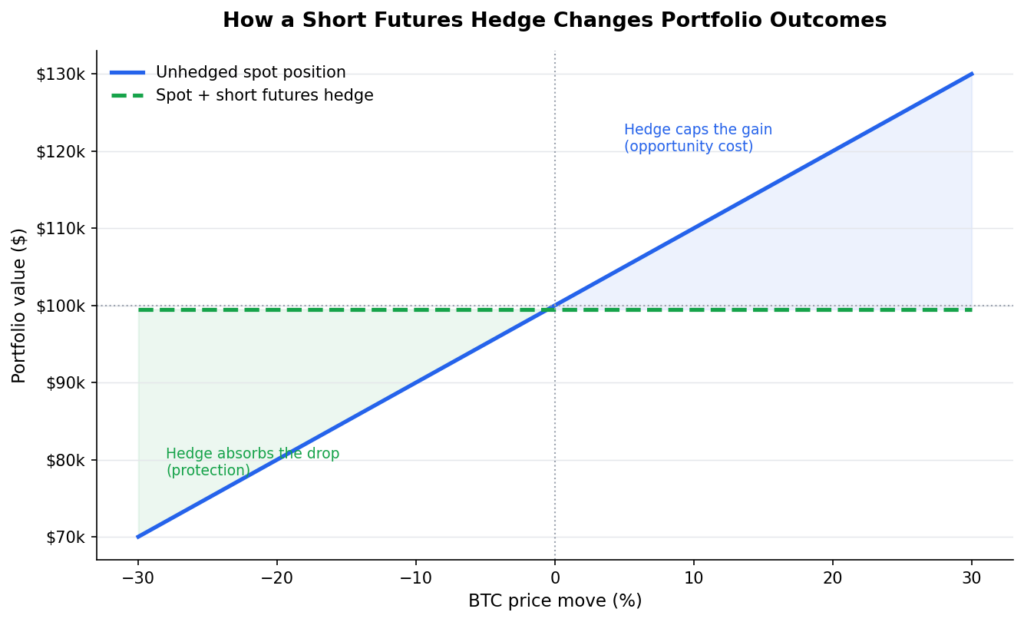
The unhedged line rises and falls directly with the market. The hedged line stays close to flat in both directions, since gains and losses on the futures position offset the spot holding. The small gap below $100k on the hedged line represents the funding and fee cost of running the hedge.
| Term | What It Means |
|---|---|
| Hedge Ratio | The share of your spot position covered by the futures hedge. A 1:1 ratio means the notional value of the short matches your spot holding. |
| Funding Rate | A recurring payment between long and short traders in perpetual futures, usually every 8 hours, that keeps the contract price close to spot. |
| Basis | The gap between the futures price and the spot price. A shrinking basis at expiry is normal for dated futures contracts. |
| Open Interest | The total number of futures contracts still open. Rising open interest alongside price can signal how crowded a move is. |
| Portfolio Beta | How much your portfolio tends to move relative to a benchmark like Bitcoin. Higher beta means more exposure to swing that a hedge might need to cover. |
| Correlation | How closely two assets move together. Low correlation between your holding and your hedge instrument increases basis risk. |
| Liquidation Price | The price at which your futures position is forcibly closed because your margin can no longer cover losses. |
| Margin Ratio | Your account equity divided by the margin required to keep a position open. A falling ratio signals rising liquidation risk. |
| Risk-Reward Ratio | The potential loss on a position compared to its potential gain, used to judge whether a trade (or a hedge) is worth taking. |
Yes, if the position is large enough that the fees would not outweigh the protection. Events like a central bank rate decision, a major token unlock, or a regulatory announcement create short, sharp windows of risk. A short futures position sized to your holding can absorb a chunk of the resulting drop.
The size of your position matters here. Hedging has fixed costs: entry and exit fees, plus the funding rate on perpetual contracts every 8 hours. For a small holding, those costs can eat up more value than the hedge protects.
Yes, if selling and rebuying would cost you more in taxes or slippage than the hedge itself. A futures hedge lets you keep your original spot position, and your original cost basis, while temporarily reducing your net market exposure. Once the turbulent period passes, you close the short and your holding continues exactly as it was.
Yes, if you have a specific exit price in mind that the market has not reached yet. Opening a short futures position on part of your holding creates a rough equivalent of locking in today’s price. If the market drops before you reach your target, the futures gain offsets the spot loss.
Usually not. A short hedge on a perpetual contract costs money every funding interval when the rate is positive, and it loses value as the market rises. That is a double drag: funding payments plus mark-to-market losses on the hedge itself. Without a clear downside catalyst, the cost of the hedge tends to outweigh the protection.
Often, yes. Hedging adds margin requirements, monitoring, and liquidation risk on the futures side. For a small holding, this overhead is disproportionate to the risk being managed. Accepting the raw volatility of a small spot position is frequently simpler and cheaper than hedging it.
The cost compounds and the reason for the hedge fades. A hedge built for a two-week risk window becomes expensive if left open for two months, since funding costs accumulate the entire time. Reviewing your hedge on a schedule, rather than leaving it open indefinitely, keeps the cost proportional to the risk.
| Condition | Hedge Likely Worth It | Hedge Likely Costly |
|---|---|---|
| Position size | Large relative to your portfolio | Small, loss is manageable |
| Time horizon | Short, tied to a specific event | Open-ended or multi-month |
| Market environment | High volatility expected | Calm or slowly trending up |
| Funding rate | Low or negative | Persistently high and positive |
| Cost of selling spot | High (taxes, slippage, long-held position) | Low, easy to re-enter |
If a request stopped at the first sentence of each section above, they would already have the correct answer. Use this table as the fast, at-a-glance version of that same decision.
The most common sizing mistake is over-hedging: opening a futures short larger than the spot position it is meant to protect. This turns a defensive trade into a net short bet. If the market rises instead of falling, losses on the oversized short can exceed the gains on your spot holding.
A simple starting point is to match the notional value of your futures position to the portion of your spot holding you want to protect. This is your hedge ratio. A 1:1 ratio covers the full position. Many traders use a partial hedge of 50% to 70% when they want to reduce risk without giving up all upside.
If you are hedging one asset with futures on a different, but correlated, asset (a cross hedge), check the correlation between the two first. Low correlation increases basis risk, meaning your hedge may not move in step with the position it is supposed to protect.
Leverage should stay low on a hedge. Higher leverage brings your liquidation price closer to the current market price, which means a sharp move in either direction could force-close your hedge before it has done its job, leaving your original spot position unprotected exactly when you need it most.
Here is a worked example using a moderate position and a short holding period.
Suppose you hold $12,000 worth of Bitcoin and want to hedge it for 3 days around a scheduled event, at a funding rate of 0.03% every 8 hours.
| Cost Item | Amount |
|---|---|
| Entry + exit taker fees | ~$14 |
| Funding over 3 days (9 intervals @ 0.03%) | ~$32 |
| Total hedge cost | ~$46 |
| As % of position | ~0.38% |
That 0.38% is the price of protection against a potentially much larger drawdown. Whether it is worth paying depends on how likely and how severe you judge the downside risk to be. Note that during bearish conditions, the funding rate often turns negative, meaning short holders receive funding instead of paying it, which can lower the hedge’s real cost during the period it matters most.
Close a hedge when the event has passed, your outlook changes, or the ongoing cost starts to outweigh the protection it provides. When you do close it, the type of exit order matters more than most traders realize.
A stop-market order will always trigger and close your position, but it can fill at a worse price than intended during fast moves (slippage). A stop-limit order only fills within your specified price range, which means it can fail to fill entirely if the market gaps past your limit, leaving your hedge open when you most needed it closed. For a hedge you plan to unwind quickly, a stop-market order is usually the safer choice precisely because it guarantees execution.
If you are unsure whether the risk event is fully behind you, a partial close, unwinding half the hedge rather than all of it, preserves some protection while reducing cost.