Crypto Futures Paper Trading: A Beginner’s Guide to Practice Before Trading Live
Most new traders don’t lose money in crypto futures because they picked the wrong coin. They lose it because they never practiced leverage, stop-losses, or order types before real money was on the line. One rushed click on a 20x position can wipe out your margin in minutes.
Crypto futures paper trading fixes this. It lets you open long and short positions, set leverage, and place stop-loss and take-profit orders using virtual money instead of real funds. You get the same price feed and the same liquidation math, minus the financial risk.
This guide covers what crypto futures paper trading is, how to start in seven steps, what a good simulator needs, and where practice accounts fall short.
TL;DR
Crypto futures paper trading is virtual trading with fake money that mirrors the leverage, margin, and order types of real futures markets. To start, pick a simulator with live prices, load your virtual funds, choose low leverage (2x to 5x), set a stop-loss on every trade, and track results in a trading journal for several weeks. It builds mechanics and habits, but not real fear or greed, so treat it as training, not proof that you’re ready to trade live.
What’s the Difference Between Paper Trading, Demo Trading, and a Live Account?
Paper trading and demo trading are the same thing: practicing with virtual money instead of your own. Both terms get used interchangeably for crypto futures demo trading, so a “demo account” and a “paper trading account” refer to the same risk-free setup.
A live account is different because real money moves in and out with every trade. In a live account, a bad trade lowers your actual balance and can trigger a real margin call. In a paper account, a bad trade only lowers a number on a screen; you can reset it and try again.
Feature
Paper / Demo Trading
Live Trading
Funds at risk
None (virtual)
Real money
Order types available
Same as live (market, limit, stop)
Market, limit, stop
Price data
Real-time market prices
Real-time market prices
Emotional pressure
Low
High
Slippage and fees
Often simplified or ignored
Real
Key Terms and Metrics to Know
New traders run into a lot of jargon in their first week. Here’s a quick reference for the terms and metrics used throughout this guide.
Term
What It Means
Paper trading
Practicing trades with virtual money instead of real funds
Borrowed exposure that lets a small margin control a larger position
Margin
The capital you set aside to open and hold a leveraged position
Stop-loss
An order that closes your trade automatically at a set loss level
Take-profit
An order that closes your trade automatically at a set profit level
Order book
The live list of buy and sell orders waiting to be filled
Liquidation
The forced closing of a position when your margin runs out
Position size
The total value of a trade, including borrowed leverage
Risk-reward ratio
How much you stand to gain compared to how much you risk per trade
Win rate
The percentage of trades that close in profit
Expectancy
The average amount you expect to win or lose per trade over time
Drawdown
The drop from a portfolio’s peak value to its lowest point after
Funding rate
A periodic payment between long and short traders in perpetual futures
Open interest
The total number of futures contracts still open in the market
Trading volume
The total value of contracts traded in a given period
ATR (Average True Range)
A gauge of how much an asset’s price typically moves
Trading journal
A log of your trades used to track and improve performance
What Is Crypto Futures Paper Trading?
Crypto futures paper trading is practicing futures contracts with virtual money instead of real funds. You place long or short positions, set leverage, and manage stop-loss orders on a live price feed, but nothing you gain or lose is real.
Definition: Crypto Futures Paper Trading A simulated trading account that mirrors real futures markets, letting you practice trades with virtual money and no financial risk.
It’s different from spot paper trading because crypto futures paper trading adds leverage, margin, and liquidation risk to the practice environment. That matters because leverage is the single biggest reason beginners blow up their first live account.
How Do You Paper Trade Crypto Futures?
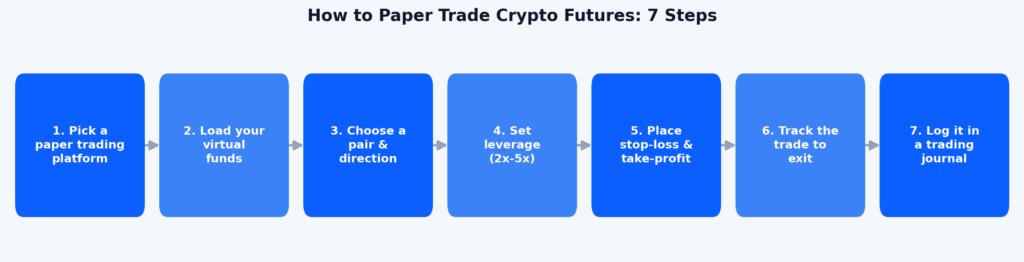
You paper trade crypto futures by loading a simulator with virtual funds, then placing trades exactly as you would on a real account. Here’s the process most beginners follow.
Crypto Futures Paper Trading for Beginners
The same seven steps apply whether you’re using a dedicated simulator or a broker’s demo mode. Skipping steps 5 and 7 is the most common reason paper trading fails to teach real discipline.
Pick a platform that offers a dedicated futures or perpetual futures simulator with live prices, not just a spot demo.
Load virtual funds that match what you’d actually deposit live. Don’t practice with ₹10 lakh if you plan to start with ₹10,000.
Choose your pair, then pick a direction: go long if you expect the price to rise, or short if you expect it to fall.
Set your leverage low, ideally 2x to 5x to start with.
Set stop-loss and take-profit levels before you confirm the trade, not after.
Track the position the way you would live, watching funding rate, margin, and unrealized profit and loss.
Log every trade in a trading journal: entry, exit, size, and what you were thinking.
What Should You Look for in a Crypto Futures Paper Trading Platform?
The best crypto futures paper trading platform gives you real-time prices, the full range of order types, and a way to reset your virtual balance. Anything less and you’re not really practicing futures; you’re practicing guesswork.
Real-time price feeds, not delayed or synthetic data that won’t match live conditions.
Full leverage controls, including isolated and cross margin modes.
Funding rate simulation for perpetual futures, since this cost adds up over time.
Downloadable trade history so you can build a proper trading journal.
A visible path to a live account once you’re consistent, so the skills transfer directly.
Once you’ve built consistency in a simulator, moving to a real crypto trading platform like Mudrex’s INR-margin futures means you can apply the same leverage and stop-loss habits with your own capital, without relearning the interface from scratch.
How Do You Practice Crypto Futures Without Risking Real Money?
You practice crypto futures without risking real money by treating every paper trade like a real one, with the same position sizing and risk limits you’d use live. The discipline matters more than the platform.
Here’s a worked example of how leverage changes your outcome on the same ₹10,000 margin.
Leverage
Position Size
Price Move
P&L
2x
₹20,000
+2%
+₹400
5x
₹50,000
+2%
+₹1,000
10x
₹1,00,000
+2%
+₹2,000
10x
₹1,00,000
-2%
-₹2,000
Higher leverage means less room for the market to move against you before you’re liquidated, which is why beginners are told to start low.
Does Crypto Futures Paper Trading Prepare You for Live Trading?
Crypto futures paper trading prepares you for the mechanics of live trading, but not for the psychology of it. You’ll learn how leverage, margin, and stop-losses actually behave, which is real preparation.
What it can’t fully replicate is the fear and greed that show up once real money is on the line. Traders often act more cautiously, or more recklessly, once their own funds are at stake. That’s why a strong paper trading win rate doesn’t guarantee the same result live.
A trading journal helps close part of that gap. Track your win rate, your risk-reward ratio per trade, and your expectancy across at least 20 to 30 paper trades before you judge whether a strategy is ready for real capital.
What Mistakes Do Beginners Make When Paper Trading Futures?
Beginners most often paper trade with unrealistic size and skip stop-losses because “it’s not real money.” Many also quit after a handful of trades instead of building a real sample size.
Trading oversized positions that don’t match what you’d actually risk live.
Skipping stop-losses since a loss on paper doesn’t feel urgent.
Overtrading just because there’s no cost to opening another position.
Ignoring funding rates on perpetual futures, which are a real cost live.
Stopping too soon, before enough trades exist to judge a strategy fairly.
Conclusion
Crypto futures paper trading is the fastest, cheapest way to learn how leverage, margin, and liquidation actually work before you risk real money. Use it to build the habits: sizing positions correctly, setting a stop-loss every time, and logging results in a trading journal, not just to chase a winning streak.
When you’re ready to put those habits to work with real capital, the Mudrex app gives you INR-margin futures with built-in risk controls. For more beginner-friendly breakdowns of futures, leverage, and risk management, subscribe to the Mudrex YouTube channel.
FAQs
What is crypto futures paper trading?
It’s practicing crypto futures contracts, like leverage and stop-loss orders, with virtual money instead of real funds.
How do you paper trade crypto futures?
Pick a simulator with live prices, load virtual funds, choose low leverage, set a stop-loss, and log each trade in a journal.
Is paper trading good for beginners?
Yes. It teaches order types, leverage, and margin mechanics without risking any real capital.
Can you practice crypto futures without risking money?
Yes, crypto futures paper trading accounts use virtual funds, so any gains or losses are simulated, not real.
Does crypto futures paper trading prepare you for live trading?
It prepares you for the mechanics, but not fully for the psychology of trading with your own money.
What are the limitations of crypto futures paper trading?
It can’t replicate real slippage, real fees, or the fear and greed that come with genuine financial risk.
Disclaimer: Crypto futures trading involves leverage, which magnifies both gains and losses. The examples in this article are illustrative only and simplified for teaching purposes; they don’t account for fees, funding rates, or maintenance margin in full. This article is not financial advice.
Siri is a writer venturing into the exciting realms of blockchain technology, cryptocurrency, and decentralized finance (DeFi), eager to explore the transformative potential of these innovations. She brings a unique perspective that bridges traditional industries and cutting-edge technology, often infused with a touch of humor through memes. She has a rich background in real estate and interior design, having previously contributed to NoBroker, where she crafted blogs and assets on these topics.