Somewhere on an exchange right now, a bot is quoting a price, cancelling it, and quoting again, all before your screen finishes loading. That is high frequency trading crypto in action: speed doing a job no human hand could do fast enough.
If you’re trying to understand what’s actually happening here, you don’t need jargon, and you don’t need a strategy playbook you can’t use yet. You need the basics: what high frequency trading crypto actually means, and how the mechanics behind it work.
By the end, you will know how a trade moves from an idea in code to a filled order in milliseconds, how HFT differs from regular algorithmic trading, and whether it is something you could ever realistically try yourself.
Key Takeaways
High frequency trading crypto relies on speed and automation to catch price gaps that often exist for a fraction of a second.
High Frequency Trading crypto is a subset of algorithmic trading. Speed and order volume set it apart, not the strategy itself.
A full HFT decision, from reading the market to a fill or cancel, typically takes about 1 to 50 milliseconds.
Four approaches cover most of the space: market making, arbitrage, scalping, and momentum trading.
Institutional-grade HFT is out of reach for almost everyone, though lighter automated strategies are realistic for retail traders.
Thin per-trade margins mean fees and slippage often decide whether a strategy is profitable, not how clever its logic is.
What Makes High Frequency Trading Crypto Different From Algorithmic Trading?
High frequency trading crypto is a subset of algorithmic trading, not a separate category. Every HFT system is algorithmic, but most algorithmic systems are not fast enough to count as HFT.
Definition: Algorithmic Trading A computer program that follows preset rules to decide when to buy or sell, without a person clicking the button each time.
A regular crypto algorithmic trading setup might check prices every few minutes and place a handful of trades a day, holding a position for hours under a trend-following or mean-reversion rule. Our guide on crypto algorithmic trading walks through those slower approaches in full.
High frequency trading crypto squeezes that same idea into milliseconds instead of minutes. The bot reacts directly to the order book, sometimes placing and cancelling the same order several times before a person could blink. A regular algo might place 20 trades a day; a high frequency trading crypto system can place thousands.
It helps to picture it as a spectrum: a person decides and clicks manually, algo trading lets rules decide on slower, human-readable timeframes, and HFT lets rules decide in milliseconds, at very high volume.
How Does High Frequency Trading Crypto Actually Work?
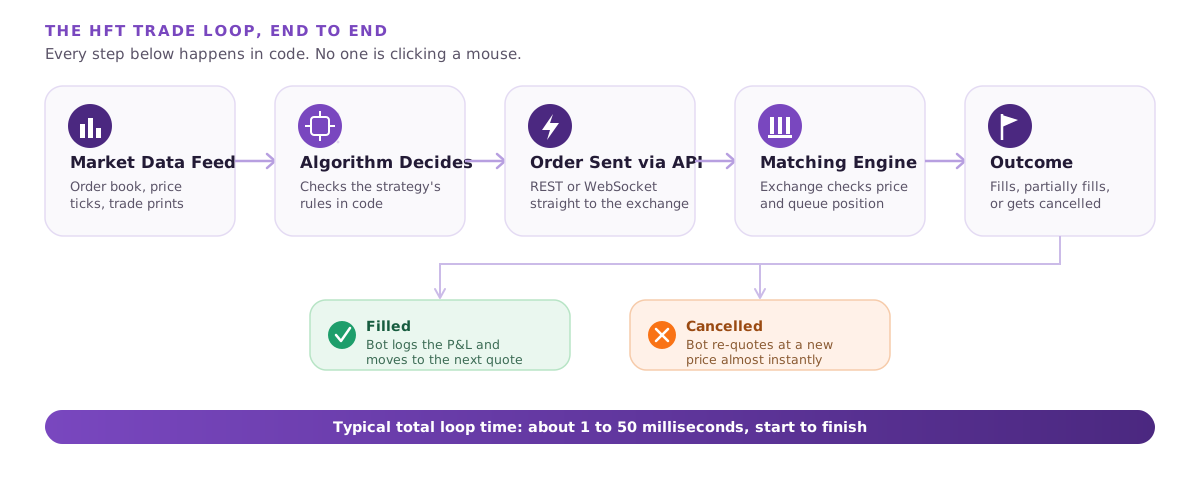
It runs on a tight loop that repeats non-stop: read the market, decide, send the order, get a result. Every step below happens in code, with no human touching a mouse.
High Frequency Trading Crypto: How HFT Works
The whole trip, from reading the market to getting an answer back, usually takes 1 to 50 milliseconds.
How Do Algorithms Decide When to Trade?
Some systems monitor order book imbalance—the difference between available buy and sell depth—to estimate where short-term pressure may be building. Before deployment, backtesting evaluates the rules using historical data, although strong simulated results do not guarantee live performance.
The algorithm is a set of rules written in code. It watches live data, like the order book or price ticks across several exchanges, and checks whether its conditions are met. A simple example: “if Bitcoin is $10 cheaper on Exchange A than Exchange B, buy on A and sell on B.” The instant that is true, the bot acts, without asking a human first.
Some strategies, like statistical arbitrage, trade on historical price relationships between related assets instead of a single price gap. A few systems layer in machine learning to adjust their rules over time. But the core idea stays the same: fixed logic, checked constantly, acted on instantly.
How Are APIs Used in Crypto HFT?
High frequency trading crypto systems skip the regular web app entirely and connect straight to an exchange through an API. This is what lets a bot see price changes and send orders in milliseconds instead of seconds.
Most systems use a WebSocket connection for live data, since it streams updates continuously rather than making the bot ask again and again, and send orders through a REST or dedicated order-entry connection built for speed. A crypto trading API is what makes this direct, bot-to-exchange link possible in the first place, instead of a person tapping through an app.
For a real exchange example, Coinbase’s Exchange documentation lists REST, WebSocket, direct market-data and FIX order-entry connections.
Why Does Latency Matter So Much in HFT?
Ultra-low latency matters because a quote may become obsolete between detection and execution. Stale price quotes can make a profitable-looking opportunity disappear before the order reaches the exchange. Research into latency arbitrage in cryptocurrency markets examines how these speed differences interact with execution and order-book dynamics.
Latency is the delay between deciding to trade and the exchange actually receiving that order. In HFT, this delay is the whole game, because the same price gap is often visible to dozens of other bots at the exact same moment.
Definition: Colocation Renting server space physically inside or next to an exchange’s data center, so orders travel the shortest possible distance.
Serious HFT setups fight latency with colocation, direct network links, and code stripped of anything that slows it down. A bot reacting even a few milliseconds slower than a competitor will consistently lose the trade, even with an equally good idea. This is also where latency arbitrage lives: exploiting the gap between when one exchange updates its price and a slower one catches up.
Do HFT Traders Use Crypto Trading Bots?
Yes. The bot is simply the software running the strategy around the clock. Institutions build custom ones, often in fast languages like C++, while some advanced retail traders lean on off-the-shelf automated crypto trading platforms instead of coding from scratch.
Either way, the bot is only as good as the rules and risk limits it was given.
What Strategies Fall Under Crypto HFT?
Most HFT systems run one of four approaches: market making, arbitrage, scalping, or momentum trading. Each targets a different kind of price inefficiency, and speed is what turns a normally tiny edge into something worth automating.
Market making is a form of liquidity provision in which a system places buy and sell orders on both sides of the order book. The strategy targets spread capture, but inventory losses, adverse price moves and fees can exceed the spread earned.
Arbitrage buys an asset where it is cheaper and sells it where it is pricier, often across two exchanges.
Scalping takes many small, fast profits from tiny price moves, often dozens or hundreds of times a day.
Momentum trading jumps in when volume and price suddenly accelerate, riding the burst for a short window.
Our dedicated guide on high frequency crypto trading strategies covers the mechanics, risk profile, and worked examples of each, including where beginners typically start.
How Is Crypto HFT Different From Traditional HFT?
Crypto HFT runs on a market that never closes and is split across dozens of competing exchanges, while traditional HFT runs on centralized, heavily regulated venues with fixed hours.
Factor
Traditional HFT
Crypto HFT
Market hours
Fixed trading sessions
24/7, never closes
Regulation
Tightly regulated, decades of rules
Still developing, varies by country
Data feeds
Standardized across venues
Different per exchange, API-dependent
Liquidity
Centralized and deep
Split across many exchanges
Entry barrier
Extremely high, institutional-only
High, but more reachable than equities HFT
Fragmented liquidity cuts both ways. It creates more arbitrage gaps to chase, but no single order book tells the whole story, which adds a layer of complexity a stock market HFT desk never has to deal with.
Who Actually Uses High Frequency Trading Crypto?
Institutional desks, market-making firms, and proprietary trading shops run the vast majority of true HFT, since it takes serious capital and infrastructure to do at scale. Some trade spot markets, while others lean on crypto futures trading for leverage and the ability to go short.
Retail traders are mostly locked out of the extreme end of this game. Competing against colocated servers and a dedicated engineering team is not realistic from a laptop and home internet. That said, a lighter version is genuinely accessible: a basic scalping or arbitrage script using public exchange APIs is within reach for a technically-minded individual trader.
Is High Frequency Trading Profitable in Crypto?
It can be, but the profit lives or dies on cost control, not cleverness. Since each trade’s edge is often just cents, fees and slippage decide whether that edge survives contact with the real market.
The table below is a simple, hypothetical example of how a shrinking edge interacts with fees. These numbers are illustrative only, not a real trading result.
Edge per trade (before fees)
Fees per trade
Net edge per trade
$0.50
$0.05
$0.45
$0.10
$0.05
$0.05
$0.02
$0.05
-$0.03 (a loss)
Once the edge gets small enough, fees alone can turn a working strategy into a losing one. This is why serious HFT operators watch their fee tier and execution quality as closely as the strategy itself.
What Are the Risks of High Frequency Crypto Trading?
Fees compound fast. A tiny edge multiplied by thousands of trades can just as easily multiply a loss.
Bugs move fast too. A single coding error can execute dozens of bad trades before a person notices.
Strategies decay. A profitable edge can weaken or disappear as market conditions change and competing systems adapt.
Exchanges can seize up. Flash crashes and downtime tend to hit exactly when volatility and risk are highest.
Leverage adds risk. Strategies run on crypto futures magnify both gains and losses. The CFTC’s virtual-currency trading advisory explains how leverage can amplify losses and highlights volatility, platform and operational risks.
Rules are still forming. Regulatory treatment of algorithmic and high frequency trading in crypto varies by country.
Bot failure risk. Incorrect market data, connectivity loss, rejected orders or faulty code can create unintended positions before a human can intervene.
Conclusion
High frequency trading crypto is not magic and not a Wall Street secret. It is a fast, disciplined loop: read the market, decide, send the order, get a result, all inside about 1 to 50 milliseconds. The strategies riding on top of that loop, like market making or arbitrage, are worth exploring once the mechanics make sense.
For most people, the honest next step is not to build an HFT system from scratch. It is to get comfortable reading an order book, understanding fees, and testing automation on a smaller, slower scale first.
Ready to see the market data this all runs on? Download the Mudrex app (also on iOS) to explore live order books and futures pricing, or subscribe to the Mudrex YouTube channel for plain-language breakdowns of how automated trading works.
FAQs
Is crypto HFT the same as algorithmic trading?
No. HFT is a fast, high-volume subset of algorithmic trading. All HFT is algorithmic, but most algorithmic trading is not fast enough to count as HFT.
What tools are needed for crypto HFT?
At minimum: an exchange API, a language like Python or C++, a low-latency connection, and a backtesting setup to test the strategy before risking real money.
What is arbitrage in high frequency crypto trading?
Buying an asset where it is cheaper and selling it where it is pricier, often across two exchanges, before the gap closes. Our crypto arbitrage trading guide covers the different types in depth.
What is scalping in crypto HFT?
Taking many small, fast profits from tiny price moves, often dozens or hundreds of times a day. Our HFT strategies guide walks through it with examples.
Do HFT traders use crypto trading bots?
Yes. The bot is simply the software running the strategy. Institutions build custom ones, while some advanced retail traders use existing automated trading platforms instead.
How do fees affect HFT profits?
Since each trade’s edge is often just cents, maker and taker fees can erase most or all of the profit if volume and fee tier are not managed carefully.
Disclaimer: Crypto trading, including high frequency and automated strategies, carries a high risk of loss. Leverage, where used, such as in crypto futures, magnifies both gains and losses, and all figures and examples in this article are illustrative only, not financial advice.
Siri is a writer venturing into the exciting realms of blockchain technology, cryptocurrency, and decentralized finance (DeFi), eager to explore the transformative potential of these innovations. She brings a unique perspective that bridges traditional industries and cutting-edge technology, often infused with a touch of humor through memes. She has a rich background in real estate and interior design, having previously contributed to NoBroker, where she crafted blogs and assets on these topics.