High Frequency Crypto Trading Strategies: How Bots Win in Milliseconds
Somewhere in Mumbai, a trader named Aakash watched his bot place and cancel an order eleven times in under a second. He didn’t touch a key. The screen just moved, quote after quote, faster than his eyes could track. By the time he’d finished his coffee, the bot had made forty trades. He hadn’t made one.
That’s the strange world of high frequency crypto trading strategies. It’s not about predicting where Bitcoin goes next month. It’s about capturing tiny, repeatable edges, a sliver of spread here, a price gap there, thousands of times a day, faster than any human hand could manage.
If you’ve heard the term HFT and wondered whether it’s some Wall Street secret weapon or something a retail trader could actually understand, this guide walks you through it plainly: what high frequency crypto trading actually is, the core strategies behind it, and the risks that quietly sink most people who try it without a plan.
High Frequency Crypto Trading Strategies: Full Guide 2026
What High Frequency Crypto Trading Actually Means
Forget the movie image of shouting traders. High frequency crypto trading is closer to a very fast, very disciplined machine doing the same small job over and over.
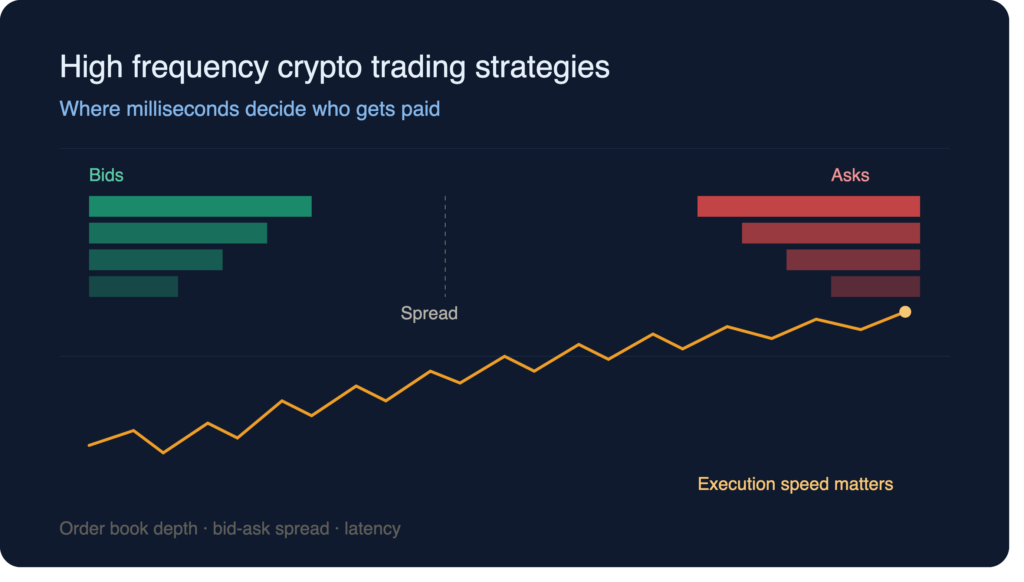
At its core, it’s algorithmic trading built for speed. A program watches live market data, an order book, a price feed, a spread, and reacts in milliseconds, sending orders faster than any person could click a mouse. The profit per trade is often tiny. The volume of trades is what makes it worthwhile.
Crypto is a natural home for this. Unlike stock markets with fixed hours, crypto trades 24/7 across dozens of exchanges, which means price gaps and inefficiencies show up constantly, and someone with a fast enough system can catch them before they close.
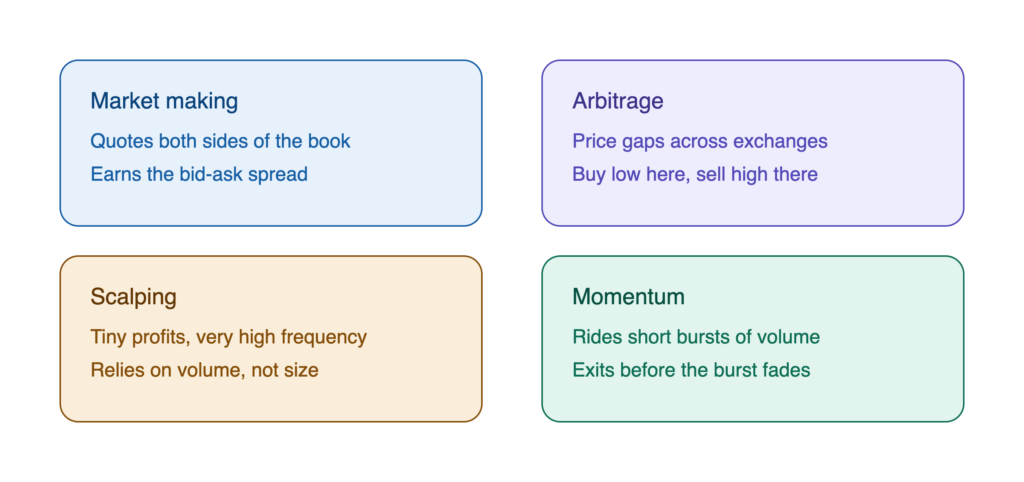
Here’s the shape of it, broken into the four strategies you’ll actually encounter.
High Frequency Crypto Trading Strategies: Full Guide 2026
Market Making: Getting Paid to Wait
Picture a stall in a busy market, always ready to buy from one customer and sell to the next. That’s a market maker.
In crypto, a market-making bot places both a buy order slightly below the current price and a sell order slightly above it, at the same time. When both orders fill, the bot pockets the difference, the bid-ask spread, without needing to guess where price goes next.
This is one of the gentler high frequency crypto trading strategies because it doesn’t bet on direction. The risk instead is holding inventory during a sudden move, if price crashes right after your buy order fills, you’re stuck holding a falling asset. Market makers manage this by keeping positions small and adjusting quotes constantly as the order book shifts.
Algo trading for beginners video
Arbitrage: Chasing the Same Coin at Two Prices
Bitcoin on one exchange rarely trades at the exact same price as Bitcoin on another, even for a second. Those tiny gaps are where arbitrage lives.
A crypto arbitrage strategy buys an asset where it’s cheaper and sells it where it’s pricier, locking in the difference before the gap closes. In crypto specifically, this often takes a few forms:
Cross-exchange arbitrage: the same coin priced differently on two platforms.
Triangular arbitrage: exploiting mismatched exchange rates across three trading pairs on one exchange.
Statistical arbitrage: using historical price relationships between correlated assets to bet on a gap closing.
The catch is speed and cost. These gaps often exist for a second or less, and by the time a slow bot notices and reacts, the opportunity is gone. Add in withdrawal times, transfer fees, and trading fees, and many arbitrage opportunities that look profitable on paper simply aren’t after costs.
If market making is patient and arbitrage is opportunistic, scalping is relentless.
A crypto scalping strategy aims for very small price moves, sometimes a few basis points, but does it dozens or hundreds of times a day. No single trade matters much. The strategy lives or dies on consistency and low costs, since fees can quietly eat every bit of profit if you’re not careful.
Scalping bots typically watch short-term price action and order flow, entering the instant a small edge appears and exiting almost as quickly. It demands a fast connection, low fees, and a system that never gets tired or greedy, three things a human trader struggles to maintain around the clock.
Momentum Trading: Riding the Short Burst
Not every high frequency approach avoids direction. Momentum trading in crypto HFT does the opposite, it tries to catch a short, sharp move right as it starts.
When volume spikes and price begins accelerating, a momentum bot jumps in, rides the burst for seconds or minutes, and exits before it fades. This isn’t the same as long-term trend following. It’s built around speed and exit discipline, since these bursts can reverse just as fast as they appeared.
The Latency Problem: Why Speed Is the Whole Game
Here’s what makes high frequency crypto trading strategies genuinely different from ordinary trading: the entire edge often lives in milliseconds.
High Frequency Crypto Trading Strategies: Full Guide 2026
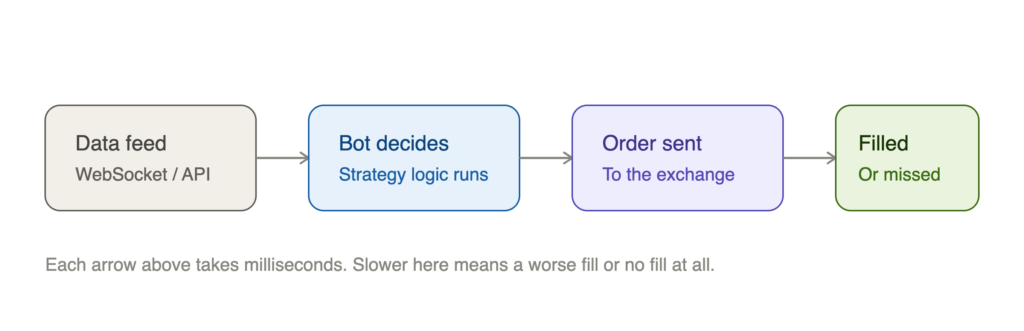
Every trade travels through the same rough pipeline: data arrives, the bot decides, an order gets sent, and it either fills or it doesn’t. Being slow at any one stage can turn a winning strategy into a losing one, because someone else’s bot got there first.
This is why serious HFT setups obsess over infrastructure: direct exchange APIs instead of slower interfaces, servers placed physically close to exchange data centers, and code stripped of anything that adds unnecessary delay. It’s less like building a clever idea and more like building a very fast, very reliable machine around that idea.
Crypto HFT vs Traditional HFT: What’s Actually Different
Traditional HFT on stock exchanges runs in a world of regulated co-location, standardized data feeds, and market structure that’s been stable for decades.
Crypto flips several of these assumptions:
Factor
Traditional HFT
Crypto HFT
Market hours
Fixed sessions
24/7, always on
Liquidity
Centralized, deep
Fragmented across many exchanges
Data feeds
Standardized
Varies by exchange, API-dependent
Regulation
Heavily regulated
Still evolving
Entry barrier
Very high (institutional)
Lower, but still technical
Comparison between traditional and crypto HFT
That fragmented liquidity is actually a gift for arbitrage-style strategies, more exchanges, more price gaps, more opportunities, but it also means no single order book tells the whole story, which adds complexity a stock-market HFT desk doesn’t deal with.
The Real Risks Nobody Puts on the Brochure
This is the part beginners skip, and it’s the part that decides whether high frequency crypto trading strategies make money or quietly drain an account.
High Frequency Crypto Trading Strategies: Full Guide 2026
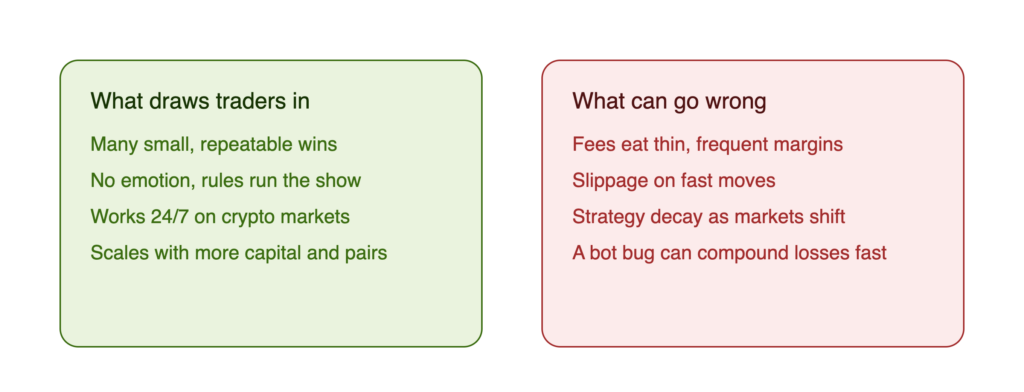
Fees compound fast. When your edge per trade is tiny, even a small taker fee can turn a winning strategy into a losing one once you multiply it by hundreds of trades a day.
Slippage bites during fast moves. The price you expect and the price you get can drift apart the moment volatility spikes, exactly when speed matters most.
Strategies decay. An edge that worked last month can vanish as other bots catch on or exchange conditions change. HFT isn’t “set and forget,” it needs constant monitoring and adjustment.
A bug moves fast too. A single coding error in an automated system can execute dozens of bad trades before a human even notices something’s wrong. This is why paper trading and careful backtesting aren’t optional steps, they’re the seatbelt.
Flash crashes and exchange downtime happen. Crypto exchanges occasionally seize up under load exactly when volatility is highest, the worst possible moment for an automated strategy to be stuck unable to act.
The honest answer: at the extreme end, no, competing against institutional infrastructure with dedicated servers next to exchange data centers isn’t realistic for most individuals.
But a lighter version is genuinely accessible. Retail traders can build simpler automated strategies, a basic scalping bot, a straightforward arbitrage script between two exchanges, using public APIs and cloud servers. The results won’t match a hedge fund’s, but the discipline and structure of automated trading strategies can still outperform manual, emotion-driven trading for a patient, technically-minded trader.
Start with paper trading. Backtest against historical data. Understand your fee structure down to the decimal before you risk real capital. High frequency crypto trading rewards preparation far more than it rewards enthusiasm.
The Bottom Line
High frequency crypto trading strategies aren’t magic, and they aren’t reserved for people with server racks in Singapore. At heart, they’re a handful of ideas, market making, arbitrage, scalping, momentum, executed with speed and discipline a human simply can’t replicate by hand.
The traders who succeed here aren’t the ones with the flashiest algorithm. They’re the ones who respect the costs, test relentlessly before going live, and treat every millisecond and every basis point like it matters, because in this world, it genuinely does.
Ready to see this in action? Start by studying an order book on a live chart and timing how fast prices actually move. Once you understand the mechanics, you can explore crypto futures trading on Mudrex and begin testing strategies with the tools built for speed.
Disclaimer: This article is for educational purposes only and is not financial advice. High frequency and algorithmic trading carry significant risk, including the risk of rapid, compounding losses. Always test thoroughly and never risk more than you can afford to lose.
FAQs
What is high frequency crypto trading?
High frequency crypto trading is an automated approach that uses algorithms to execute a large number of trades in very short timeframes, often milliseconds, to capture small, repeatable price edges like spreads or cross-exchange gaps.
How does HFT work in crypto?
A bot continuously monitors live market data such as order books and price feeds, applies a set strategy, and sends orders automatically the moment conditions match, all without manual input, relying on speed and low latency infrastructure to succeed.
What are the best HFT strategies in crypto?
The most common approaches are market making, arbitrage, scalping, and momentum trading. Each targets a different kind of edge, spread capture, price gaps, small frequent moves, or short volume bursts, and beginners typically find market making and simple arbitrage the most approachable starting points.
Is high frequency crypto trading profitable?
It can be, but margins per trade are thin and highly sensitive to fees, slippage, and infrastructure speed. Profitability depends heavily on execution quality and cost control rather than any single clever idea.
How is crypto HFT different from traditional HFT?
Crypto markets run 24/7 with liquidity fragmented across many exchanges and less standardized data access, compared to the centralized, tightly regulated infrastructure of traditional stock market HFT. This creates more arbitrage opportunities but also more operational complexity.
Can retail traders do high frequency crypto trading?
Retail traders generally can’t match institutional-grade speed, but simpler automated strategies using public exchange APIs are accessible. Success depends more on rigorous testing, fee awareness, and risk controls than on raw speed alone.
Anupam has over 3 years of experience in the crypto industry, having worked with top indian crypto exchanges. He writes about Bitcoin, altcoins, AI, and emerging tech, helping readers understand what’s driving markets and where the digital asset ecosystem is headed.