Crypto Futures Scalping Strategies: 3 Simple Plays for Beginners
It’s 9:47 in the morning. Rohan opens his phone during a chai break, spots Bitcoin twitching sideways, takes a small futures position, and closes it four minutes later up ₹3800. No overnight worry. No staring at a chart for twelve hours. Just one tight, planned trade.
That is scalping. And these three crypto futures scalping strategies are built so a beginner can copy that same rhythm without guessing. Scalping means taking many small, fast trades to capture tiny price moves, using clear rules for when to enter, where to place a stop loss, and when to take profit.
The catch nobody tells you upfront: scalping rewards discipline far more than it rewards being clever. So we’ll keep it simple. You get three plays, the exact signals to watch, and the risk rules that keep small losses small.
Picture a busy market vendor. He doesn’t wait weeks for one big sale. He makes dozens of quick, small-margin sales all day, and they add up. A scalper trades the same way.
In crypto futures, you’re trading a contract that tracks the price of an asset like Bitcoin, often with leverage. Scalping crypto futures means holding for seconds to a few minutes, aiming for a small move, then getting out. You repeat that with strict rules.
Three things make this style different from crypto day trading strategies that hold positions for hours:
Timeframe. You live on the 1-minute and 5-minute charts, not the daily.
Target size. You’re happy with a small, defined gain per trade.
Frequency. You may take five to twenty trades in a session, not one.
Leverage amplifies both wins and losses, so beginner scalping strategy work should start with the lowest leverage your platform allows. More on that below.
Why Beginners Are Drawn to Scalping (and the Honest Trade-off)
You’re here because scalping feels controllable. Trades are short. You’re not exposed to shocking overnight news. Wins arrive quickly, which is satisfying.
Here’s the honest part. Because trades are frequent, fees and the bid-ask spread eat into results fast. And speed cuts both ways: a rushed exit can turn a planned small loss into a big one. The traders who last treat scalping as a repeatable process, not a slot machine.
That’s why every strategy below comes with a fixed stop and a fixed target before you enter. You decide the risk while you’re calm, not while the candle is moving.
The 3 Simple Crypto Futures Scalping Strategies
Each play uses common indicators you’ll find on any charting tool: EMA, VWAP, and RSI. Learn one first. Trade it on paper. Only then add the next.
Crypto Futures Scalping Strategies: 3 Easy Beginner Plays
An EMA (Exponential Moving Average) is just a smoothed line of recent prices. When a fast line crosses a slower one, momentum is shifting.
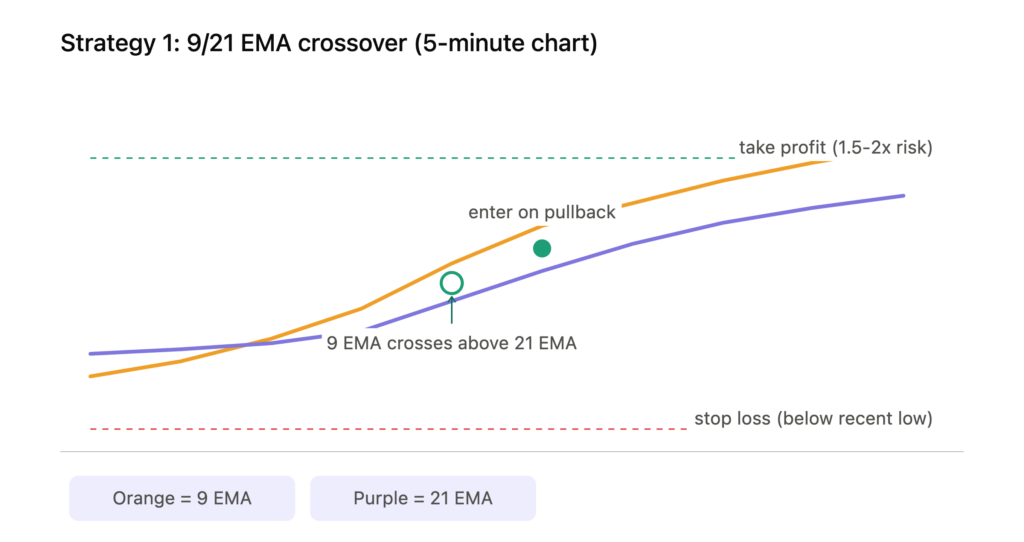
Add the 9 EMA and 21 EMA to a 5-minute chart. When the 9 EMA crosses above the 21 EMA, buyers are gaining control. Rather than chasing the crossover candle, wait for price to pull back slightly toward the fast line, then enter long. Place your stop just below the recent swing low, and set your target at roughly 1.5 to 2 times that risk.
The diagram above the FAQ shows the crossover point, the pullback entry, and where the stop and target sit. For a short setup, you flip it: the 9 EMA crossing below the 21 EMA signals sellers taking over.
Why beginners like this: the signal is visual and hard to misread. When the two lines are tangled and flat, there is no trade. You simply wait.
Crypto Futures Scalping Strategies: 3 Easy Beginner Plays
VWAP (Volume Weighted Average Price) is the average price weighted by how much volume traded at each level. Big players watch it closely, which is exactly why it works as a scalping level.
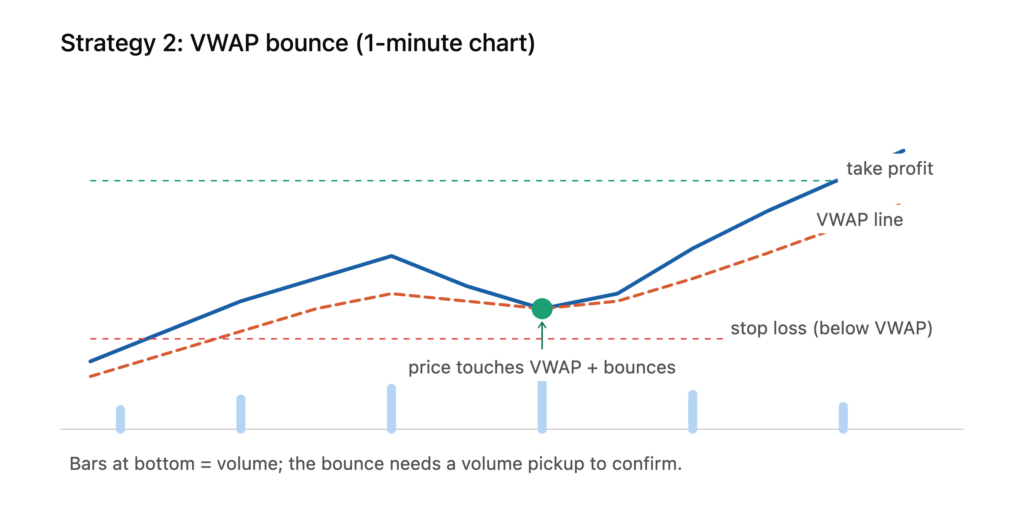
On a 1-minute chart, add VWAP. In an uptrending session, wait for price to drift down and touch the VWAP line, then bounce off it. That bounce is your long entry. Your stop goes just below VWAP, and your target is a small move up toward the recent high.
The single most important filter here is volume. A bounce on rising volume is a real one. A bounce on dead volume often fails, so skip it. In a downtrending session, you do the reverse and short the rejection from VWAP.
Think of VWAP as the tide line on a beach. Price keeps returning to it. You’re trading the return, not fighting it.
Crypto Futures Scalping Strategies: 3 Easy Beginner Plays
RSI (Relative Strength Index) measures how stretched a move is, on a scale of 0 to 100. Below 30 is “oversold” and above 70 is “overbought.”
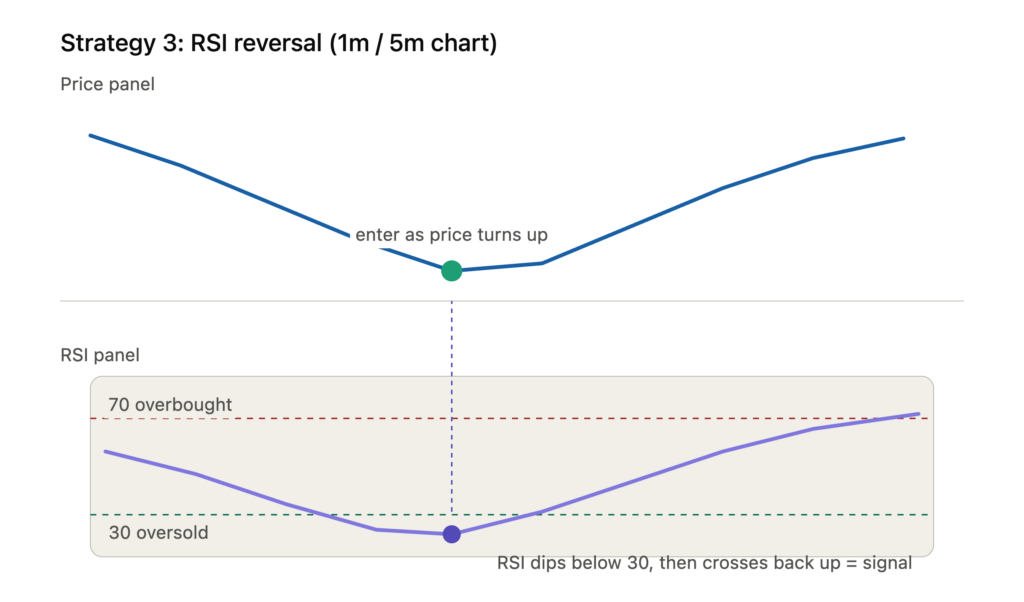
Set RSI to its standard 14 period on a 1-minute or 5-minute chart. When RSI dips below 30 and then crosses back up through 30, a short-term bounce is often starting. That cross-back is your entry, not the dip itself. Waiting for the cross keeps you from catching a falling knife. Stop goes below the recent low; target is a modest snap-back move.
The two-panel diagram above shows price making a low while RSI drops under 30, then turning up together. That alignment, price and RSI turning at once, is what you want to see.
A word of caution: in a strong trend, RSI can stay oversold or overbought for a long time. This play works best in choppy, range-bound conditions, not in a violent one-way move.
Comparing the Three Strategies at a Glance
Strategy
Best timeframe
Core signal
Works best in
9/21 EMA crossover
5-minute
Fast EMA crosses slow EMA
Trending markets
VWAP bounce
1-minute
Price bounces off VWAP on volume
Trending sessions
RSI reversal
1m / 5m
RSI crosses back through 30 or 70
Range-bound markets
Comparison of Strategies
Notice they don’t overlap much. EMA and VWAP shine when price is trending; RSI shines when price is chopping sideways. Reading which condition you’re in is half the skill.
The Risk Rules That Keep You in the Game
Strategies get the attention. Risk rules keep your account alive. These are non-negotiable for a beginner:
Use low leverage. Start at the smallest your platform offers. High leverage turns a small wrong move into a wipeout.
Set the stop before you enter. Every trade has a pre-decided exit. No exceptions, no “let me give it room.”
Risk a tiny fixed percentage per trade. Many traders cap risk at around 1% of their account on any single scalp so no one trade can hurt badly.
Mind the fees and spread. Since you trade often, small costs compound. Check your platform’s futures fees before you start.
Stop for the day after a set loss. A daily loss limit protects you from revenge trading.
Scalping isn’t about being right every time. It’s about making sure your winners are bigger than your losers and that no single loss is catastrophic.
How a Beginner Should Actually Start
Don’t open a live position tomorrow. Do this instead. Pick one strategy, ideally the EMA crossover for its clarity. Watch it on a live chart for a few sessions without trading, just to see the signal appear and play out. Then practice on a demo or with the smallest possible size. Keep a simple log of every trade: setup, entry, stop, result. After twenty or thirty logged trades, you’ll know whether the play suits you far better than any article can tell you.
Skill compounds the same way small wins do. Slowly, then all at once.
Conclusion: Small Wins, Repeated with Discipline
These three crypto futures scalping strategies, the EMA crossover, the VWAP bounce, and the RSI reversal, give a beginner a clear, rule-based way to trade fast moves without guessing. The edge isn’t in any single indicator. It’s in taking the same clean setup over and over, cutting losses quickly, and letting small, consistent wins stack up like that market vendor’s daily sales.
Start with one strategy, size small, and protect your capital above all. That’s how Rohan turned a chai break into a habit instead of a gamble.
Ready to practise these setups? Explore crypto futures on a trusted platform, start with the lowest leverage, and place your first small, planned scalp today.
Disclaimer: This content is for educational purposes only and is not financial advice. Crypto futures trading involves significant risk, and leverage can amplify losses beyond your initial capital. Do your own research and never trade more than you can afford to lose.
FAQs
What is scalping in crypto futures?
Scalping in crypto futures is a short-term trading style where you take many small, fast trades to capture tiny price moves, usually holding for seconds to a few minutes. Traders use the 1-minute and 5-minute charts, set a tight stop loss and a small profit target on each trade, and repeat the process with strict rules.
Is crypto scalping profitable?
Crypto scalping can be profitable, but profit comes from consistency and risk control, not from any single trade. Because you trade frequently, fees and the bid-ask spread reduce your edge, so scalpers rely on keeping losses small and letting winners slightly outweigh them. Most beginners lose money early, which is why practising on a demo first is strongly recommended.
Which indicator is best for crypto scalping?
There is no single best indicator, but EMA, VWAP, and RSI are the most popular for scalping. EMA crossovers show momentum shifts, VWAP acts as a magnet level watched by large players, and RSI flags short-term oversold or overbought conditions. Many scalpers combine two of these for confirmation rather than relying on one alone.
What timeframe is best for scalping crypto?
The 1-minute and 5-minute charts are the most common timeframes for scalping crypto futures. The 1-minute chart suits very fast setups like VWAP bounces, while the 5-minute chart gives slightly cleaner signals for EMA crossovers and is often friendlier for beginners.
How do beginners scalp crypto futures?
Beginners should start by learning one strategy, using the lowest available leverage, and setting a stop loss before every trade. A good routine is to watch the signal on a live chart first, practise on a demo account, log each trade, and only scale up size after seeing consistent results across twenty to thirty trades.
Is scalping better than day trading?
Neither is objectively better; they suit different people. Scalping involves many quick trades and demands fast focus, while crypto day trading strategies hold positions longer with fewer decisions. Scalping avoids overnight risk but incurs higher fees from frequent trading, so the right choice depends on your attention span, time availability, and temperament.
Anupam has over 3 years of experience in the crypto industry, having worked with top indian crypto exchanges. He writes about Bitcoin, altcoins, AI, and emerging tech, helping readers understand what’s driving markets and where the digital asset ecosystem is headed.