
Spend a few days following the crypto markets and you will almost certainly come across headlines like “$500 million in longs liquidated” or “Short sellers wiped out as Bitcoin surges.” At first glance, they look like reports of traders losing money. Experienced futures traders often see something very different. Large liquidation events often reveal where leveraged traders were positioned before a significant price move. They can expose where leverage has accumulated, where panic has taken over, and where volatility and forced order flow increased. That is why liquidation is not just a risk to avoid.
For some traders, it is also a source of market context. Rather than relying on price action alone, disciplined traders often combine liquidation data, liquidation heatmaps, long and short liquidation volumes. In addition, technical analysis to better understand market sentiment. Used cautiously, these datasets can add context to momentum and highlight areas where volatility may increase; they do not predict a reversal. Before using liquidation as part of a trading strategy, though, it is important to understand what liquidation is and why it happens.
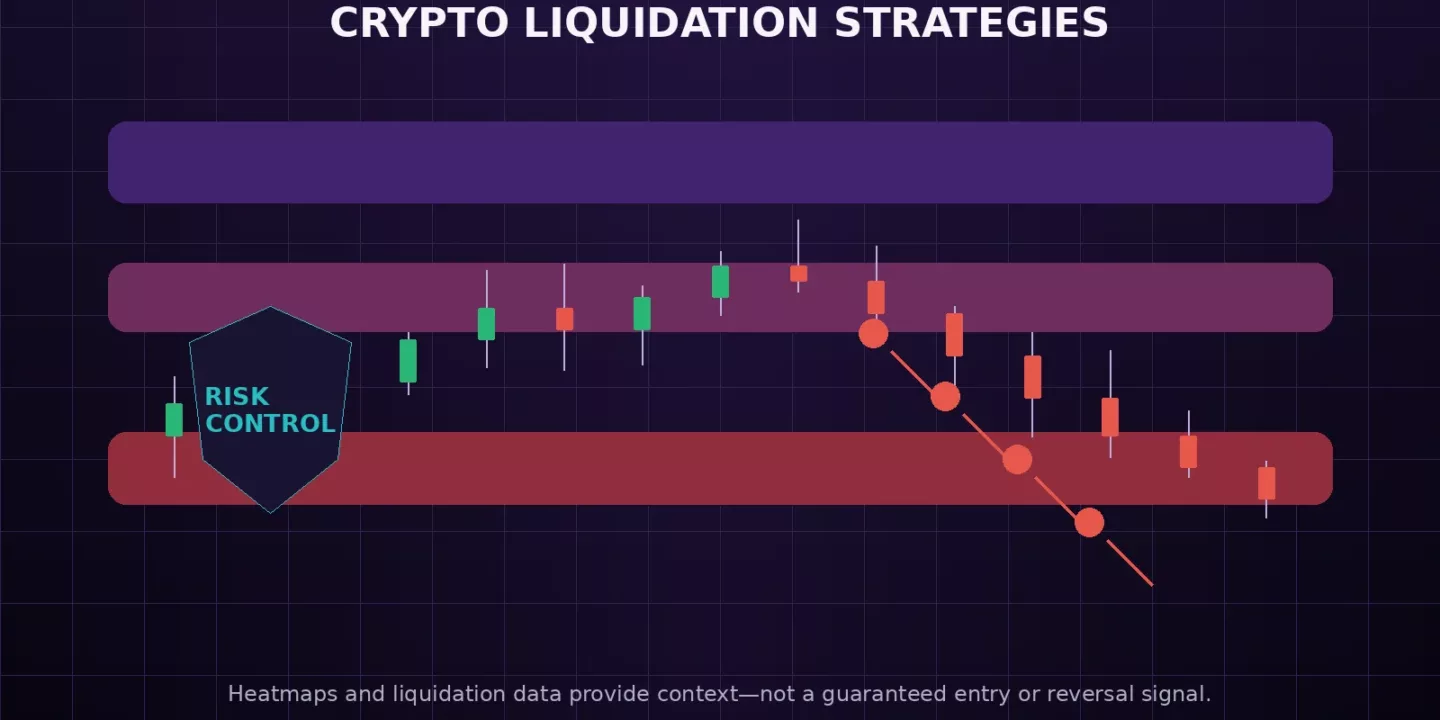
This guide explains crypto liquidation strategies, how forced closures occur, how traders interpret liquidation data and heatmaps, and how risk controls can reduce exposure to forced closure.
Crypto liquidation is the automatic closure of a leveraged futures position when the remaining margin is no longer enough to support the trade. Unlike spot trading, crypto futures allow traders to control a much larger position with a relatively small amount of capital by using leverage. While leverage can amplify potential returns, it also increases potential losses. As the market moves against your position, your available margin gradually falls. Once it drops below the exchange’s maintenance margin requirement, the exchange’s risk engine automatically closes the trade. Traders know this as forced liquidation.
Liquidation is not designed to punish traders. Instead, it prevents losses from exceeding the collateral backing a position while helping exchanges maintain a stable and orderly derivatives market.
Not every losing trade ends with the exchange stepping in. Disciplined traders often choose to exit a position before liquidation becomes a possibility. This is better described as a manual exit before forced liquidation. The phrase ‘voluntary liquidation’ is not standard across all venues. Imagine you open a Bitcoin (BTC) futures position expecting the price to rise. Instead, Bitcoin breaks below a key support level, invalidating your trading idea. Rather than hoping for a recovery, you close the position, accept a controlled loss, and preserve your remaining capital. Now imagine doing the opposite.
You ignore your stop-loss, keep the position open, and continue holding as losses mount. Eventually, your available margin falls below the required level, leaving the exchange with no choice but to close the trade automatically. That is forced liquidation. The difference is not simply who closes the position. It’s who remains in control of the risk. Most beginners focus solely on avoiding liquidation. Disciplined traders also study it, recognising that liquidation data can provide context about positioning, sentiment and forced order flow.
Imagine two traders opening the exact same Bitcoin (BTC) futures position at the same price. One chooses 5x leverage. The other chooses 20x leverage. If Bitcoin drops by just a few percent, one trader might still have plenty of room for the trade to recover. However, the other could already be facing liquidation.
The difference is not luck. It’s how leverage, margin, and the exchange’s risk management system work together. Understanding that process does not just help you avoid unnecessary liquidations,it also helps you make better trading decisions.
When you trade crypto futures, you do not pay the full value of a position upfront. Instead, you deposit an initial margin, which acts as collateral, while leverage allows you to control a much larger position. As the market moves against your trade, your unrealised losses increase and the margin supporting your position gradually decreases. This is why higher leverage does not simply increase your potential return. It also reduces your margin for error.
The more leverage you use, the closer your liquidation price moves to your entry price. This means even ordinary price fluctuations can trigger a forced liquidation. Disciplined traders understand this trade-off and often choose leverage based on their risk tolerance, not just the returns they are hoping to achieve.
Also Read : How much leverage is too much
Many beginners assume liquidation begins the moment a trade turns negative. That is not how crypto futures work. Every exchange requires traders to maintain a minimum amount of collateral known as the maintenance margin. As long as your remaining margin stays above that threshold, your position remains open,even if it is temporarily losing money. Liquidation only becomes a possibility when your available margin falls below the required maintenance level.
On most crypto futures exchanges, this is determined using the mark price rather than the last traded price. Using the mark price helps reduce unnecessary liquidations caused by temporary price spikes or thin liquidity. Although every exchange uses its own liquidation formula, the underlying principle is the same: once your remaining margin can no longer support the position, the exchange’s risk engine closes the trade automatically. Your liquidation risk can also differ depending on whether you are using isolated margin or cross margin, as each manages collateral differently.
Read more about Maintenance Margin in detail
In traditional financial markets, traders often receive a margin call, giving them an opportunity to deposit more funds before their position is closed. Crypto futures work a little differently. Many exchanges monitor positions in real time and liquidate them automatically once margin requirements are no longer met. Some platforms display margin warnings as your margin ratio approaches dangerous levels, but they do not necessarily issue a formal margin call.
Rather than relying on those warnings, disciplined traders regularly monitor their leverage, available collateral. In addition, margin ratio to reduce the likelihood of forced liquidation.
Most beginners see liquidation as something to avoid. Experienced futures traders see something more. Large waves of long liquidations or short liquidations can reveal where leverage was concentrated, where sentiment changed rapidly, and why momentum suddenly accelerated. When combined with liquidation data, liquidation heatmaps, liquidation clusters, technical analysis. In addition, sound risk management, these events can provide valuable context for understanding market behaviour. Liquidation does not predict the future.
But it can help explain what the market is doing,and why disciplined traders pay close attention whenever large numbers of leveraged positions are wiped out.
A liquidation event tells you one thing: leveraged positions have been forced to close. When thousands of positions are liquidated within minutes, however, they begin to reveal something much more valuable, where traders were overleveraged, how market sentiment shifted. In addition, why price momentum suddenly accelerated. That is why experienced futures traders do not look at crypto liquidation data in isolation. They combine it with technical analysis, open interest, funding rates, and broader market structure to better understand what’s happening beneath the surface. The goal is not to predict every market move.
It’s to make better-informed trading decisions.
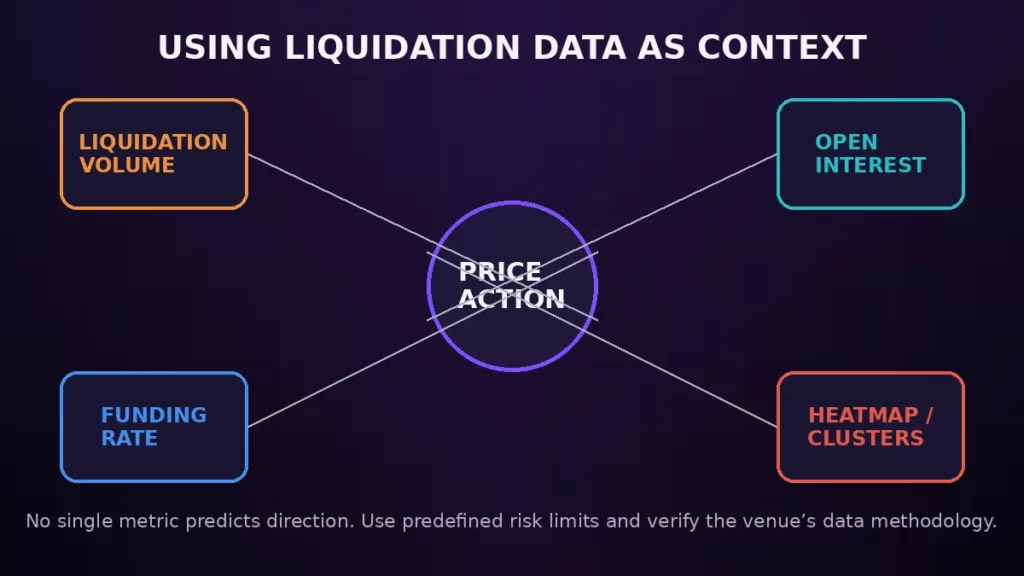
There is not a single approach to crypto liquidation strategies that works in every market. Instead, disciplined traders use liquidation data to add context to their existing trading plans. One common approach is to monitor liquidation spikes during strong trends. A surge in long liquidations can accompany bearish momentum, while short liquidations can accompany a rally. The liquidation event alone does not confirm continuation. Rather than entering a trade simply because liquidations occurred, traders look for confirmation from price action and trading volume.
Another strategy involves watching liquidation heatmaps and liquidation clusters. These tools estimate price zones where leveraged positions may be vulnerable, using the provider’s methodology and available data. When these clusters align with key support, resistance, or order book liquidity, they can help traders identify areas where volatility may increase.
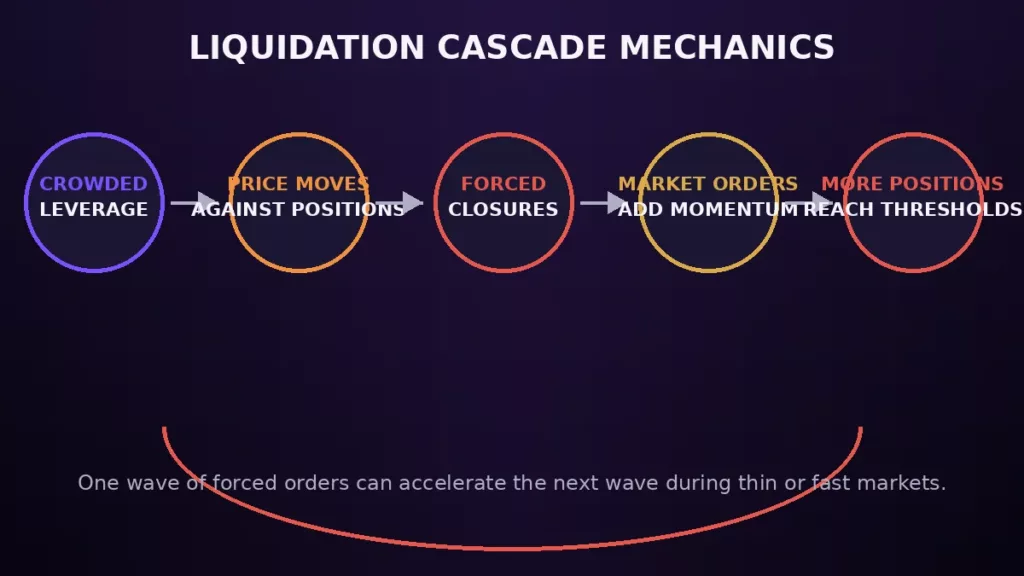
Some traders also compare liquidation data with open interest and funding rates. For example, rising open interest combined with increasing leverage may indicate that crowded positions are building. If the market suddenly moves against those traders, it can trigger a liquidation cascade, where one wave of forced liquidations fuels another, accelerating the price move.
The first priority is not trying to trade every liquidation event. It’s avoiding becoming part of one. Disciplined futures traders focus on risk management before looking for opportunities. They use leverage that matches their risk tolerance, maintain a healthy margin buffer, size positions conservatively. In addition, place stop-loss orders with enough distance from estimated liquidation levels; stop orders still carry slippage and execution risk. Crypto liquidation strategies should not treat liquidation data as a standalone trading signal.
No indicator, including liquidation data, can consistently predict future price movements.
Crypto liquidation strategies begin with understanding that forced closure is a structural risk of leveraged trading, not an event that can be forecast perfectly.
Continue learning on Mudrex Learn, watch the Mudrex YouTube channel, or trade crypto futures on Mudrex. Crypto derivatives carry substantial risk; use only capital you can afford to lose.
Crypto liquidation is the automatic closure of a leveraged futures position when your remaining margin falls below the exchange’s maintenance margin requirement. It helps prevent losses from exceeding the collateral backing your trade and protects both traders and the exchange from excessive risk.
When the market moves against your leveraged position, your available margin decreases. If it falls below the required maintenance margin, the exchange’s risk engine automatically closes the position to limit further losses.
Forced liquidation occurs when an exchange automatically closes a trader’s leveraged position because there is no longer enough margin to support it. This usually happens during adverse price movements and is designed to prevent negative account balances
A manual exit occurs when a trader closes a position before the venue’s risk engine begins forced liquidation. Accepting a controlled loss early can often preserve more capital than waiting for automatic liquidation
Liquidation happens because leveraged trading increases both potential profits and potential losses. When a position can no longer meet the exchange’s maintenance margin requirement, it is automatically closed to reduce financial risk
Higher leverage brings your liquidation price closer to your entry price, meaning even relatively small price movements can trigger liquidation. Lower leverage gives your position more room to absorb normal market volatility.
Maintenance margin is the minimum amount of collateral required to keep a leveraged position open. If your available margin falls below this level, the exchange may liquidate your position automatically.
Unlike traditional financial markets, many crypto futures exchanges do not issue formal margin calls. Instead, they monitor positions in real time and may display margin warnings before automatically liquidating positions that no longer meet margin requirements
Traders can reduce liquidation risk by using lower leverage, maintaining a healthy margin buffer, sizing positions appropriately, placing stop-loss orders. In addition, avoiding overleveraging during periods of high volatility.
A stop-loss order submits an exit after its trigger condition is met, allowing traders to limit losses before the exchange is forced to liquidate the position. This can provide greater control over risk and helps preserve trading capital.
Crypto liquidation data shows the value and number of leveraged positions that have been liquidated over a given period. Traders use this information to better understand market sentiment, leverage build-up, and periods of increased volatility.
Disciplined traders use liquidation data alongside price action, open interest, funding rates, and technical analysis to understand market conditions. Rather than acting as a standalone trading signal, liquidation data provides additional context for making informed trading decisions
High liquidation volumes indicate that a large number of leveraged positions were closed within a short period. These events often occur during sharp price moves and can signal heightened volatility, panic selling, or short squeezes, depending on market conditions.
With 5x leverage, a trader controls a position five times larger than their initial margin. Compared with a higher-leverage position of the same notional size and margin mode, the liquidation threshold is generally further from entry. Exact distance depends on fees and venue rules.
At 10x leverage, losses accumulate much faster because your market exposure is larger relative to your margin. As a result, your liquidation price is closer to your entry price. This means a smaller adverse move can reach the liquidation threshold; exact mechanics depend on margin mode, fees and the venue’s formula.