
Bitcoin’s futures price sits above its spot price most weeks, and most traders never touch that gap. That gap is the basis, and basis trading crypto turns it into a market-neutral trade, not a missed signal.
Directional bets on Bitcoin or Ethereum can wipe out an account in one bad session. Basis trading crypto, also called cash and carry arbitrage, skips the guesswork: buy the coin on spot, short an equal amount on futures, and price direction barely matters.

This is a full breakdown of basis trading for Indian traders: the mechanics, the math, and the fees, funding, and liquidation risk that turn a “low-risk” trade risky if you skip a step.
Basis trading in crypto is a market-neutral strategy: hold an asset on spot, short the same amount on futures, and collect the price gap between them, called the basis.
DEFINITION
Basis
Basis is the price difference between an asset’s futures price and its spot price at a single moment in time.
Traders also call this cash and carry arbitrage, a strategy borrowed from traditional stock and commodity markets, because you “carry” the spot position until futures price and spot price meet. For Bitcoin basis trading, or any BTC basis trade, the mechanic is the same whether the coin is Bitcoin, Ethereum, or another large-cap asset. The goal: earn the spread, not the direction.
Crypto cash and carry arbitrage runs in two legs, opened at nearly the same time.
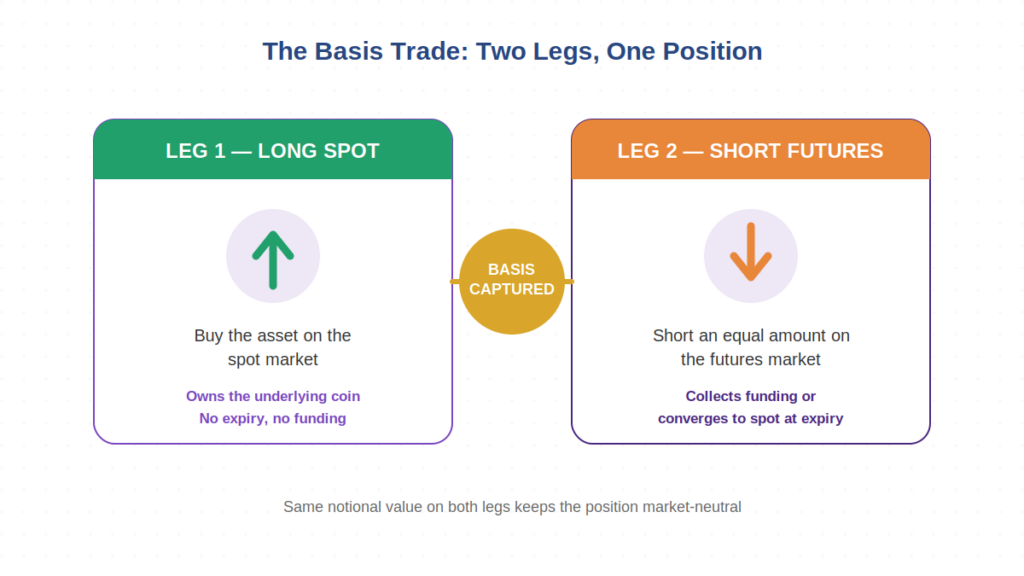
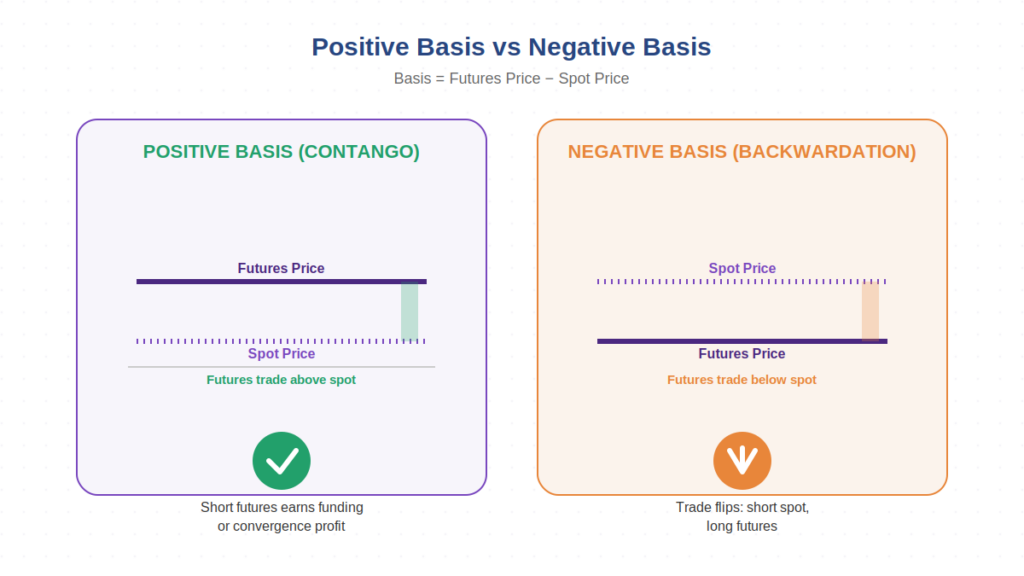
When futures trade above spot, called a futures premium crypto traders watch for, your short futures leg profits from price convergence between futures and spot, or from funding along the way. When futures trade below spot, called a futures discount or backwardation, the trade flips: short spot, long futures.
This is basis trading in crypto futures at work: a spot futures arbitrage crypto setup and a crypto arbitrage strategy, not a directional bet. Profit comes from convergence and funding, not price direction.
Perpetual futures and delivery futures, including quarterly futures, both support crypto futures arbitrage, but they pay you differently. Perpetual futures carry no expiry and use a funding rate, settled every few hours, to keep the contract near spot; a positive rate means longs pay shorts, so your short leg earns funding directly. Delivery futures skip funding: the futures price and spot price converge as expiry nears, and the basis you locked in becomes your profit at settlement.
Our full comparison of perpetual futures vs delivery futures covers funding, expiry, and rolling costs before your first trade.
Basis uses one formula: Basis = Futures Price – Spot Price.
| Term | Illustrative example | Meaning |
| Spot price | ₹83,00,000 per BTC | Current cash market price |
| Futures price | ₹83,24,900 | Price of the futures contract |
| Basis | ₹24,900 | Futures price minus spot price |
| Basis as % | ~0.30% | Basis divided by spot price |
To compare trades of different lengths, annualise: multiply the basis percentage by (365 ÷ days to expiry). A 0.30% basis over 15 days works out to roughly 7.3% annualised, before fees. Illustrative only, not a return projection.
Positive basis (contango) is the standard crypto basis trade India traders use on large-cap coins. Negative basis (backwardation) is rarer, usually during sharp sell-offs.
Crypto basis trading carries real costs despite being market-neutral.
No. It reduces directional risk, not all risk. It removes the need to predict direction, but not fee, funding, margin, liquidation, or execution risk. Past basis levels do not indicate or guarantee future basis levels or returns.
Basis trading crypto rewards arithmetic over prediction. The strategy, long spot, short futures, capture the gap, is simple. What separates a clean trade from a losing one is fee discipline, funding awareness, and respecting margin on the futures leg.
Explore live spot and futures pricing on Mudrex, or subscribe to the Mudrex YouTube channel for more walkthroughs like this one.
Buying an asset on spot and shorting the same amount on futures to collect the price gap, with minimal directional risk.
They largely overlap on perpetual futures. Basis trading is the broader term, covering both perpetual funding capture and delivery-futures convergence.
Neither is universally better. Perpetual futures suit continuous funding capture; delivery futures suit a known settlement date.
Yes, subject to applicable VDA tax and TDS rules. Confirm current compliance requirements and keep records of every trade.
Fees on both legs, plus funding paid rather than earned, reduce net basis. Compare after-fee basis against your target return before entering.
Crypto futures trading involves substantial risk, including the potential loss of your entire margin. Leverage magnifies both gains and losses.
The figures and worked examples above are simplified and illustrative, not real market data or a return projection, and past basis or funding levels do not guarantee future results. This article is educational content, not financial advice. Please assess your own risk tolerance and consult a qualified financial advisor before trading crypto derivatives.