
Crypto futures trading is emerging as the next frontier of digital asset markets, giving traders greater flexibility to participate in both rising and falling prices. But long-term success depends on more than predicting market direction.
Risk management in crypto futures trading includes the rules, position-sizing decisions, and stop-loss habits that determine how much capital is exposed when a trade does not go as planned. It is especially important in crypto markets, where prices move around the clock without circuit breakers.
| Term | What it means |
|---|---|
| Risk management | A set of rules used to limit potential losses and protect trading capital. |
| Crypto futures trading | Trading contracts based on the future price movement of a cryptocurrency without necessarily owning the asset. |
| Position sizing | Deciding how much money or how many contracts to allocate to a trade. |
| Exit points | Predetermined price levels at which a trader closes a position to take profit or limit losses. |
| Leverage | Using borrowed funds to open a position larger than the trader’s available capital. |
| Market swing | A significant upward or downward movement in an asset’s price. |
| Stop-loss | An order that automatically closes a trade when the price reaches a specified loss level. |
| Stop-loss placement | Choosing the price level at which a stop-loss order should close the position. |
| Margin | The funds a trader must provide to open and maintain a leveraged position. |
| Margin monitoring | Regularly checking whether sufficient margin is available to keep a leveraged trade open. |
| Hedging | Opening another position designed to reduce the potential loss from an existing position. |
| Volatility | The speed and extent at which cryptocurrency prices rise or fall. |
| 24/7 trading | A market that operates continuously, including nights, weekends, and holidays. |
| Funding rates | Periodic payments exchanged between long and short traders to keep perpetual futures prices close to spot prices. |
| Perpetual futures | Futures contracts that do not have a fixed expiry date. |
| Expiry | The date on which a traditional futures contract ends or must be settled. |
| Margin ratio | A measure showing how much margin remains relative to the risk of the open position. A weak ratio can increase liquidation risk. |
| Liquidation | The forced closure of a leveraged position when the available margin is no longer sufficient to cover losses. |
Futures trading for beginners often starts with the same mistake: sizing a position by how much leverage a platform allows, not by how much loss you can absorb. Crypto futures for beginners means separating two numbers that feel similar but aren’t: position size, and risk taken.
Good risk management in futures trading starts with a written trading plan: fix your risk per trade, your stop-loss level, and your target risk/reward ratio in advance. Emotional trading, chasing a loss or moving a stop-loss mid-trade, is how even beginner traders give up capital protection they’d otherwise have.
You manage risk in crypto futures trading by fixing your risk per trade first, then letting your stop-loss distance and leverage decide your position size, never the other way around.
| Order type | How it behaves |
| Stop-market | Always triggers, but can fill at a worse price during a big move (slippage) |
| Stop-limit | Protects your fill price, but can fail to execute at all if price gaps past your limit |
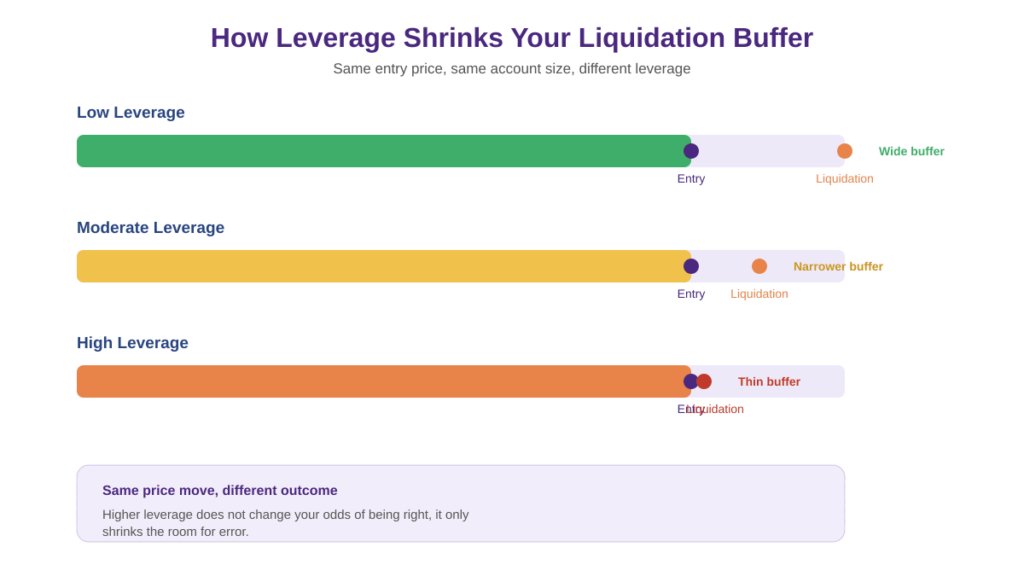
Leverage increases crypto futures risk by shrinking the price move needed to wipe out your margin, not by changing your odds of being right. On a long position or a short position, higher leverage means your liquidation price sits closer to your entry.
Definition: Liquidation Price The exact price at which an exchange force-closes your position because your margin can no longer cover unrealised losses.
Every futures position needs initial margin to open and maintenance margin to stay open. Your unrealised PnL swings with every tick until you close the trade and lock in realised PnL; when losses push your account below the maintenance level, the position is liquidated regardless of what you believed would happen next. This is the leverage risk crypto beginners underestimate most.
The chart below shows why: higher leverage leaves less room between entry and liquidation.
Here’s a detailed guide on you can add margins to your futures trades:
Liquidation risk crypto futures traders face is the chance that a price move forces your position closed before it can recover. It gets worse during liquidation cascades, when one forced sale pushes price into the next trader’s liquidation zone. Read the full breakdown in our guide on liquidation cascades in crypto futures.
Lower leverage, wider stop distance from your liquidation price, and watching open interest and funding rate spikes together are the most reliable ways to reduce this risk. Our advanced crypto futures strategy guide covers liquidation-risk controls used by experienced traders in more depth.
Hedging reduces crypto trading risk management mistakes by offsetting an existing spot trading position with an opposite futures position, rather than selling an asset you want to hold long-term. A short futures position against spot holdings can limit downside during a correction.
Funding rate and funding cost matter too. Holding a leveraged position across funding periods costs money even when price doesn’t move, quietly eroding your risk/reward ratio. Our 3-5-7 risk framework and position sizing walkthrough build on the same fixed-risk logic above.
Risk management in crypto futures trading is a written plan, not one tool: fix your risk per trade, size around your stop-loss, watch your margin ratio, and hedge only where it genuinely reduces exposure. Keep it simple, but keep it consistent every time you open a position.
Put your plans into practice. Download the Mudrex app or subscribe to the Mudrex YouTube channel for more on safer crypto futures trading.
Crypto futures trading carries a high risk of loss, and leverage can magnify both gains and losses. The strategies, ratios, and examples above are illustrative and based on historical patterns, not guarantees of future performance or returns. This article is for educational purposes only and is not financial advice. Please assess your own risk tolerance and consult a qualified financial advisor before trading with leverage.
It’s the practice of sizing positions, setting stop-losses, and controlling leverage so no single trade can wipe out your account equity.
There’s no single “safe” number. It depends on stop-loss distance and account size, so beginner traders should size around a fixed 1-2% risk per trade instead of maximum leverage.
Most traders cap risk at 1-2% of account equity per trade, regardless of position size or leverage used.
The risk that a price move forces your position closed before it can recover, based on your margin and leverage.
Yes. A hedge uses an opposite futures position to offset an existing spot trading position’s downside, without requiring you to sell it.
Funding cost is charged periodically between long and short positions holding perpetual futures, and it adds to your total cost even when price is flat.