
PENGU vs PEPE is one of the most common meme coin debates of 2026, and for good reason: both are top-50 meme tokens with large communities, but they’ve built their value in almost opposite ways. This Pudgy Penguins vs Pepe coin matchup pits a solana meme coin vs ethereum meme coin, PEPE leans on pure meme virality with a fixed, locked supply, while PENGU leans on an actual consumer brand still expanding into physical retail.
This guide compares PENGU vs PEPE across market cap, tokenomics, utility, and price performance, so you can judge for yourself which is the best meme coin 2026 pick for your own portfolio.

PENGU is the token behind Pudgy Penguins, an NFT collection acquired by Luca Netz in 2022 that has since expanded into physical retail (plush toys, trading cards) alongside its Solana-based token, launched in December 2024.
PEPE is a purely community-driven meme token on Ethereum, launched in April 2023 with no presale, no team allocation, and an anonymous creator team. Its entire draw is the Pepe the Frog internet meme itself; the project doesn’t claim any utility beyond that.
| Metric | PENGU | PEPE |
| Blockchain | Solana | Ethereum |
| Market capitalization | ~$375-395 million | ~$1.1 billion |
| Circulating supply | ~62.9B of 88.88B (71%) | ~420.7T (fully circulating) |
| Team allocation | 17.8% (vesting) | None |
| Contract | Standard, ongoing unlocks | Permanently locked at launch |
The PENGU vs PEPE market cap gap is significant: PEPE is roughly 3x larger by that measure, despite PENGU’s brand recognition. This PENGU PEPE comparison shows a meme coin rivalry shaped as much by supply structure as by brand; PEPE’s fixed, deflationary supply (helped by a 2023 burn of 6.9 trillion tokens) gives it a cleaner scarcity story than a token still unlocking new supply monthly.
This is the starkest difference between the two. PENGU tokenomics allocate 88.88 billion total supply across community, team (17.8%, vesting through 2028), company, and liquidity pools, meaning new circulating supply enters the market on a schedule regardless of demand.
PEPE has no such token dilution risk: 93.1% of its fixed supply went directly to a liquidity pool at launch, the deployer contract was sent to a null address, and no new PEPE can ever be minted. For investors who weigh supply certainty heavily, this is PEPE’s clearest structural advantage in the PENGU vs PEPE investment decision.
Here the comparison flips. PENGU’s ecosystem utility comes from an actual consumer brand: Pudgy Penguins plush toys are now in every Target store in the US, alongside trading cards and a comic book series, real retail adoption most meme coins never achieve.
PEPE offers no comparable brand-backed token utility, and doesn’t claim to. Its value is driven entirely by community strength, viral narrative, and social media buzz rather than any product or partnership. Neither token grants governance rights, revenue share, or a claim on company assets, so “utility” here means brand-driven demand (PENGU) versus meme-driven demand (PEPE), not functional utility in either case.
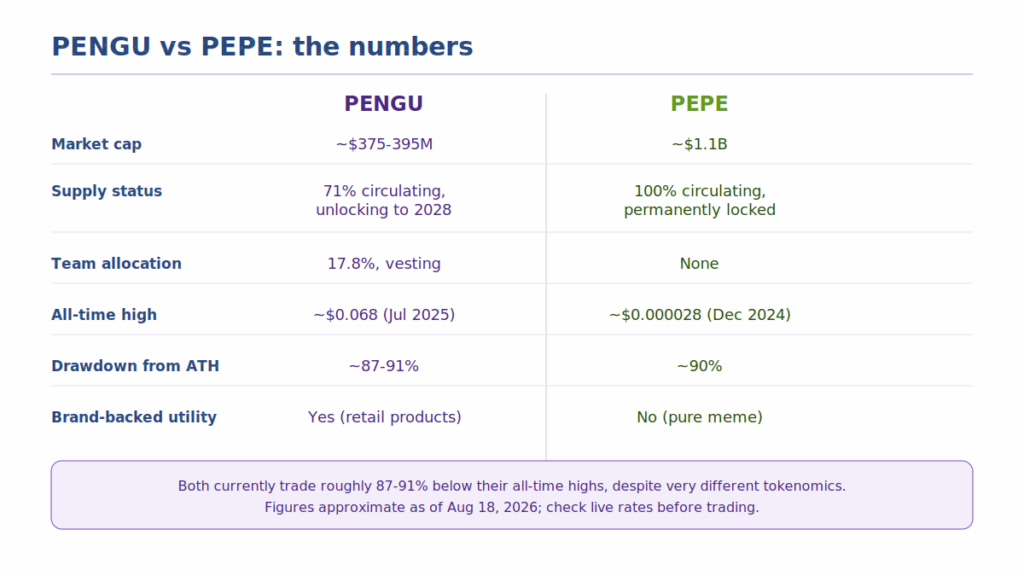
| Metric | PENGU | PEPE |
| All-time high | ~$0.068 (Jul 2025) | ~$0.000028 (Dec 2024) |
| Current price (approx.) | ~$0.006-0.008 | ~$0.0000026 |
| Drawdown from ATH | ~87-91% | ~90% |
| 24-hour trading volume | ~$45-55 million | ~$48-80 million |
The PENGU price vs PEPE price comparison in dollar terms doesn’t mean much on its own since both have vastly different supplies, what matters is that both tokens show a similar drawdown pattern: sharp rallies followed by steep, sustained pullbacks, typical market momentum swings for the meme coin sector generally.
Both tokens are widely available: PENGU and PEPE are each listed on major centralized exchanges (Binance, Coinbase, Kraken) and on Mudrex for Indian users, plus decentralized exchanges on their respective chains. Liquidity depth is healthy for both, with tens of millions of dollars in daily trading volume.
Holder distribution differs by design: PEPE’s concentration risk comes from a relatively small number of early wallets holding a large share of supply, a common pattern for tokens with no ongoing distribution. PENGU’s holder base grew through a wide airdrop (over 780,000 addresses claimed at launch) spread across NFT holders and Web3 communities, arguably a broader starting distribution, though both still carry normal whale concentration risk typical of the meme coin market.
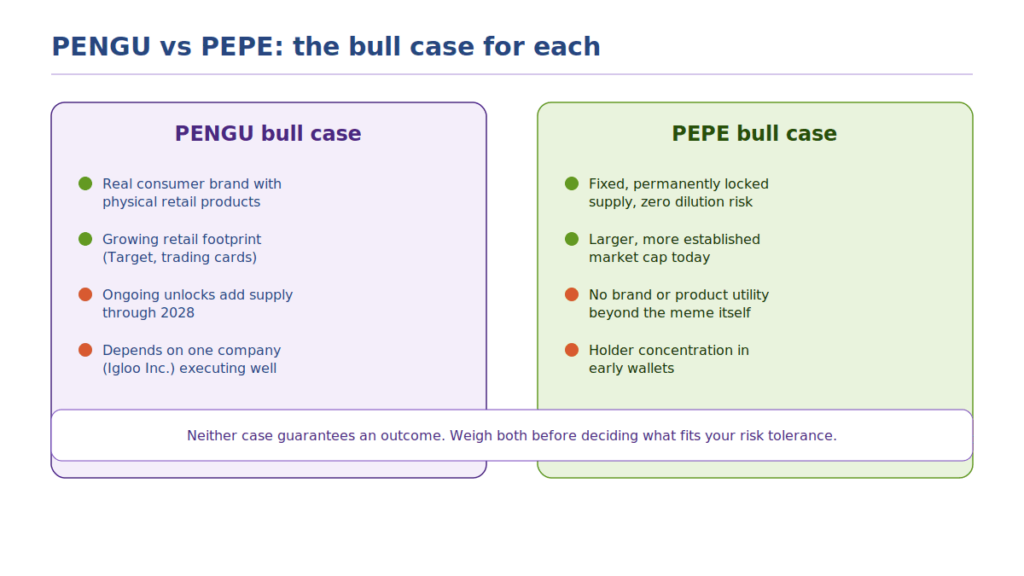
Rather than pick a winner, here’s the honest case for each side. The bull case for PENGU: real brand momentum and retail expansion could compound demand faster than scheduled unlocks dilute it, a genuine adoption catalyst PEPE lacks.
The bull case for PEPE: a fixed, locked supply removes dilution risk entirely, so any renewed meme coin cycle enthusiasm flows straight into price without new supply absorbing it.
The relative performance between the two will likely come down to which narrative captures more speculative demand in any given cycle, brand-driven or meme-driven, rather than either token’s fundamentals in isolation.
Yes, and for many investors that’s a reasonable answer to the PENGU vs PEPE investment question. They represent genuinely different bets, brand-driven versus meme-driven, Solana versus Ethereum, unlocking versus fixed supply, so holding both offers a form of diversification within the meme coin category, rather than concentrating on a single narrative.
There’s no universal answer to PENGU vs PEPE: PEPE offers supply certainty and a larger market cap, while PENGU offers real brand utility and retail momentum, both carry the volatility and speculative risk typical of any meme coin. If you’ve weighed the factors above, you can buy PENGU or buy PEPE directly on Mudrex starting from ₹100, or check live rates on the PENGU/INR and PEPE/INR converters first. Download the Mudrex app to get started, or subscribe to the Mudrex YouTube channel for regular market updates.
PENGU is backed by the Pudgy Penguins consumer brand with ongoing token unlocks; PEPE is a pure meme token with a fixed, permanently locked supply and no team allocation.
PEPE, at roughly $1.1 billion versus PENGU’s approximately $375-395 million as of writing.
It’s possible if brand-driven demand outpaces PENGU’s scheduled unlocks faster than PEPE’s fixed supply benefits from renewed meme coin interest, but neither outcome is guaranteed.
Neither has functional utility like governance or revenue share; PENGU has real brand and retail backing, while PEPE has none beyond its meme identity.
PENGU still has about 29% of its 88.88 billion supply left to unlock through 2028; PEPE’s 420.69 trillion supply is fully circulating and can only shrink through burns.
Both have deep liquidity and tens of millions in daily volume; PENGU’s holder base grew from a broad airdrop, while PEPE’s is more concentrated in early wallets.
Both carry meme coin risk: no independent utility, high volatility, and value driven by sentiment. PENGU adds dilution risk from unlocks; PEPE adds concentration risk from early holders.
Yes, holding both offers diversification across two different meme coin theses rather than betting on a single narrative.
PENGU and PEPE are highly volatile, community-driven cryptocurrencies. This article is for educational purposes only and is not financial advice. Past performance does not guarantee future results, and this article does not promise or imply any specific returns. Do your own research and consult a qualified financial advisor before investing.