
Spend ten minutes watching a live Bitcoin (BTC) chart, and you will realise something interesting. The market is almost never still. Price pushes higher, gets rejected, finds support, bounces again, and repeats the same cycle over and over. To most people, these are random candles. A scalper may treat them as potential setups. That is the idea behind scalp trading in crypto futures.
Instead of waiting hours or days for Bitcoin to make a big move, scalpers look to capture small price swings that happen throughout the trading session. A single trade might last only a few seconds or a few minutes before it is closed and the trader starts looking for the next setup. The goal is not to catch the biggest move of the day. It’s to consistently take small, high-quality opportunities while keeping risk under control.

This guide explains scalp trading in crypto futures, including market context, timeframes, liquidity, indicators, leverage, fees and risk controls for short holding periods.
Scalp trading in crypto futures is possible around the clock because crypto markets do not close. Unlike stock markets, where trading stops after market hours, crypto markets run 24/7. Whether it is the Asian, European, or US session, there is almost always enough volatility to keep active traders interested. But that is only part of the story. Scalpers also need markets where they can enter and exit quickly without allowing spread, fees and slippage to overwhelm a small target.
That is why pairs like BTC/USDT and ETH/USDT are among the most popular for scalping. They usually offer deep liquidity, tight bid-ask spreads, and enough trading volume for orders to be filled efficiently. If you have ever clicked Buy only to realise your order executed at a slightly worse price, you have already experienced slippage. For a swing trader chasing a 15% move, that might not matter much. For a scalper targeting less than 1%, it can materially change the trade’s net result.
Crypto futures let traders take long or short positions to express a directional view. If momentum is building, they can go long. If buyers lose control and sellers step in, they can simply flip their bias and go short. That is one of the biggest reasons active traders prefer futures over spot markets.
One of the biggest myths about scalping is that disciplined traders are constantly clicking Buy and Sell. They’re not. In reality, disciplined scalpers spend far more time waiting than trading. Most of their job is watching how price reacts around key levels. Is support holding? Are buyers stepping in with conviction? Is resistance starting to weaken? Is volume confirming the move, or is it just another fake breakout?
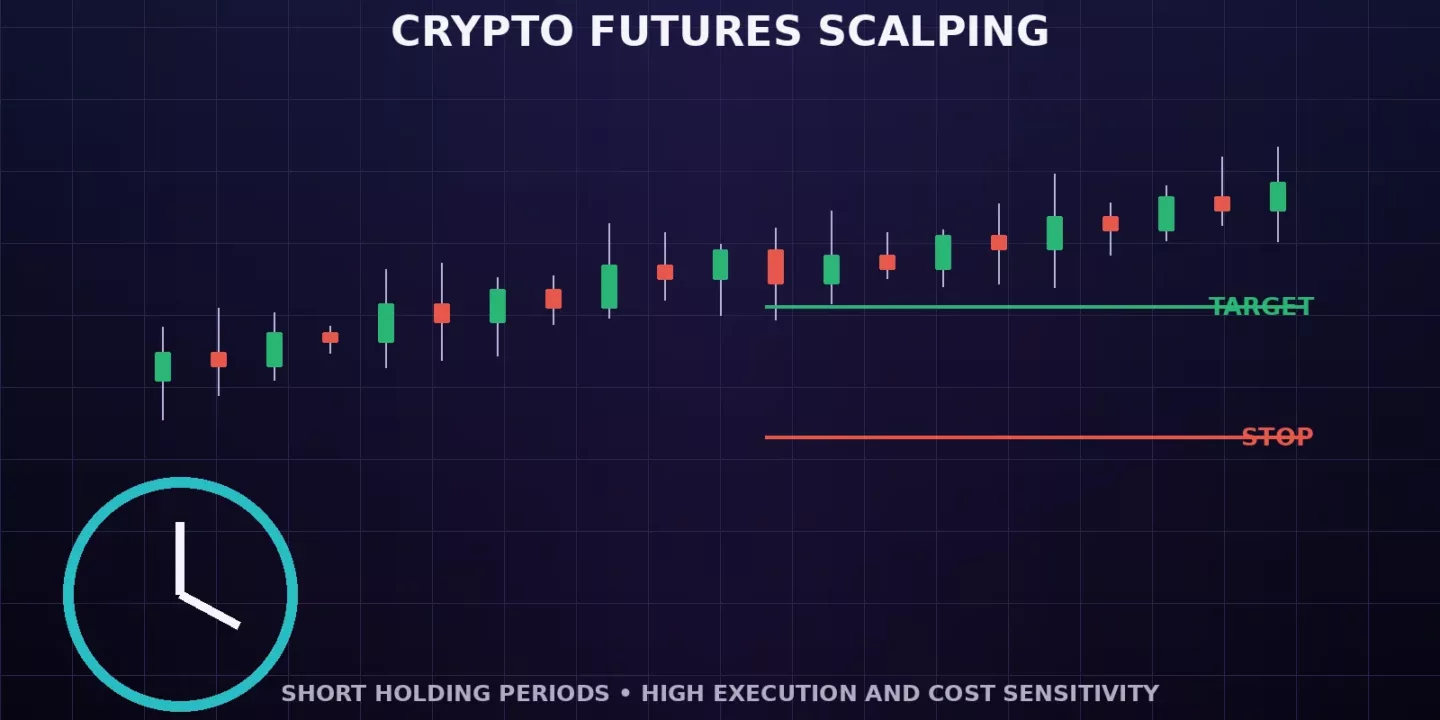
Those questions matter far more than trying to predict where Bitcoin will be tomorrow. When the pieces start lining up, a possible setup becomes easier to define. Before entering a position, disciplined scalpers already know where they’ll get in, where they’ll get out. In addition, exactly where they’ll admit they are wrong. There is no guessing once the trade is live.
Leverage is one of the biggest reasons traders choose crypto futures, but it is also a feature that can rapidly increase account losses. Many beginners think higher leverage automatically means higher profits. Disciplined traders know that is the wrong way to look at it. They decide how much they are willing to risk first. Only then do they choose the leverage that fits the setup.
Remember, leverage does not just magnify potential gains,it magnifies mistakes too. The higher the leverage, the closer your liquidation price moves to your entry, leaving much less room for the market to breathe. Disciplined scalpers do not treat leverage as an edge. They rely on consistency. In scalp trading in crypto futures, leverage is only a tool; it does not improve the quality of a setup.
| Feature | Scalp trading | Day trading |
| Holding time | Seconds to minutes | Minutes to hours |
| Objective | Capture several small moves | Capture larger intraday moves |
| Trade frequency | Usually high | Usually moderate |
| Operational demand | Very high execution and monitoring demand | Lower frequency but still active management |
Ask ten disciplined scalpers what gives them the confidence to enter a trade, and most will not mention an indicator. They’ll talk about price. Disciplined scalpers trust price first because every indicator reacts to what the market has already done. Price moves first. Indicators simply catch up. The first question they ask is not, “What does RSI say?”
It’s, “Who’s in control right now?” Are buyers stepping in aggressively? Are sellers defending a key level? Is momentum building, or is the market simply drifting sideways? Those answers come from price action, and that is where every good setup begins.
One of the biggest mistakes beginners make is treating support and resistance as exact prices. Disciplined traders do not. They see them as reaction zones where buyers and sellers fight for control. Imagine Bitcoin rallies into a resistance zone that is rejected price several times before. The level itself is not what matters. The reaction is. Is every rally getting sold into?
Are buyers absorbing the selling pressure and refusing to give up ground? Is the order flow becoming more aggressive, or is buying interest starting to dry up? Is volume confirming the move, or quietly fading away? Those clues reveal far more than a horizontal line ever will. The same idea applies to support. A support level is not important because it worked yesterday, it is important because buyers continue defending it today.
Disciplined scalpers also know that not every breakout deserves to be traded. They’re usually happy to let the market prove a move is genuine before committing capital. Missing the first few dollars of a breakout is almost always cheaper than getting trapped in a fake breakout.
Many beginners spend hours searching for the perfect indicator. The truth is, there is not one. Most disciplined scalpers keep their charts surprisingly clean. Indicators are there to confirm what price is already saying, not tell them what to do. Take the Relative Strength Index (RSI).
One of the quickest ways to get trapped is blindly shorting Bitcoin because RSI crossed above 70. Strong trends do not reverse simply because an indicator reaches a certain number. An overbought market can stay overbought far longer than most traders expect. The Exponential Moving Average (EMA) is used in a similar way. During strong trends, many scalpers use a fast EMA to judge whether momentum is still healthy. As long as price keeps respecting it during pullbacks, the trend often remains intact.
More coherent setups tend to appear when price action, market structure, volume, and indicators all tell the same story.
The 1-minute chart attracts many beginners because it is fast, exciting, and full of opportunities. It’s also full of noise. Every candle can feel like the start of the next big move, making it easy to overtrade. That is why many disciplined scalpers first check the 15-minute or 5-minute chart to understand the bigger picture before dropping to the 1-minute chart for a precise entry. Trading with the prevailing trend is usually far easier than fighting against it.
The goal is not to take more trades. It’s to take better ones.
One lesson disciplined scalpers learn is that doing nothing is sometimes the best trade. Bitcoin will not trend cleanly every session. Some days are slow, choppy, and filled with fake breakouts that tempt impatient traders into poor entries. Chasing every candle usually leads to unnecessary fees, avoidable losses, and emotional decision-making. Disciplined scalpers do not feel the need to always be in the market. They wait until price, momentum, liquidity, and market structure all begin working together.
The market will always create another opportunity. Make sure you are still around to take it.
Spend enough time studying disciplined crypto traders and you will notice something. The traders who last are not always the ones with the best entries. They’re the ones who know exactly what to do when the market proves them wrong. Every scalper gets stopped out. A breakout fails. Momentum disappears.
That is not a sign you are a bad trader. It’s simply part of it. The difference is that disciplined scalpers expect losing trades. They do not build strategies around being right every time, they build them around making sure one bad trade never becomes a bad week.
Ask a beginner what they are looking for before entering a trade, and they’ll usually talk about profit. Ask an experienced scalper, and you will hear a different question. “Where am I wrong?” Before clicking Buy or Sell, they already know their entry, stop-loss, take-profit, position size. In addition, the maximum amount they are prepared to lose.
Once the trade is live, there is not much left to decide. The plan has already been made. That is why disciplined traders rarely panic when the market moves against them. They accepted the risk before entering the position.
When you are only aiming for a small price move, every detail counts. A little slippage. A wider bid-ask spread. An unnecessary taker fee.
One trade will not make much difference. Hundreds of trades will. That is why disciplined scalpers usually trade highly liquid pairs like BTC/USDT and ETH/USDT. Better liquidity often means tighter spreads, smoother execution, and more predictable fills. Sometimes improving your results is not about finding a bigger move. It’s about keeping more of the profit you have already earned.
Most beginners think scalping is about learning indicators. Disciplined traders know it is mostly about managing yourself. Win a few trades in a row, and confidence can quickly turn into overconfidence. Lose a couple, and the temptation is to jump straight back into the market and win the money back. Every trader feels those emotions. Disciplined scalpers simply do not let those emotions make trading decisions.
They trust their process instead.
Most improvement happens after the trading session ends. Many disciplined scalpers review every trade, save screenshots, and keep a trading journal. They’re not looking for perfect trades. They’re looking for patterns.
Did they follow their plan? Did they enter too early? Did emotion influence the decision? Over time, those small lessons become one of the biggest advantages a trader can have.
Scalp trading in crypto futures is not about finding a perfect indicator or using the highest leverage. It is about reading price action, controlling execution risk and following a repeatable process.
The traders who remain consistent are not the ones who predict every move correctly. They’re the ones who protect their capital, stay patient, and trust a repeatable process instead of their emotions. The market will always create another opportunity. The real edge is making sure you are ready when it does.
Continue learning on Mudrex Learn, watch the Mudrex YouTube channel, or trade crypto futures on Mudrex. Crypto derivatives carry substantial risk; use only capital you can afford to lose.
Scalp trading in crypto futures is a trading style where positions are opened and closed within seconds or minutes to profit from small price movements. Instead of waiting for one large trend, scalpers aim to build returns by capturing multiple smaller opportunities throughout the day.
Scalpers look for short-term opportunities using price action, market structure, liquidity, and technical indicators. Once a setup meets their trading plan, they enter a position, manage their risk with predefined stop-loss and take-profit levels, and exit the trade quickly.
It can be, but it has a steep learning curve. New traders should focus on understanding risk management, use lower leverage, and practise on a demo account before trading with real funds.
Most scalpers use the 1-minute and 5-minute charts. A common approach is to analyse the broader trend on the 5-minute chart before using the 1-minute chart to fine-tune entries and exits.
Neither is better in every situation. The 1-minute chart offers more opportunities but also more market noise. The 5-minute chart provides clearer market structure and can help traders avoid lower-quality setups.
There isn’t a single “best” indicator. Many experienced scalpers combine RSI, EMA, trading volume, and support and resistance with price action instead of relying on any one indicator.
Scalpers aim to profit from small price movements by executing multiple trades during a session. While individual gains are often modest, consistency and disciplined risk management can compound those gains over time.
Yes. Bitcoin futures are among the most popular markets for scalping because they typically offer deep liquidity, tight spreads, and strong trading volume.
Leverage can increase both potential profits and potential losses. Experienced traders use it carefully as part of their overall risk management rather than treating it as their trading edge.
Some of the biggest risks include liquidation, slippage, trading fees, overtrading, emotional decision-making, and sudden market volatility. Using sensible position sizing and stop-loss orders can help reduce those risks.
Scalpers often place many trades in a single session, so maker fees, taker fees, spreads, and slippage can have a significant impact on overall profitability. Keeping trading costs low is an important part of a successful scalping strategy.
Scalping focuses on capturing multiple small price movements over seconds or minutes. Day trading typically involves holding positions for longer and targeting larger intraday trends.
Yes. Many traders use automated bots to execute predefined scalping strategies. However, bots still require careful configuration, ongoing monitoring, and sound risk management. They don’t guarantee profitable trades.
The simplest way to reduce liquidation risk is to use lower leverage, trade smaller position sizes, set stop-loss orders, and avoid risking more capital than you can comfortably afford to lose. Learning to protect your downside is often more important than chasing bigger returns.