

Bitcoin vs Bitcoin ETF is the question every new investor eventually runs into: both track the same asset, but owning actual BTC and owning shares of a fund that holds BTC on your behalf are genuinely different experiences, with different costs, tax outcomes, and risks attached.
Since the SEC approved the first 11 spot Bitcoin ETFs in January 2024, the category has grown to 13 funds in the year 2026, holding tens of billions of dollars, making this a real choice rather than a hypothetical one.

This guide compares Bitcoin or Bitcoin ETF across fees, custody, tax treatment, and access, covering direct Bitcoin vs spot Bitcoin ETF and the full BTC vs ETF investment picture, so you can decide what actually fits your situation.
A spot Bitcoin ETF is a fund that holds actual BTC in custody and issues shares that track its price, traded on a regular stock exchange through normal brokerage access rather than a crypto exchange account. Authorized participants create and redeem large blocks of shares against the fund’s Bitcoin holdings, which keeps the ETF’s price closely tracking the spot Bitcoin price, though a small tracking difference can still show up day to day.
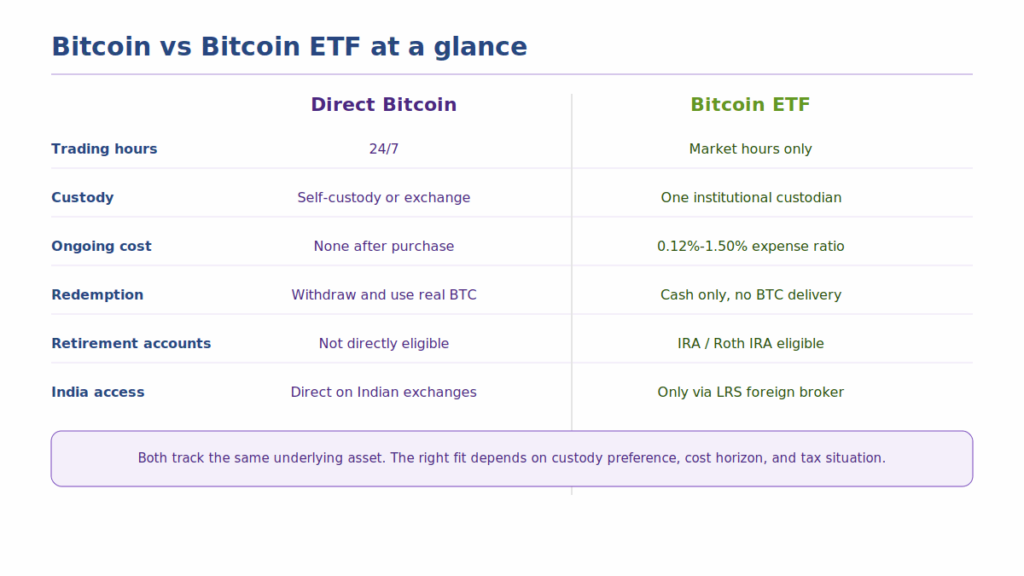
| Factor | Direct Bitcoin | Bitcoin ETF |
| Ownership | You hold the actual asset | You hold fund shares backed by BTC |
| Trading hours | 24/7 market | Stock exchange hours only |
| Custody | Self-custody or exchange wallet | Institutional custodian (mostly one firm) |
| Ongoing cost | None (one-time trade fee) | Expense ratio, 0.12%-1.50% annually |
| Redemption | Can withdraw and use the actual BTC | Cash only; no BTC withdrawal for retail investors |
| Retirement account eligible | Not directly | Yes, in IRAs, Roth IRAs, and similar accounts |
Weighing these Bitcoin ETF advantages and disadvantages side by side is the fastest way to see which column matches how you actually want to invest.
Yes. Spot Bitcoin ETFs are backed by actual BTC held by a custodian, not futures contracts or synthetic exposure. But retail investors never touch that Bitcoin directly: creation and redemption happen in cash at the shareholder level, so buying IBIT or FBTC gives you regulated exposure to Bitcoin’s price, not a claim you can redeem for coins. Custody itself is concentrated: an estimated 80% of all ETF-held Bitcoin sits with a single custodian (primarily Coinbase Custody), a real institutional product convenience but also a concentration point worth knowing about.
It depends on your holding period and trading style. Bitcoin ETF fees are an ongoing expense ratio, ranging from as low as 0.12%-0.14% (BlackRock’s IBIT and the newer Morgan Stanley Bitcoin Trust) up to 1.50% for the original Grayscale GBTC, deducted continuously from the fund’s net asset value.
Buying Bitcoin directly costs a one-time exchange fee (roughly 0.16%-3.99% depending on the platform and order type) plus small on-chain withdrawal fees if you self-custody. For a buy-and-hold investor, a $50,000 position in a 0.25% expense ratio ETF costs roughly $625 over five years in cumulative fees; the same amount bought directly at a competitive rate can cost under $100 total, with no further ongoing cost. Frequent traders may find the math shifts back toward an ETF’s tight, brokerage-standard spreads.
This is the heart of Bitcoin custody vs brokerage. Direct ownership means you (or your exchange) hold the private keys; self-custody removes counterparty risk entirely but shifts private-key risk onto you, lose your keys or seed phrase, and the Bitcoin is unrecoverable. A Bitcoin ETF removes that specific risk by outsourcing custody to a regulated institution, but introduces counterparty and concentration risk instead, you’re trusting the custodian’s security and operational integrity, and a large share of the category’s assets sit with one firm.
Not directly. US-listed spot Bitcoin ETFs aren’t available on Indian exchanges; accessing one would require routing through the RBI’s Liberalised Remittance Scheme via an international broker, similar to how Indians access US stocks.
Direct Bitcoin ownership, by contrast, is available immediately on Mudrex, with no foreign remittance needed.
Tax treatment is where this gets genuinely complicated, and worth a professional’s input rather than a blog’s. Direct crypto held by an Indian investor is taxed as a Virtual Digital Asset: a flat 30% rate with no loss offset against other income. A US-listed Bitcoin ETF bought via LRS would likely fall under standard foreign capital asset rules instead, a meaningfully different regime, but this hasn’t been extensively tested and shouldn’t be assumed without checking with a tax advisor first.
No, not for retail investors. The redemption mechanism for Bitcoin ETF shares settles in cash on both the buy and sell side; you can sell your shares for money, but you can’t redeem them for actual BTC to move to a wallet, use in DeFi, or spend directly. If having the option to actually hold, move, or use the underlying asset matters to you, that’s a meaningful point in favor of direct ownership over paying an ongoing management fee for a wrapper you can’t unwrap.
Yes, and plenty do. A hybrid approach, some Bitcoin ETF exposure inside a retirement account where direct crypto isn’t easily eligible, plus direct BTC held for actual use, portfolio allocation flexibility, or lower long-term cost, isn’t unusual. There’s no rule that says it has to be one or the other.
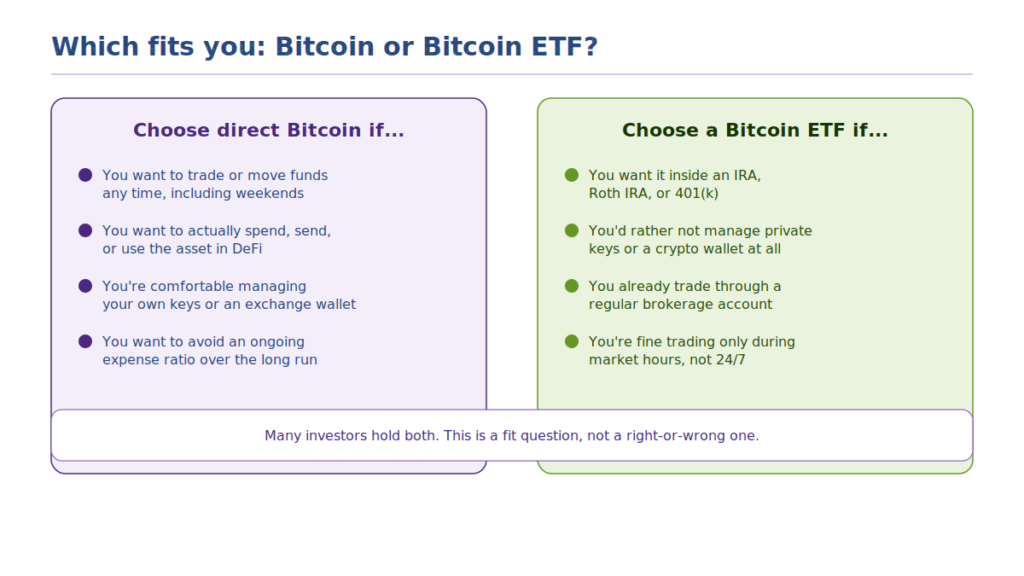
Neither wins outright; it depends on what you’re optimizing for. If retirement-account eligibility, brokerage familiarity, and not managing private keys matter most, a Bitcoin ETF’s regulated exposure fits that brief. If 24/7 trading, actually being able to use or move the asset, and lower long-run cost matter more, direct Bitcoin ownership through a regulated exchange is the more natural fit. Own Bitcoin or an ETF isn’t really a question with one right answer, it’s a question about which tradeoffs you’re comfortable making.
Bitcoin vs Bitcoin ETF comes down to custody, cost, tax treatment, and what you actually want to do with the asset, not which one is objectively superior.
If direct ownership fits what you’re after, you can buy Bitcoin on Mudrex starting from ₹100, check the live BTC/INR rate, or track it on the live BTC chart. Go to Mudrex to get started, or subscribe to the Mudrex YouTube channel for regular market updates.
Direct Bitcoin means you own the actual asset; a Bitcoin ETF means you own shares of a fund that holds BTC on your behalf, traded through a regular brokerage account.
Yes, spot Bitcoin ETFs hold actual BTC in custody, but retail investors can’t redeem shares for the underlying coins.
It removes private-key risk but introduces custodian concentration risk instead; “safer” depends on which risk you’re more worried about.
For long-term holding, direct ownership is usually cheaper since ETFs charge an ongoing expense ratio while direct purchases are typically a one-time fee.
No. Bitcoin ETF shares settle in cash only; there’s no mechanism for retail investors to redeem shares for actual BTC.
Direct ownership shifts risk to you or your exchange; ETFs shift it to an institutional custodian, with a large share of the category concentrated in one firm.
Not domestically. Accessing a US-listed Bitcoin ETF would require an LRS-based international broker; direct Bitcoin ownership is available immediately on Indian exchanges.
Yes, a hybrid approach combining both is common and reasonable depending on your account types and goals.
This article is for informational purposes only and does not constitute investment, tax, or legal advice. Tax treatment, especially for Bitcoin ETFs accessed from India, is complex and can change; consult a SEBI-registered investment adviser and a qualified tax professional before making investment decisions.