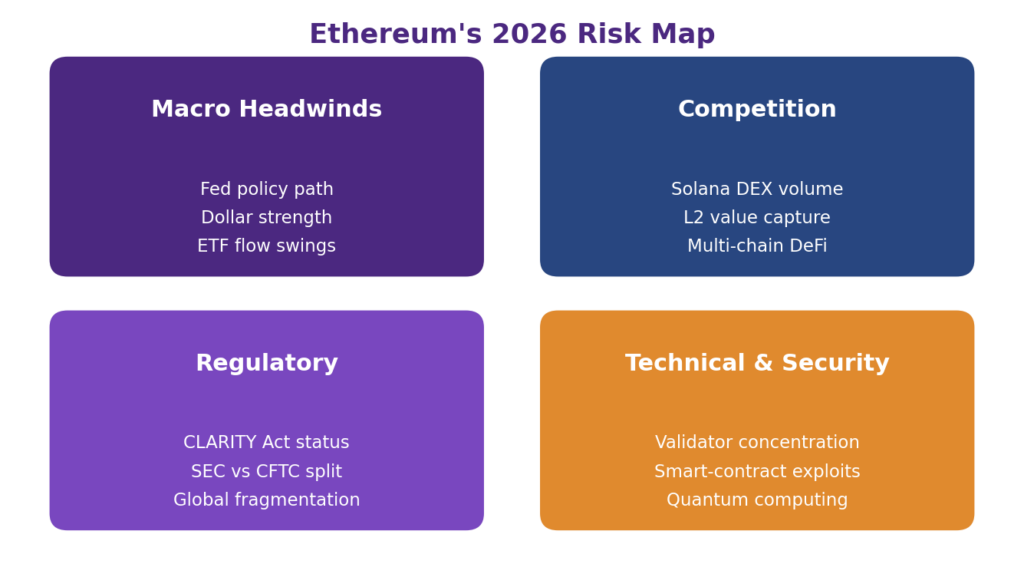
If you hold ETH or you’re thinking about buying it, 2026 is not a simple story. Ethereum risks in 2026 are coming from four directions at once: the Fed’s rate path is unsettled, Solana keeps winning on trading volume, US regulators are still finishing the rulebook, and Ethereum’s own tokenomics are under fresh debate.
None of these pressures are new on their own. What’s new is that they’re all live at the same time, right as ETH trades roughly 60% below its August 2025 high. Here’s what’s actually driving the risk, and what could offset it.
Key Takeaways
Macro pressure is the biggest near-term swing factor. Fed rate decisions, dollar strength, and ETF flows move ETH price more than most single crypto-specific headlines do.
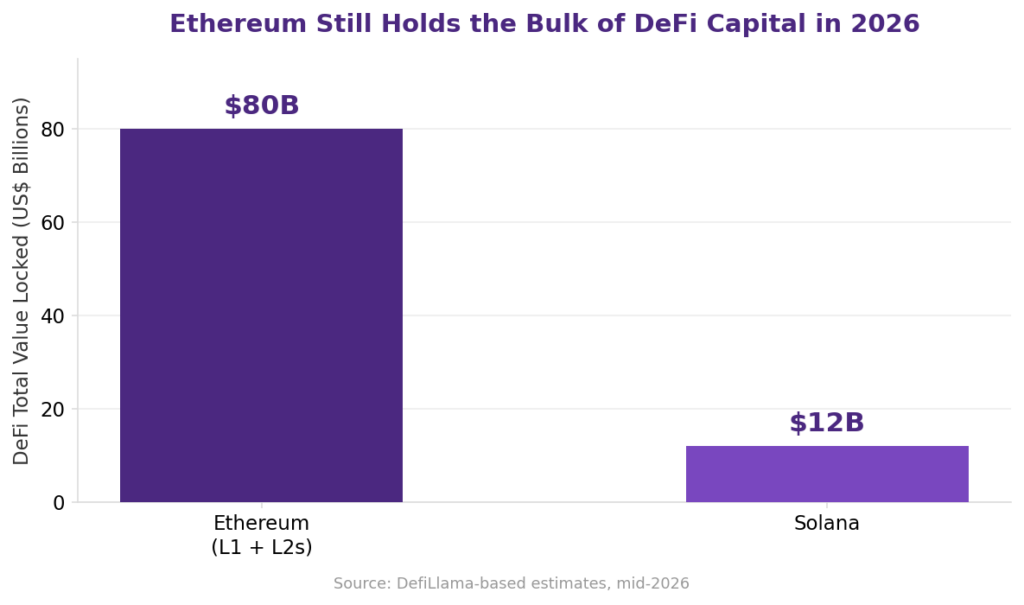
Solana leads on trading activity, not capital. Ethereum still holds the majority of DeFi’s locked capital, but Solana out-trades it on weekly volume.
Regulatory risk is shrinking, not disappearing. Ethereum has been informally classified as a digital commodity, but the law that would lock this in is still stuck in the Senate.
Quantum computing is a 2029+ problem, not a 2026 one. Ethereum’s core team is already building defenses years ahead of any real threat.
Ethereum’s supply model can swing between inflationary and deflationary depending on network activity, which adds a layer of uncertainty to long-term value.
Ethereum risks 2026 break down into four connected categories: macro conditions, competition, regulation, and technical/security factors. Each is covered in turn below, starting with the economy, since it moves ETH’s price the fastest.
Macro conditions are the single biggest swing factor behind Ethereum risks and opportunities in 2026. ETH trades like a high-beta risk asset, so it reacts fast to anything that changes how much cheap money is floating around the financial system. Three forces matter most: Federal Reserve policy, the strength of the US dollar, and the direction of spot ETF flows.
The Fed has stayed in wait-and-see mode through most of 2026. The central bank held rates for a fifth straight meeting in July, and hike odds swung from roughly 11% to 38% in just nine days before that decision. That kind of whiplash is exactly the sort of Ethereum macro factor that can move ETH several percentage points in a single session, with no crypto-specific news involved at all.
How Do Interest Rates Affect Ethereum’s Price?
Definition: Interest Rate Sensitivity This means how much an asset’s price moves in response to central bank rate decisions, since rates change how attractive “risk-free” returns like bonds look next to volatile assets like ETH.
When rates stay high, investors can earn steady returns from bonds and cash, so fewer of them bother with a volatile asset like Ethereum. When the Fed signals cuts, that calculation flips, and money tends to rotate back into risk assets, ETH included. This is one of the clearest Ethereum macro headwinds 2026 traders track, because it does not depend on anything Ethereum itself does.
Rising Treasury yields tend to hit ETH the hardest during the exact weeks the Fed is deciding policy. Thirty-year Treasury yields pushed above 5.20% in mid-2026 for the first time since 2007, which pulled some capital away from risk assets even before any rate change actually happened.
Is the Ethereum ETF Outflow Risk Something to Worry About?
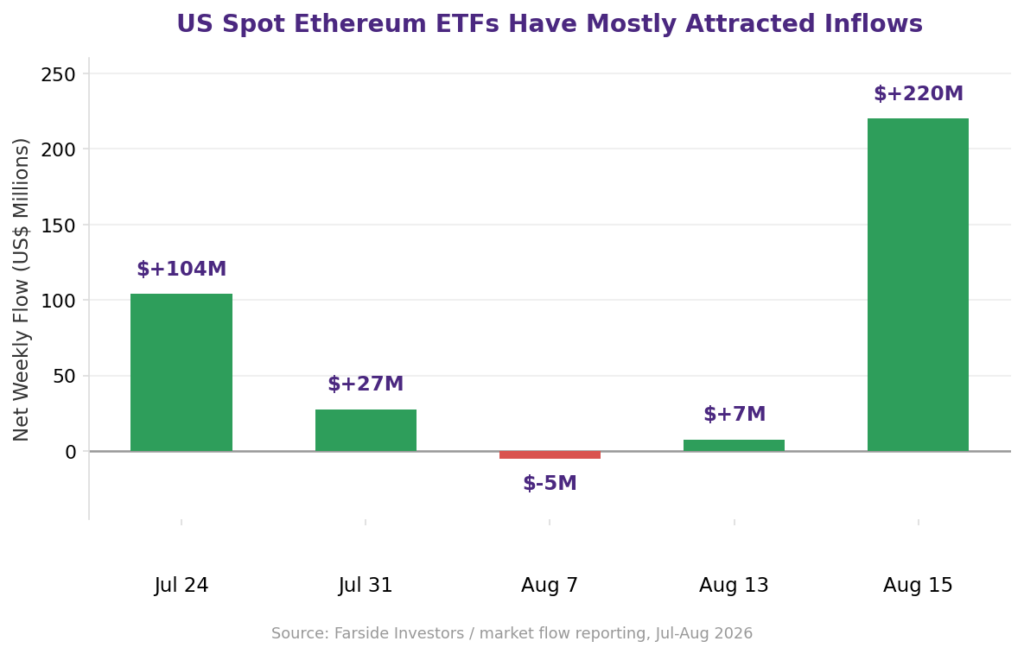
Ethereum ETF outflow risk gets a lot of attention, but the 2026 data tells a more balanced story than the headlines suggest. Spot ETH ETFs have posted net inflows in most recent weeks, even while Bitcoin ETFs saw the opposite.
BlackRock’s ETHA fund alone controls roughly 68% of US spot ETH ETF assets, which means the inflow trend is heavily concentrated in one product. A single large issuer pulling back could flip this picture quickly, so ETH investment risks tied to ETF concentration are worth watching even during a positive stretch.
If you’re comparing ETH’s setup against Bitcoin’s, our Ethereum price prediction breaks down how these flow patterns feed into longer-term price scenarios.
Is Solana a Serious Competition Risk for Ethereum in 2026?
Ethereum competition 2026 is really a story of two different chains winning at two different things. Solana is not close to displacing Ethereum’s capital base, but it has pulled ahead on a metric that matters just as much to traders: raw activity.
Ethereum’s DeFi ecosystem holds roughly $55.6 billion in total value locked, about 68% of the entire global DeFi market, according to mid-2026 tracking. Solana’s chain-level TVL sits far behind at roughly $8-12 billion. Capital, in other words, still overwhelmingly prefers Ethereum.
But trading tells a different story. Solana’s weekly DEX volume of $11.49 billion has outpaced Ethereum’s $7.62 billion in recent 2026 readings. More trades happen on Solana; more capital still sits on Ethereum. Both facts are true, and they point to a real Solana competition risk for Ethereum on the retail and trading-activity side of the market, even if the deposit base hasn’t shifted.
Does Layer 2 Growth Create a Value-Capture Risk for ETH?
Layer 2 value-capture risk for ETH is a subtler competition problem than Solana, and arguably a bigger long-term question. Layer 2 rollups like Base and Arbitrum process Ethereum-secured transactions far more cheaply than Ethereum’s own mainnet, which is good for users but complicates ETH’s economics.
Definition: Value Capture This refers to how much of the economic activity happening on a network actually flows back to holders of that network’s native token, rather than to a separate layer built on top of it.
When most transaction volume moves to L2s, mainnet fee burn slows down, which weakens one of the mechanisms that makes ETH’s supply deflationary during busy periods. Ethereum’s core developers are aware of this, and part of the reasoning behind the upcoming Hegotá upgrade is to keep improving base-layer capacity so the mainnet stays economically relevant rather than becoming a settlement layer that captures less and less value over time.
Can Regulation Still Limit Ethereum’s Growth in 2026?
Ethereum regulatory risks have eased substantially compared to a few years ago, but “eased” is not the same as “resolved.” The core question, whether ETH counts as a security or a commodity, has effectively been answered by regulators already, just not yet by law.
On March 17, 2026, the SEC and CFTC jointly classified 16 digital assets, including Ethereum, as digital commodities outside securities laws. That single decision removed years of Ethereum regulation and securities risk overhang, since it strips the SEC of the ability to treat ETH as an unregistered security going forward.
The catch is that this classification currently exists as agency guidance, not statute. A merged Senate text landed in July 2026, but the votes weren’t there before the August recess, and lawmakers have narrowed disagreement down to a handful of sticking points around stablecoin rewards and developer protections. Until the CLARITY Act actually passes, a future SEC leadership change could, in theory, walk the classification back.
Definition: CLARITY Act This is the pending US bill that would formally split crypto oversight between the SEC and CFTC, and legally define which digital assets count as commodities versus securities.
For traders and long-term holders alike, this is one of the more manageable risks of investing in Ethereum right now: the direction of travel is clearly favorable, even if the final legal lock-in is still pending in Washington. If you’re weighing how much of this uncertainty to price in, our guide on Ethereum volatility versus altcoin risk covers how to think about ETH’s risk profile relative to smaller tokens.
What Technical, Security and Centralization Risks Does Ethereum Face?
Ethereum scalability, security and centralization risks tend to get less daily attention than price and regulation, but they matter just as much to Ethereum’s long-term investment case. Three areas stand out: validator concentration, smart-contract exploits, and the more distant quantum computing threat.
On centralization, Ethereum’s validator set is large by crypto standards, but staked ETH is concentrated among a small number of liquid-staking providers and exchanges. That concentration doesn’t mean the network is unsafe today, but it’s a structural risk worth monitoring, since a small number of large stakers could theoretically coordinate in ways a fully distributed validator set could not.
Smart-contract risk remains a constant background hazard across DeFi, including on Ethereum. High-profile hacks have hit both Ethereum-native and Solana-native protocols in 2026, which is a reminder that this risk scales with how much value a chain secures, not with which chain it is.
What Quantum Computing Risk Does Ethereum Face?
Quantum computing risk to Ethereum sounds dramatic, but the near-term reality is calmer than the headlines suggest. Ethereum.org stated in May 2026 that no existing quantum computer can currently break Ethereum’s cryptography, and that remains true today.
That said, the Ethereum Foundation isn’t waiting around. A dedicated Post-Quantum Security team formed in January 2026, and Vitalik Buterin published a phased roadmap in February 2026 covering the network’s four quantum-vulnerable components: consensus signatures, data availability proofs, wallet signatures, and zero-knowledge proofs.
Quantum Readiness Milestone
Status (as of August 2026)
Post-Quantum Security team formed
Complete (January 2026)
Vulnerable components identified
Complete (February 2026)
Devnet testing of quantum-safe signatures
Complete (February 2026)
Full Layer 1 quantum-safe upgrade
Targeted by 2029
The realistic risk window sits years out, and Ethereum is already ahead of most blockchains in planning for it, which softens this particular ETH investment risk considerably.
Is Ethereum’s Supply Model an Investment Risk?
Ethereum’s tokenomics sit at the center of one of the oldest debates in the Ethereum risks 2026 conversation: does ETH’s uncapped supply make it inherently risky, or does its burn mechanism offset that? The honest answer is that it depends entirely on network activity.
Since the Merge, Ethereum burns a portion of every transaction fee. During high-activity periods, that burn can outpace new issuance, making ETH net deflationary. During quieter stretches, as much of 2026 has been, issuance can outpace burn, meaning supply grows rather than shrinks.
This swing between inflationary and deflationary states is itself the risk: unlike Bitcoin’s fixed 21 million cap, ETH holders can’t assume a permanently shrinking supply. Long-term investors weighing risks of investing in Ethereum should treat this as a variable tied to usage, not a fixed promise.
What Opportunities Could Offset These Ethereum Risks in 2026?
Ethereum risks and opportunities in 2026 exist side by side, and several developments could meaningfully offset the pressures above. Ethereum’s next major upgrade, Hegotá, is being scoped now from a list of 66 proposals, with core developers narrowing the list over the coming months ahead of an expected 2027 release.
Privacy improvements could reduce the outside infrastructure privacy-focused apps currently need, per proposals like Frame Transactions.
CLARITY Act passage would convert today’s favorable agency guidance into durable law.
Continued ETF inflows would deepen institutional demand beyond the current ETHA-driven concentration.
Quantum-safe upgrades already in devnet testing reduce a multi-year tail risk well ahead of any real threat.
Staking also remains a structural offset to volatility, since it gives long-term holders a yield stream independent of price direction. Our guide on Ethereum futures and hedging strategies covers how some investors use derivatives to manage downside risk without exiting a position entirely.
Conclusion
Ethereum risks in 2026 span four connected fronts: macro policy, competition from faster chains, an unfinished regulatory rulebook, and structural questions around security, centralization, and supply. None of these are fatal on their own, and several, like the regulatory classification and quantum-readiness work, are trending in Ethereum’s favor. The realistic takeaway is that ETH remains a higher-risk, higher-volatility asset whose 2026 story depends heavily on factors outside crypto entirely, especially Fed policy.
Ready to track ETH yourself? Download the Mudrex app for Android or iOS to follow live prices, or subscribe to the Mudrex YouTube channel for weekly market breakdowns.
FAQs
What are the main risks facing Ethereum in 2026?
The four biggest are macro pressure from Fed policy, competition from faster chains like Solana, unfinished US regulation, and structural risks around validator concentration and supply.
Is Solana a serious competitive threat?
Solana leads on trading volume and transaction speed, but Ethereum still holds far more DeFi capital, so the threat is real but partial.
Can regulation limit Ethereum adoption?
Regulatory risk has fallen sharply since Ethereum’s 2026 commodity classification, but the law that would make it permanent hasn’t passed yet.
Does Layer 2 growth weaken ETH value capture?
Yes, to a degree, since cheaper L2 transactions reduce mainnet fee burn, though ongoing upgrades aim to keep the base layer economically relevant.
What opportunities could offset these risks?
The Hegotá upgrade, potential CLARITY Act passage, steady ETF inflows, and early quantum-safe development all work in Ethereum’s favor if they land as planned.
Is Ethereum becoming inflationary?
It depends on activity: high network usage burns more ETH than is issued, while quiet periods can let supply grow instead of shrink.
Risk Disclaimer
Cryptocurrency investments, including Ethereum, carry a high risk of loss and are highly volatile. Any use of leverage or futures magnifies both potential gains and potential losses. The scenarios, figures, and examples in this article are illustrative and for educational purposes only; they are not financial advice or a guarantee of future performance. Please consult a qualified financial advisor before making any investment decisions.
Siri is a writer venturing into the exciting realms of blockchain technology, cryptocurrency, and decentralized finance (DeFi), eager to explore the transformative potential of these innovations. She brings a unique perspective that bridges traditional industries and cutting-edge technology, often infused with a touch of humor through memes. She has a rich background in real estate and interior design, having previously contributed to NoBroker, where she crafted blogs and assets on these topics.