Live now: Ethereum is trading around $1,870 (₹1.87 lakh) as of August 5, 2026.
If you want a clear Ethereum price prediction, here is the direct answer. Most current models place ETH between roughly $1,500 and $4,000 through 2026, with higher ranges into 2030 if staking demand, ETF inflows, and Layer-2 growth hold up. The near term stays choppy, so this Ethereum price prediction covers the short term, the yearly outlook, and the INR view using live data rather than dated figures.
Where Ethereum Stands Today
Ethereum reached an all-time high of about $4,954 in August 2025 and is now trading roughly 62% below that peak. Over the past year, ETH is down close to 47%, so the broader trend has been weak even as monthly moves turn positive.
Unlike Bitcoin, Ethereum has no fixed supply cap. Its supply is managed through issuance to stakers and the EIP-1559 burn mechanism, which permanently removes ETH from circulation with network activity. That makes any Ethereum price prediction a function of usage and demand rather than pure scarcity.
Ethereum Price Prediction Based on Technical Analysis
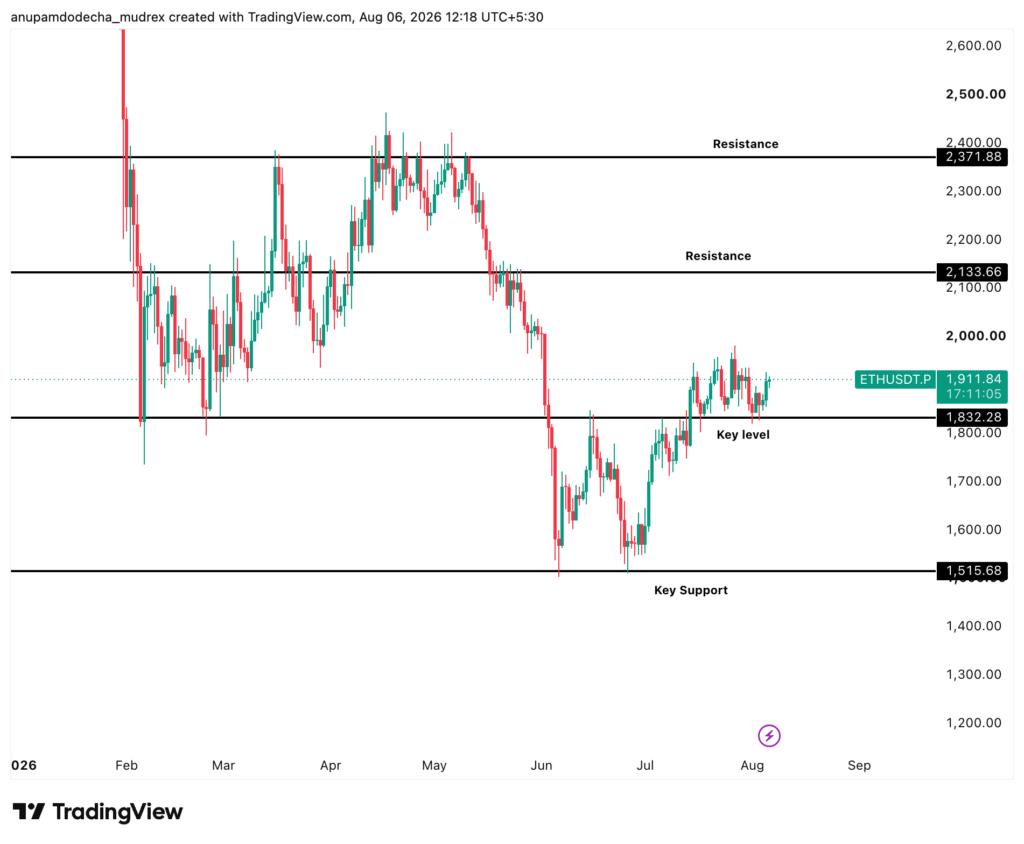
Recent price action has been range-bound. ETH has traded a choppy pattern roughly between $1,850 and $1,930, supported by steady spot ETF inflows but capped by tight monetary policy and regulatory uncertainty. Quantitative funds have been trimming positions while leveraged longs remain, which reflects a market without a clear breakout.
What the current read shows:
Trend: Higher-timeframe structure still weak, down ~47% year on year
Short term: Consolidation inside a narrow band, no confirmed breakout
Catalyst ahead: The Glamsterdam upgrade, expected end-August 2026
Short-Term ETH Forecast: This Week and This Month
The near-term picture is consolidation, not collapse. ETH keeps defending the low $1,800s while struggling to hold above $1,900. A decisive close above resistance would open room toward the $2,000+ zone; losing support would expose lower levels.
Levels to watch:
Support: $1,830 → $1,516
Resistance: $2,134 → $2,372
ETH Key Levels
The Glamsterdam upgrade at the end of August is the key near-term event. It is described as the largest upgrade since the Merge, with changes aimed at MEV resistance. Upgrades can act as catalysts, but there is no confirmed data yet on adoption or short-term price impact, so treat any pre-upgrade rally with caution. You can convert ETH to INR at the live rate on our converter.
Key Strengths of Ethereum
Smart contract dominance: The largest platform for DeFi, NFTs, and Web3 apps
Staking: Proof-of-Stake lets holders earn yield and locks up supply
Layer-2 scaling:Arbitrum, Optimism, and others cut fees and expand capacity
Deflationary pressure: The EIP-1559 burn can offset issuance during active periods
Institutional access: Spot Ethereum ETFs channel traditional capital into ETH
Risks to Monitor
No supply cap: Value relies on demand, not hard scarcity
Regulation: Staking and ETF rules remain a moving target in major markets
Competition: Rival Layer-1s compete for developers and users
Macro pressure: Tight monetary policy weighs on risk assets
Execution risk: Delayed or flawed upgrades can dent confidence
Ethereum Price Prediction Table 2026–2030 (USD)
These are scenario ranges, not promises, and assume no major shock.
Year
Bear
Base
Bull
Core Driver
2026
$1,500
$2,800
$4,000
ETF flows, Glamsterdam upgrade
2027
$2,200
$3,800
$5,500
Layer-2 adoption, staking growth
2028
$3,000
$5,000
$7,500
RWA tokenization, DeFi expansion
2029
$3,800
$6,500
$9,000
Institutional integration matures
2030
$4,500
$8,000
$12,000
Settlement layer for tokenized assets
Ethereum Price Prediction in INR 2026–2030
For Indian investors, the rupee view matters most. Below is the same base case in INR, using the current rate near ₹1.87 lakh per ETH (roughly ₹100 per dollar; the live rate shifts daily).
Year
Base (USD)
Approx. INR
2026
$2,800
~₹2.8 lakh
2027
$3,800
~₹3.8 lakh
2028
$5,000
~₹5.0 lakh
2029
$6,500
~₹6.5 lakh
2030
$8,000
~₹8.0 lakh
INR figures move with both the ETH price and the rupee-dollar rate, so treat them as indicative.
2026: The year hinges on the Glamsterdam upgrade and the pace of ETF inflows. A base case near $2,800 assumes gradual recovery from the current range, with the bull case tied to a strong upgrade reception and sustained inflows.
2027: Layer-2 adoption and rising staking participation tighten effective supply. If usage climbs, ETH has room toward the mid-$3,000s in the base case.
2028: Real-world asset tokenization and DeFi growth are the swing factors. Ethereum’s role as settlement infrastructure could push it toward $5,000 if adoption compounds.
2029: Deeper institutional integration and maturing products support a base case in the mid-$6,000s, though competition from rival chains remains a live risk.
2030: If Ethereum cements its position as the settlement layer for tokenized assets, the base case reaches $8,000, with wide bull and bear spreads reflecting real uncertainty this far out.
What Analysts Are Saying
Sentiment among institutions is split. Some desks maintain a long-term bullish thesis on Ethereum tied to staking and tokenization, even while trimming near-term targets. Others flag that regulatory clarity and macro conditions must improve before ETH can retest prior highs. As always, treat named targets as opinions, not guarantees, and note that forecasts get revised as conditions change.
Conclusion: Is Ethereum a Long-Term Buy?
The base-case Ethereum price prediction points to a wide $1,500–$4,000 range through 2026 and materially higher scenario ranges into 2030, supported by staking, Layer-2 growth, and institutional access. The near term is consolidation-driven and event-sensitive, so this Ethereum price prediction is best read as a range of outcomes. If you want to act on it, you can buy Ethereum on Mudrex in minutes, and beginners can follow our guide on how to buy Ethereum in India.
Disclaimer: Crypto products and NFTs are unregulated and can be highly risky. There may be no regulatory recourse for any loss from such transactions. This is general information, not financial advice.
FAQ
Why is ETH falling right now?
Recent weakness reflects a broad downtrend, with ETH down about 47% over the past year on tight monetary policy and profit-taking, even as monthly moves have turned slightly positive.
How much will Ethereum be worth in 2030?
Scenario ranges span roughly $4,500 to $12,000, with a base case near $8,000, driven by tokenization, staking, and Layer-2 adoption. These are estimates, not guarantees.
What is the Ethereum price prediction for 2026?
Most models place ETH between $1,500 and $4,000 in 2026, with a base case near $2,800, subject to ETF flows and the Glamsterdam upgrade.
Is ETH predicted to go up?
Base-case forecasts point higher over the 2026–2030 window, but the path is volatile and depends on adoption, regulation, and macro conditions.
Will Ethereum hit $10,000?
A $10,000 ETH sits within some 2030 bull-case scenarios but would require sustained tokenization demand, strong ETF inflows, and broad Layer-2 adoption.
Will ETH reach $50,000?
A $50,000 ETH is well beyond current credible 2026–2030 models and would require a far larger market cap than any near-term forecast supports.
Ethereum could outperform Bitcoin in a given cycle if smart-contract demand surges, but it has no fixed supply cap and a different thesis. See our Bitcoin price prediction for the comparison.
What is 1 ETH worth in 2030 in INR?
A base case near $8,000 converts to roughly ₹8 lakh at current rates, though the INR figure moves with both ETH price and the rupee-dollar rate.
Can AI predict Ethereum’s price?
AI models can spot patterns and process data quickly, but crypto prices hinge on unpredictable events, so no tool can forecast ETH reliably.
Anupam has over 3 years of experience in the crypto industry, having worked with top indian crypto exchanges. He writes about Bitcoin, altcoins, AI, and emerging tech, helping readers understand what’s driving markets and where the digital asset ecosystem is headed.