

For investors who have been waiting for a sign before taking digital assets seriously, this week brought one of the strongest yet.
The US SEC has proposed Regulation Crypto Assets, a new framework that would give crypto issuers clearer rules for token offerings and, more importantly, establish a path for certain crypto assets to eventually fall outside securities regulation.

The announcement was followed by a White House meeting involving President Donald Trump, SEC Chair Paul Atkins, CFTC Chair Mike Selig, crypto executives and representatives from the broader financial infrastructure industry.
The headline proposal includes two registration exemptions for qualifying crypto offerings.
One would cover offerings of up to $5 million over four years, while another would allow offerings of up to $75 million during a 12-month period. Instead of requiring the full disclosure regime traditionally associated with securities offerings, qualifying issuers would operate under a more tailored set of disclosure requirements.
But the industry’s attention is largely on another part of the proposal: a conditional safe harbour.
Under the SEC’s proposed approach, a token could potentially stop being treated as an investment contract once the issuer has completed (or permanently ceased) the essential managerial work it originally promised investors.
SEC Chair Paul Atkins described the proposal as providing a safe harbour once an issuer has completed or permanently stopped those essential managerial efforts.
For years, one of the biggest unresolved questions in US crypto regulation has been whether a token that may have initially been sold as part of an investment contract must remain a security indefinitely.
The SEC’s proposal begins to put a framework around that question.
The rules would also pre-empt certain state registration requirements for qualifying offerings and secondary-market transactions, potentially creating a more consistent national framework instead of forcing businesses to navigate overlapping state-level regimes.
The SEC announcement did not happen in isolation.
A day later, President Trump met with crypto executives and regulators at the White House, with discussions covering the Clarity Act, tokenization and the future regulatory structure for digital assets in the US.
The market responded with strength. For a detailed analysis of the surge, watch this video:
The involvement of both the SEC and CFTC is particularly notable. So is the growing participation of established financial-market infrastructure companies such as Nasdaq, NYSE, CME Group and DTCC in conversations around blockchain-based markets and settlement.
For the market, that institutional involvement is important.
Crypto is increasingly being discussed not simply as a parallel financial system, but as technology that may become integrated with existing capital markets, trading infrastructure and asset tokenization.
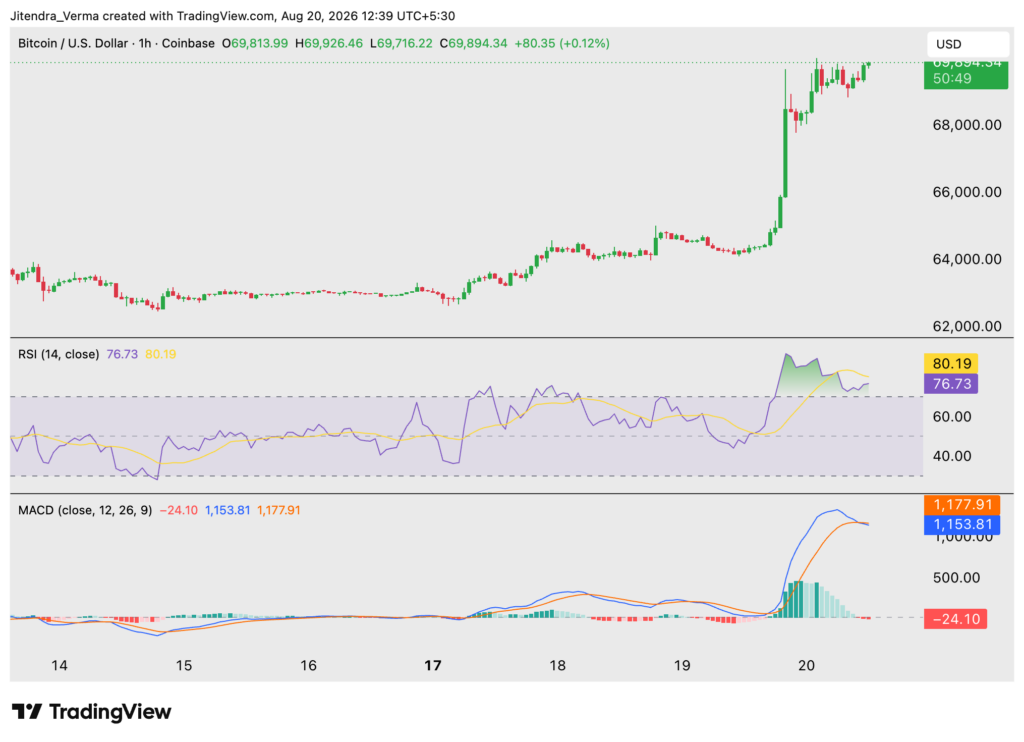
Recent market reactions have reflected that optimism as well. Bitcoin has moved back toward the $70K level, while the broader crypto market has rallied alongside improving liquidity conditions.
The most important takeaway is not that US crypto regulation is suddenly “finished.”
It isn’t.
The SEC’s framework is still a proposal. It will go through a public comment period before any final rule can be adopted, and details may change along the way. Broader crypto legislation in Congress also remains unresolved.
But the direction of travel has become considerably clearer.
For investors who have remained on the sidelines because they wanted evidence that the world’s largest capital market was moving toward formal rules for digital assets, this is a meaningful development.
The conversation is increasingly moving away from regulation through enforcement and toward defined registration pathways, clearer token classifications and rules that institutions can build around.
The future is now.