

Why is Ethereum underperforming in 2026? For most of the year, ETH fell harder than Bitcoin on the way down and gained less on the way back up, a gap best measured by the ETH/BTC ratio, which slid to a 10-month low near 0.024-0.027 in May. But the last few days flipped that script: between August 19 and 21, ETH rallied nearly 20% while Bitcoin gained about 7%, ETH actually outperforming for once, on the back of two Washington-linked catalysts.
This guide covers the structural reasons Ethereum has underperformed, what’s changed in the past week, and the levels that show whether the reversal has legs.

Why is Ethereum underperforming Bitcoin 2026, in dollar terms? ETH peaked near $4,954 in August 2025 and fell to roughly $1,550-1,600 by June 2026, Ethereum price weakness far steeper than Bitcoin’s drawdown over the same stretch. The clearest single measure of this ETH vs BTC performance gap isn’t ETH’s price in dollars, it’s the ETH/BTC ratio, which strips out moves that hit all of crypto at once. That ratio fell to roughly 0.024-0.027 in May, a 10-month low, down from levels above 0.035 earlier in the cycle.
Institutional capital has favored Bitcoin for most of 2026, part of a broader capital rotation toward the more established asset. Spot Bitcoin ETFs pulled in far larger sums than Ethereum’s ETF products for most of the year, concentrating institutional demand in BTC and widening the institutional demand gap, a clear sign of Ethereum’s relative weakness. Ethereum also carries a higher correlation to the Nasdaq 100 (around 0.78, versus Bitcoin’s roughly 0.55), making ETH the first asset sold when Treasury yields rise. Unlike Bitcoin, Ethereum also lacks a single, famous corporate treasury holder anchoring demand the way MicroStrategy-style buyers have for BTC, though firms like BitMine and SharpLink have built meaningful ETH treasury and staking positions.
Yes, and this is one of the more structural Ethereum underperformance reasons. Layer 2 networks like Base, Arbitrum, and Optimism were built to scale Ethereum by moving transactions off the expensive mainnet. That worked for users, but it also means a growing share of network growth and activity happens on L2s that settle back to Ethereum in bulk, rather than paying mainnet gas directly. This Layer 2 migration compresses the fees (and ETH burn) that used to accrue to mainnet, a real value capture problem even as the broader Ethereum ecosystem keeps expanding.
Partly, yes. Solana has captured a meaningful share of on-chain activity, especially meme coin and retail trading volume, competing directly with Ethereum and its Layer 2s for transactions, developer attention, and market-share loss shows up in metrics like DEX volume and social engagement. This adds to the competitive Layer 1s pressure Ethereum faces, on top of its own internal L2 fee-compression dynamic. It’s a genuine Ethereum adoption paradox: usage and developer activity keep growing across the broader ecosystem, yet that growth doesn’t fully translate into ETH price strength, which is exactly why Ethereum is not rising in step with its own on-chain metrics.
Staking economics have shifted meaningfully. Staked ETH has reached a record 41.7 million ETH, roughly a third of total supply, as issuance pressure has become less about pure token dilution and more about yield competing with other places to park capital. Ethereum’s post-Merge issuance is already far lower than pre-2022 levels, so this isn’t the dominant force behind the 2026 underperformance, but it does shape how attractive holding (versus staking or migrating capital elsewhere) looks at any given yield level.
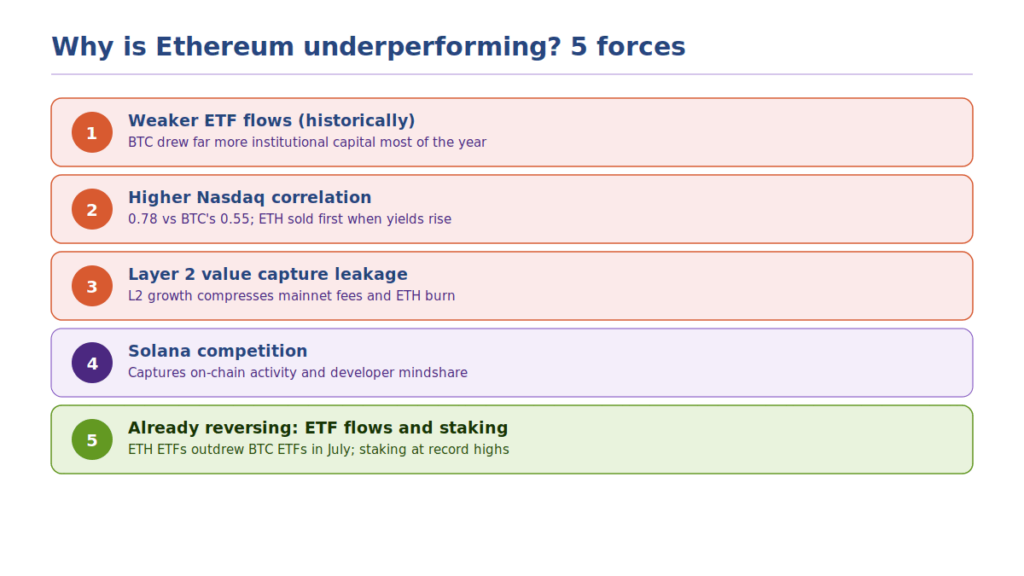
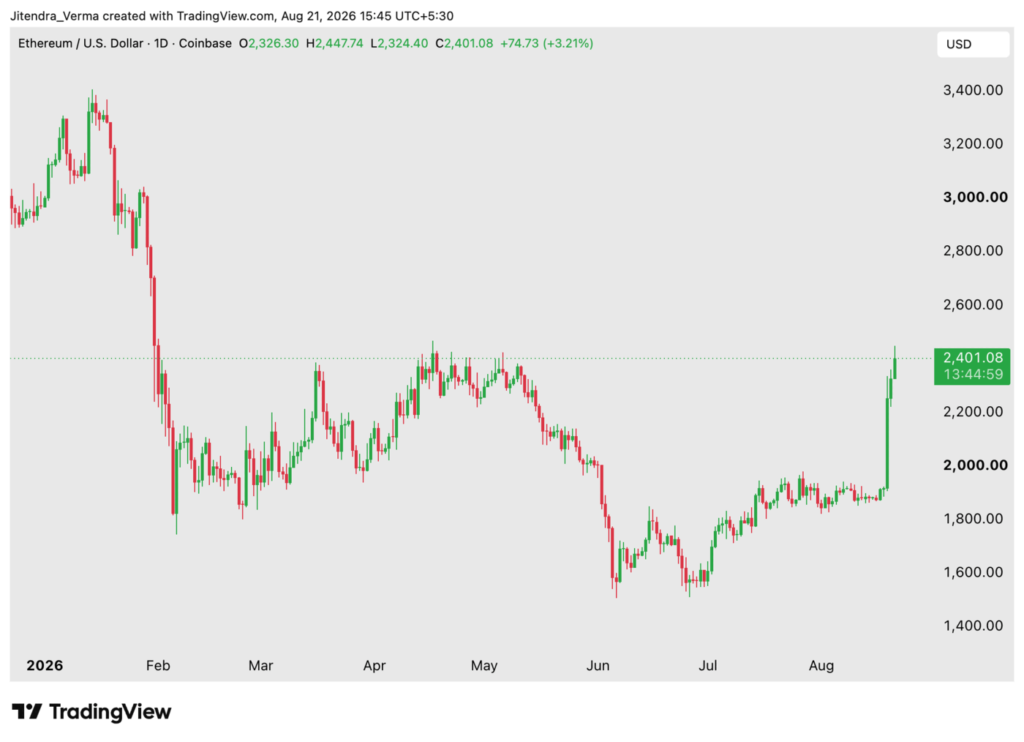
Some of this had already begun reversing before the recent rally. Ethereum ETFs recorded $365 million in net inflows in July 2026, their strongest month ever and, for the first time, more than Bitcoin ETFs took in that same month. The ETH/BTC ratio recovered from its May low near 0.024 to around 0.030 by July.
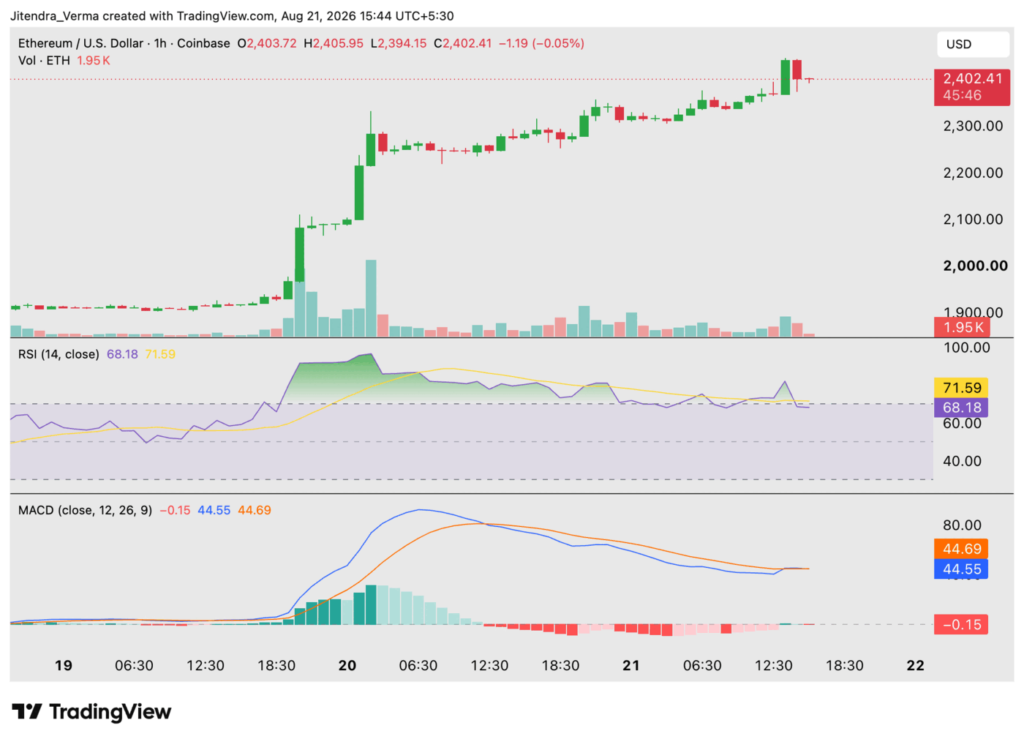
Then, on August 19, prices jumped after the SEC proposed new crypto rules, including exemptions for some token offerings. On August 20, Bitcoin and Ethereum surged further after President Trump hosted crypto executives at the White House and pushed Congress to pass the CLARITY Act, while a Treasury bond buyback eased a multi-year high in long-term yields. ETH opened up 17.5% that day alone, outpacing Bitcoin’s 7.1% gain, amplified by a reported $2.9 billion short squeeze.
Possibly, and the case is genuinely split. The bull case: record staking levels, a stablecoin and tokenization narrative that plays to Ethereum’s strengths, and an ETF flow trend that had already turned in ETH’s favor before this week’s rally. Standard Chartered has floated a “year of Ethereum” scenario with meaningful outperformance if these trends hold. The bear case: JPMorgan has argued ETH is unlikely to reverse its multi-year underperformance without a real reacceleration in network activity and DeFi adoption, and this week’s rally was driven by macro and political catalysts external to Ethereum, not a fix to the underlying value-capture and competition issues.
What indicators show relative recovery? Watch the ETH/BTC ratio directly: a sustained move back above 0.035 would suggest a genuine reversal, while a slide back toward the May lows would suggest this week’s strength was macro-driven rather than fundamental.
Why is Ethereum underperforming in 2026? Mostly weaker historical ETF demand, higher macro sensitivity, Layer 2 fee compression, and Solana competition, not a single cause. The last few days show real signs that gap can close fast when sentiment turns.
If you’re watching ETH, you can buy Ethereum on Mudrex starting from ₹100, check the live ETH/INR rate, or read our Ethereum price prediction for a longer-term view. Download the Mudrex app to get started, or subscribe to the Mudrex YouTube channel for regular market updates.
Weaker historical ETF flows, higher correlation to risk assets like the Nasdaq, Layer 2 fee compression, and Solana competition all contributed, though the gap narrowed sharply this week.
Bitcoin has drawn larger, steadier institutional ETF demand for most of 2026, while Ethereum’s higher macro sensitivity made it fall harder in risk-off periods.
Yes. Layer 2 networks route activity off mainnet, compressing the fees and ETH burn that used to accrue directly to Ethereum.
They were for most of 2026, but Ethereum ETFs outdrew Bitcoin ETFs in July for the first time, a meaningful shift.
Partly. Solana has captured a real share of on-chain and meme coin activity that competes directly with Ethereum’s ecosystem.
Less than in the past. Post-Merge issuance is already low, and record staking levels (41.7 million ETH) now matter more than raw dilution.
Possibly. Bulls point to record staking and improving ETF flows; bears note this week’s rally was macro-driven, not proof the underlying issues are fixed.
This article is a market analysis for educational purposes only and is not financial advice. Cryptocurrency prices are highly volatile, and past performance does not guarantee future results. Do your own research and consult a qualified financial advisor before making investment decisions.