When Will the Bitcoin Bear Market End? Here’s What History Says
Most cycle analysts now point to one window: a Bitcoin bottom between October and December 2026. That is the short version of when the Bitcoin bear market will end, if history holds. It is drawn from a simple pattern, since past bear markets have bottomed about a year after the top.
Bitcoin peaked near $126,000 in October 2025 and has traded well below that since. So when will the Bitcoin bear market end, and how would you even know it is over? This guide walks through the historical timing, where we sit in the cycle now, the signals that confirm a bottom, and what it means for you as an investor in India.
So, When Will the Bitcoin Bear Market End? The Short Answer
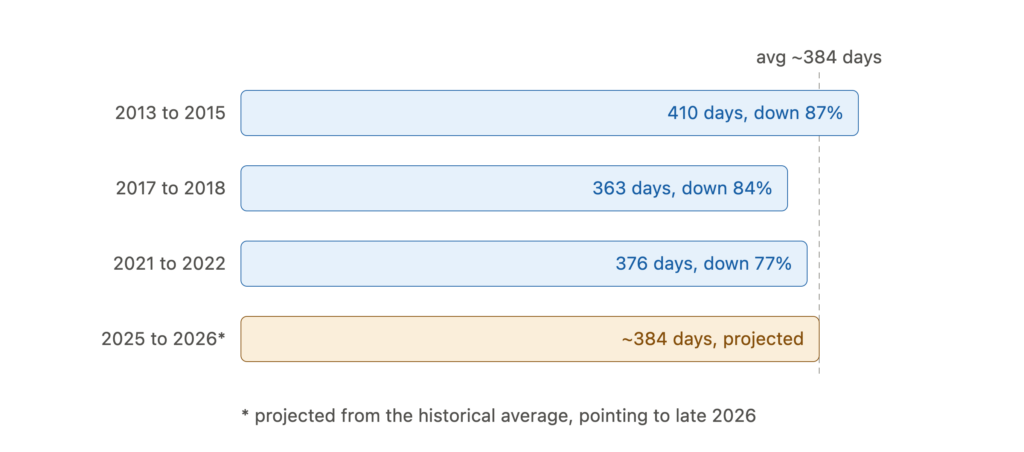
The honest answer is that nobody can name the exact day, but the historical model is unusually consistent. Across the last three cycles, Bitcoin took roughly 360 to 410 days to fall from its peak to its bear market low, an average near 384 days.
Measured from the October 6, 2025 top, that average points to a bottom around late October 2026, with a wider window running through December. Several respected desks land in the same place. Cantor Fitzgerald has flagged late October 2026, analyst Benjamin Cowen leans to October, and veteran trader Peter Brandt has even named early October as a possible date.
When Will the Bitcoin Bear Market End? 2026 Outlook
So when will the Bitcoin bear market end? The base case, if the four year cycle still rules, is late 2026.
How Long Do Bitcoin Bear Markets Usually Last?
Bitcoin bear markets have been remarkably similar in length, even across very different eras.
Cycle
Time from top to bottom
Drawdown from peak
2013 to 2015
about 410 days
around 87%
2017 to 2018
about 363 days
around 84%
2021 to 2022
about 376 days
around 77%
2025 to 2026
projected near 384 days
so far around 50%
When Will the Bitcoin Bear Market End? 2026 Outlook
Two things stand out. First, the timing keeps clustering near a year, which is why so many analysts converge on late 2026. Second, the current drawdown of roughly 38% from the record, and about 50% at the summer low, is milder than past cycles. That is a key clue in judging when the Bitcoin bear market will end and how deep it goes first.
Where Are We in the Bitcoin Cycle Right Now?
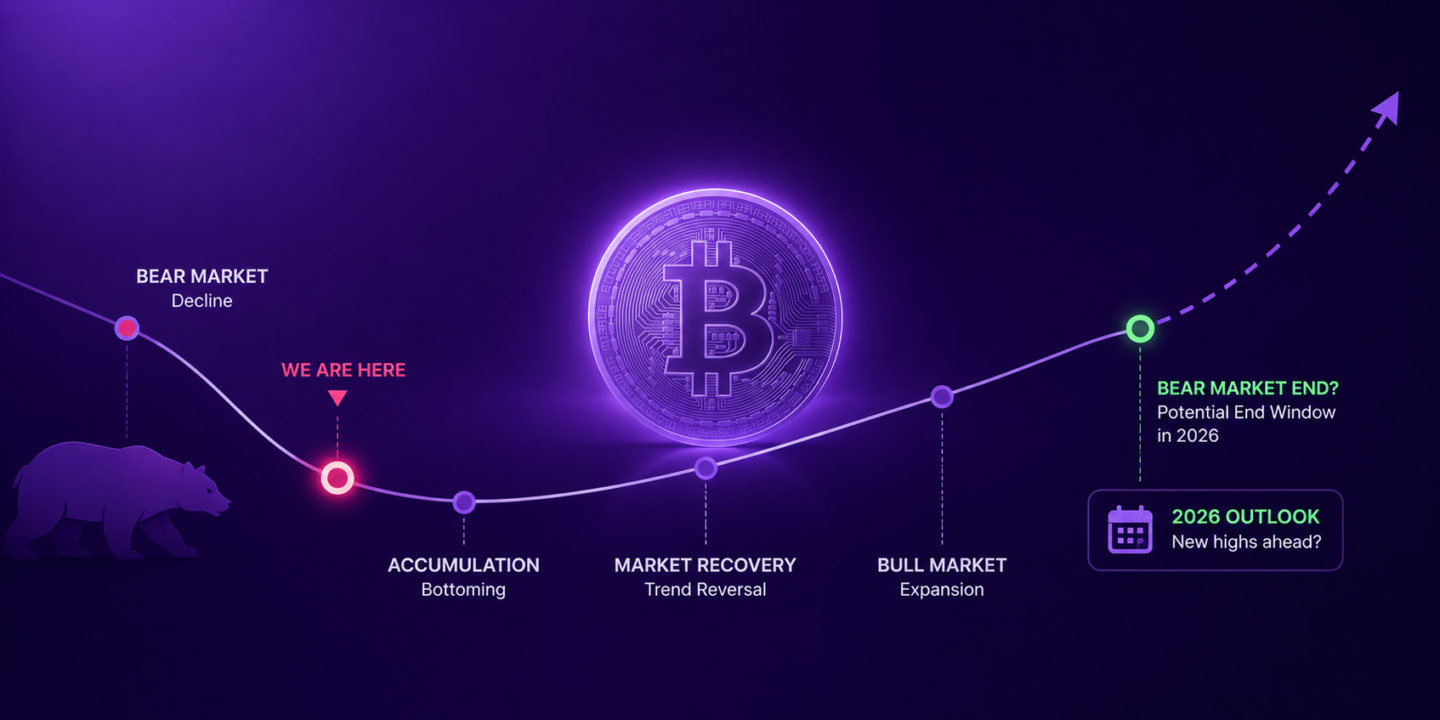
Every Bitcoin cycle tends to move through four phases: accumulation, markup, distribution, and then the markdown, which is the bear market. The April 2024 halving set off the accumulation and markup that peaked at $126,000 in October 2025. Since then, price has been in the markdown phase.
As of late August 2026, Bitcoin trades near $78,700 after a sharp rebound from summer lows in the low $60,000s. That places the market in what looks like a late stage bear phase, not the early panic of one. Whether the bounce is the turn or a pause before a final low is the debate that decides when the Bitcoin bear market will end.
When Will the Bitcoin Bear Market End According to Analysts?
Forecasts split into two camps, and it is worth knowing both.
The cycle intact camp believes the four year rhythm still governs Bitcoin. In this view the bottom is not yet fully in, and a final flush is likely in Q4 2026. Price targets for that low vary widely: Mudrex research has pointed to a $50,000 to $55,000 zone, 10x Research to the $46,000 to $47,000 area, and a NYDIG scenario to as low as $38,000 to $39,000 if the drawdown matches past depths. These are scenarios, not promises.
The cycle broken camp, including Grayscale, argues that Bitcoin is now driven more by interest rates and economic growth than by the halving clock, thanks to spot ETFs and institutional demand. In this view, the bottom may already be in if the Federal Reserve holds steady and growth stays firm.
So when will the Bitcoin bear market end depends partly on which camp is right. The truth may sit in between, with the cycle still mattering but the swings getting shallower as bigger, steadier buyers arrive.
What Signals Confirm the Bitcoin Bear Market Is Over?
Rather than guess a date, watch for confirmation. A bear market is usually declared over only in hindsight, but these signals stack the odds.
Price reclaims the 200 day and 200 week moving averages and holds above them.
A clear higher low forms, followed by a higher high, breaking the downtrend structure.
Spot Bitcoin ETF flows turn consistently net positive again.
On chain value metrics such as realized price and the MVRV ratio lift out of the historically cheap zone.
The Fear and Greed Index shifts from extreme fear toward neutral and stays there.
Miner capitulation ends, which the hash ribbons indicator helps confirm.
When several of these line up at once, it is a far stronger sign that the Bitcoin bear market is ending than any single green week.
The 2026 Bear Market vs 2022
The rhythm rhymes, but the details differ. The 2021 to 2022 bear market fell about 77% and was driven by leverage blowups and failing crypto firms. The 2026 downturn has been milder so far, near 50% at its worst, and the market structure is sturdier.
The biggest change is the spot Bitcoin ETF, which did not exist in 2022. It has channeled tens of billions of dollars of steady demand into Bitcoin and gives this cycle a structural bid that earlier bears lacked. That is a core reason some analysts think the bottom could be shallower and arrive on schedule rather than overshooting to the downside.
Can Bitcoin Rally Before the Bear Market Ends?
Yes, and this trips up a lot of investors. Bear markets are full of sharp relief rallies, sometimes 20% or more, that fade before the real bottom. Bitcoin’s late August 2026 bounce of roughly 22% is a live example, and it may or may not be the turn.
The lesson is simple. A rally is not the same as a recovery. Until the confirmation signals above line up, treat big green weeks as encouraging but unproven, and keep your focus on when the Bitcoin bear market will actually end rather than on a single move.
What This Means for You as an Investor in India
You do not need to call the exact bottom for a plan to work. Trying to time it perfectly is how many investors lose money in both directions.
A few grounded habits:
Use a recurring buy, a Bitcoin SIP, to spread purchases across the bottoming window instead of guessing one date.
Keep some cash ready so a deeper flush becomes an opportunity, not a panic.
Watch the confirmation signals, not the loudest predictions.
Size positions so a further 30% drop would not force you to sell at the worst time.
This article is general information, not financial advice. Crypto is highly volatile and you can lose money. Any real decision is yours to own, ideally with a qualified advisor.
When Will the Bitcoin Bear Market End? The Verdict
So, when will the Bitcoin bear market end? If the four year cycle holds, the base case is a bottom in late 2026, roughly a year after the October 2025 top, with the exact low impossible to pin to a day. A milder drawdown and the ETF driven bid mean the end could be shallower than past cycles, and a minority view says the bottom may already be in.
The takeaway is not a date to bet the house on. It is a window to prepare for, and a checklist of signals to confirm the turn. That is something you can plan around calmly.
Frequently Asked Questions
When will the Bitcoin bear market end?
If the historical four year cycle holds, the most likely window is late 2026, roughly October to December, about a year after the October 2025 peak. No one can name the exact day, and a minority view holds that the bottom may already be in.
How long does a Bitcoin bear market usually last?
Past bear markets ran about 360 to 410 days from top to bottom, an average near 384 days. That is the basis for the late 2026 estimate measured from the October 2025 high.
Has Bitcoin already bottomed in 2026?
It is unconfirmed. Bitcoin rebounded strongly from summer lows near $62,000, but a bounce is not proof of a bottom. Watch for reclaimed moving averages, higher lows, and positive ETF flows before calling it.
What indicators signal the end of a Bitcoin bear market?
Key signals include reclaiming the 200 day and 200 week moving averages, a higher low then higher high, ETF inflows turning net positive, realized price and MVRV lifting off lows, and the Fear and Greed Index leaving extreme fear.
How does the 2026 bear market compare with 2022?
The 2022 bear fell about 77% on leverage blowups. The 2026 downturn has been milder, near 50% at its worst, with a steadier structure and the spot ETF adding demand that did not exist in 2022.
Does the four year cycle still predict Bitcoin bottoms?
It has been accurate so far, which is why the late 2026 window is the base case. But some analysts argue ETFs and macro forces now matter more than the halving clock, so treat the cycle as a guide, not a guarantee.
Anupam has over 3 years of experience in the crypto industry, having worked with top indian crypto exchanges. He writes about Bitcoin, altcoins, AI, and emerging tech, helping readers understand what’s driving markets and where the digital asset ecosystem is headed.