When Will Bitcoin Bottom? 2026 Prediction Based on Historical Cycles
Based on the price action, bitcoin may have already bottomed at $57,800. There’s a 75% chance the cycle low is in, while a 25% chance of further downside remains. A small correction toward $70,000 is possible, but a fresh cycle low looks less likely.
Key Takeaways
Expected bottom: Bitcoin may have already bottomed at $57,800 in June 2026.
Current outlook: 75% chance the cycle low is in, 25% chance of further downside.
Potential correction: BTC could pull back toward $70,000.
What to watch: Price action, ETF flows, on-chain data, macro conditions, and market sentiment.
The question on every crypto investor’s mind right now: Has Bitcoin bottomed, or is there more pain ahead?
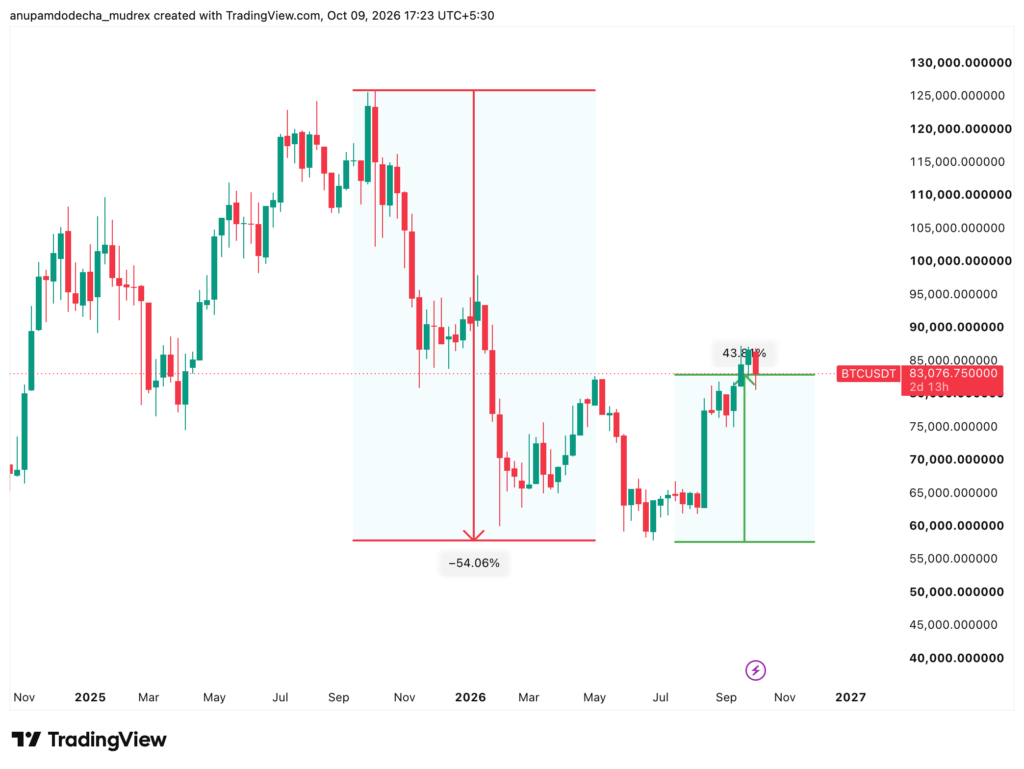
After reaching an all-time high of $126,000 in October 2025, Bitcoin entered a correction, eventually hitting a low of $57,800 in June 2026, down roughly 55% from its peak. However, the subsequent recovery suggests the cycle bottom may already be in, with a fresh low below $50,000 looking less likely.
Bitcoin Price Chart
Here’s the bullish signal many are watching: Bitcoin already tested $58-$60,000 and bounced back. This recovery from lower levels suggests underlying strength, but does it mean the worst is over?
To assess whether Bitcoin has bottomed, we need to look beyond daily price action and examine historical four-year cycles, past bear markets, and on-chain data.
The recovery from Bitcoin’s June low of $57,800 has strengthened the case that the cycle bottom may already be in. BTC has rebounded around 40–50% from its low, despite widespread expectations of a deeper correction below $50,000. From an analyst’s perspective, the price action points to a roughly 75% chance that the bottom is in, although further downside cannot be ruled out.
Bitcoin could still see a short-term correction toward $70,000, but a fresh cycle low appears less likely at this stage. The key is whether BTC can hold its recovery structure or whether renewed selling pressure changes the outlook.
Did Bitcoin’s 2022 Bottom Form in June or December?
Bitcoin’s cycle low was set in June 2022, when the price dropped to around $17,600. Although the market experienced another wave of panic following the FTX collapse in November, Bitcoin never fell below its June low. Instead, it spent the following months consolidating before beginning a sustained recovery in early 2023.
So, from a price perspective, June 2022 marked the true market bottom, while December 2022 represented the final phase of the bear market, when sentiment remained weak but the foundation for the next bull cycle was being built.
Why Bitcoin’s June Low Could Mark the Bottom
Bitcoin’s drop to $57,800 in June 2026 marked a roughly 55% decline from its $126,000 all-time high. Since then, BTC has recovered around 40–50% from that low, strengthening the case that the worst of the correction may be over.
Strong buying interest: Buyers stepped in around the June low, preventing a deeper decline toward the sub-$50,000 levels many traders expected.
Recovery after a deep correction: Bitcoin’s rebound suggests selling pressure may be easing, although further confirmation is needed to establish a sustained uptrend.
Limited downside risk: From a price-action perspective, the chances of a fresh cycle low appear relatively low, even though a short-term pullback toward $70,000 remains possible.
The bottom is not confirmed, but the recovery so far supports the view that Bitcoin may have already reached its cycle low.
Understanding Bitcoin’s 4-Year Halving Cycle
Bitcoin doesn’t move randomly. Its price follows a remarkably predictable pattern driven by a programmed scarcity event called the halving.
This isn’t theory—it’s hardcoded into Bitcoin’s DNA. And for over a decade, this event has triggered remarkably similar market cycles.
Bitcoin Four-Year Cycle Explained
Phase 1 – Post-Halving Accumulation (Months 0-12) After the halving, price typically consolidates or rises modestly as supply shock begins building. Smart money accumulates quietly.
Phase 2 – Bull Market Explosion (Months 12-18) The supply squeeze kicks in. Price breaks to new all-time highs. Media coverage explodes. Retail FOMO peaks. ✓ We experienced this in 2024-2025, peaking at $126K in October 2025
Phase 3 – Bear Market Correction (Months 18-30) Post-euphoria reality check. Early buyers take profits. Late buyers panic sell. Price corrects 60-80%. ← We are here now in March 2026
Phase 4 – Bottom Formation & Recovery (Months 24-40) Maximum pain. Capitulation. “Bitcoin is dead” headlines. Then slowly, quietly, smart money returns. The next cycle seed is planted.
When Will Bitcoin Bottom? The Timeline
Based on historical halving cycles, on-chain analytics, and analyst consensus across the industry, here’s the most probable scenario:
Highest Probability: The Bottom May Already Be In
Bitcoin’s recovery from its June 2026 low of $57,800 suggests the cycle bottom may have formed earlier than historical patterns predicted. While the traditional four-year cycle pointed toward a late-2026 bottom, current price action makes that timeline less likely.
Price Action Analysis
Bitcoin fell to $57,800 in June 2026, down roughly 55% from its $126,000 all-time high
BTC has since recovered around 40–50% from its low
A pullback toward $70,000 remains possible, but another cycle low appears less likely
From Peak to Trough
October 2025 peak: $126,000
June 2026 low: $57,800
Correction: Roughly 55% from the all-time high
Current analyst view: Approximately 75% chance the cycle bottom is in, with a 25% chance of further downside
Why the Earlier Bottom Is Possible
Bitcoin has a history of moving against popular expectations. With many traders waiting for prices below $50,000, the recovery from June’s low suggests the market may not offer that opportunity.
Could Bitcoin Still Fall Lower?
Further Correction (Lower Probability)
Bitcoin could revisit lower levels if:
Key support breaks and the current recovery structure weakens
Macroeconomic conditions deteriorate or selling pressure returns
ETF flows and broader market demand weaken significantly
What Happens Next?
A short-term correction toward $70,000 remains possible, but the current price action favours the view that Bitcoin has already bottomed. This is not a confirmed reversal, and the outlook would need to be reassessed if BTC breaks below its key support levels.
Where Will Bitcoin Bottom? Price Targets
Bitcoin’s June 2026 low of $57,800 may have marked the cycle bottom after a 55% correction from its $126,000 all-time high. Since then, BTC has recovered around 40–50% from its low, making a fresh cycle low less likely. While a pullback remains possible, the current price action favours an earlier bottom than historical cycle models predicted.
Most Likely: $57,800 May Hold as the Cycle Low
The Math:
Bitcoin corrected roughly 55% from its $126,000 peak to $57,800.
BTC has since recovered around 40–50% from its low.
A fresh low below $50,000 remains possible, but appears less likely under the current outlook.
Key Technical Levels:
$75,000: Key support to watch.
$70,000: Next important support if selling pressure increases.
$87,000: Key upside resistance.
$97,000–$100,000: Major resistance zone that could signal a stronger recovery if reclaimed.
Market Structure: This cycle marks Bitcoin’s first as a mainstream institutional asset. Spot ETFs from BlackRock, Fidelity, and others create a permanent bid that didn’t exist in previous cycles. This structural change could prevent traditional 80% bloodbaths. Read: Could ETFs prevent a deeper Bitcoin bottom?
What Will Determine Where Bitcoin Bottoms?
The battle between these forces will determine whether we see $50K or $40K—or if $58K really is the bottom.
Forces Pushing for a Higher Bitcoin Bottom (Bullish)
1. Bitcoin ETF Structural Bid Spot ETFs aren’t momentum traders—they’re long-term allocators. When Bitcoin drops, rebalancing creates automatic buying pressure. BlackRock, Fidelity, and others represent permanent capital that didn’t exist in previous cycles.
2. Corporate Treasury Adoption Companies like MicroStrategy have proven the playbook: buy Bitcoin as treasury reserve, use as collateral, never sell. More corporations following this model removes supply from circulation permanently.
3. Supply Shock Reality Post-halving, miners produce 50% fewer bitcoins. Combined with long-term holders refusing to sell, available supply for purchase shrinks dramatically. Basic economics: less supply + steady demand = price support.
4. Sovereign Nation Interest Countries exploring Bitcoin reserves (El Salvador led, others watching) represent new demand category that could absorb selling pressure.
5. Federal Reserve Pivot If inflation cools and the Fed cuts rates in 2026, risk assets including Bitcoin typically rally. Lower rates = more liquidity = higher asset prices.
Forces Pushing for a Lower Bitcoin Bottom (Bearish)
1. Profit-Taker Overhang Everyone who bought Bitcoin between $70K-$126K is either underwater or barely breaking even. As price approaches their entry, many will sell to escape—creating resistance and selling pressure.
2. Miner Capitulation Smaller mining operations with high costs may be forced to sell Bitcoin holdings to stay operational. This creates supply waves that can accelerate downtrends.
3. Macro Recession Risk If the economy enters recession, investors flee to cash and safety. Bitcoin, despite its store-of-value narrative, still trades as a risk asset during panics.
4. Regulatory Uncertainty Government crackdowns, unfavorable legislation, or exchange restrictions can trigger fear-based selling. Regulatory clarity remains Bitcoin’s biggest unknown.
5. Leverage Liquidations Over-leveraged traders getting liquidated creates cascading selling pressure. As price drops, more margin calls trigger, forcing more selling, creating death spirals.
The Current Tug-of-War: Right now these forces are balanced around $70K. The $60K bounce suggests bulls have support, but breakdown below could quickly cascade lower as bearish factors dominate.
Critical Price Levels Every Bitcoin Investor Should Watch
These aren’t just numbers—they’re psychological and technical battlegrounds where buying and selling decisions happen en masse.
What to Watch Right Now
If $75K holds: Strengthens the case that Bitcoin has already bottomed.
If $75K breaks: Watch for a pullback toward $70K.
If $70K breaks: The current bottom thesis weakens, raising the risk of a deeper correction.
If $57.8K breaks: A fresh cycle low becomes more likely, with $50K as a key downside level.
On-Chain Indicators to Monitor
Smart investors track blockchain data for bottom signals:
MVRV Ratio: When market value drops significantly below realized value (typically <1.0)
You may place limit orders at major support levels: $60K, $55K, $50K, $45K, $40K. Scale position size based on confidence.
Wait for Confirmation
Conservative approach: Wait for bottom confirmation signals like:
Higher highs and higher lows on weekly charts
MVRV ratio reversal
Volume profile showing accumulation
On-chain metrics flipping bullish
Risk Management
Never invest more than you can afford to lose
Maintain 6-12 month emergency fund
Diversify across asset classes
Use stop-losses if trading actively
What Comes After Bitcoin Bottom?
Historical patterns suggest the post-bottom recovery unfolds in phases:
Phase 1: Accumulation (Bottom to +6 months)
Price consolidates in range
Smart money accumulates quietly
Sentiment remains pessimistic
Media declares “crypto is dead”
Phase 2: Markup (6-18 months post-bottom)
Breakout from consolidation range
Momentum builds gradually
Retail interest returns slowly
Bitcoin reclaims previous resistance levels
Phase 3: Euphoria (18-30 months post-bottom)
New all-time highs achieved
Mainstream media coverage explodes
“This time is different” narratives emerge
Next cycle peak forms
If Bitcoin has already bottomed in June 2026, the next phase could look like this:
Late 2026: Consolidation and potential recovery.
2027: Gradual recovery as market confidence returns.
2028: Potential bull-market expansion around the next halving cycle.
2029–2030: Possibility of new all-time highs, with $200K–$300K as a speculative target.
The Bottom Line
While no one can predict exact bottoms with certainty, Bitcoin’s recovery from its June 2026 low of $57,800 suggests the cycle bottom may already be in. Although historical patterns pointed toward a late-2026 bottom, the current price action favours an earlier low, with roughly a 75% chance that the bottom is in and a 25% chance of further downside.
Bitcoin could still correct toward $70,000, but a fresh cycle low appears less likely unless key support levels break. For now, the focus is on whether BTC can sustain its recovery and build momentum for the next major bull market.
Key Takeaways:
June 2026’s low of $57,800 may mark the cycle bottom.
A short-term correction toward $70,000 remains possible.
$75,000 and $70,000 are key support levels to watch.
$87,000 and $97,000–$100,000 are the next major resistance levels.
A sustained recovery could set the stage for new all-time highs, although the timing and price targets remain uncertain.
Important Disclaimer:This analysis is for educational purposes only and does not constitute financial advice. Cryptocurrency markets are highly volatile and unpredictable. Past performance does not guarantee future results. Always conduct your own research (DYOR), understand the risks, and never invest more than you can afford to lose completely. Consider consulting with licensed financial advisors before making investment decisions.
FAQs
What price will Bitcoin hit at the bottom?
Bitcoin may have already bottomed at $57,800 in June 2026, following a roughly 55% correction from its $126,000 all-time high. Based on the current price action, there is an estimated 75% chance that the cycle low is in, although further downside toward $50,000 or below cannot be ruled out.
Has Bitcoin already bottomed at $58K?
Bitcoin’s drop to $57,800 in June 2026 and its subsequent recovery suggest the cycle bottom may already be in. While historical cycles often involve prolonged corrections and multiple support retests, the current price action favours an earlier bottom. From an analyst’s perspective, there is roughly a 75% chance the low is in, although a further correction remains possible if key support levels break.
Should I buy Bitcoin now or wait for lower prices?
Bitcoin may have already bottomed at $57,800, making it uncertain whether waiting for prices below $50,000 will pay off. However, a correction toward $70,000 remains possible, and further downside cannot be ruled out. Dollar-cost averaging (DCA) can help reduce the risk of trying to time the exact bottom, while key levels such as $75,000 and $70,000 are worth watching for signs of support or weakness.
Can Bitcoin fall below $50,000?
Yes, but the chances appear low based on the current price action. Bitcoin has recovered from its June low of $57,800, suggesting the cycle bottom may already be in. Read the full blog to understand why.
Anupam has over 3 years of experience in the crypto industry, having worked with top indian crypto exchanges. He writes about Bitcoin, altcoins, AI, and emerging tech, helping readers understand what’s driving markets and where the digital asset ecosystem is headed.