
Robinhood had the kind of week that makes you rewrite your price targets mid-sentence. HOOD ran from the low $100s to a high near $124.70, at one point spiking over 17% in a single session on September 3.
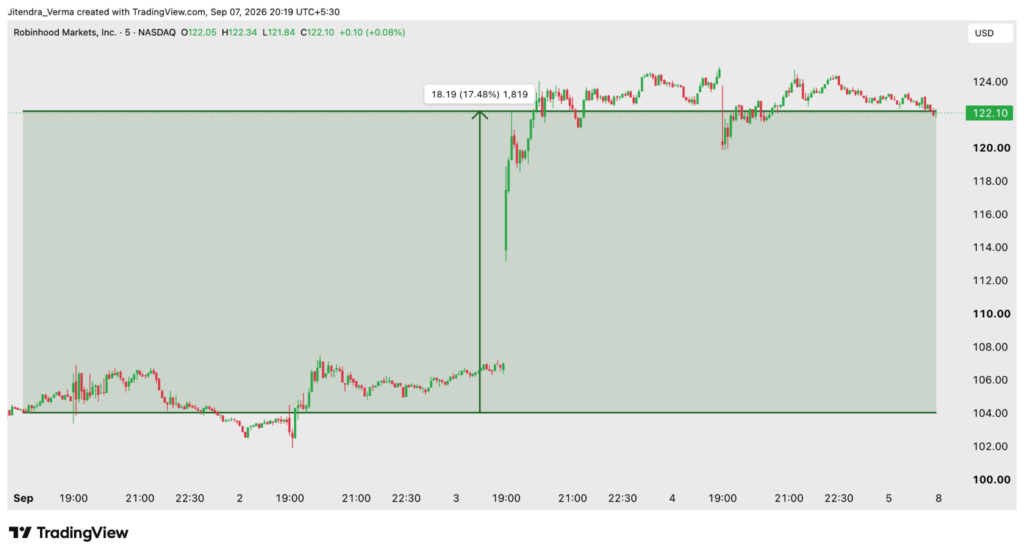
There were maby triggers. Morgan Stanley kicked things off on September 1, upgrading HOOD to Overweight and lifting its target to $150, pointing to Robinhood’s expansion beyond trading into retirement, banking, credit cards, and prediction markets.
Two days later, Deutsche Bank added fuel, flagging prediction markets (specifically KPI-linked event contracts) as a potentially trillion-dollar category by 2028, with Robinhood positioned as a direct beneficiary. Scotiabank and Bernstein piled on with Sector Outperform and Outperform calls of their own.
Then came the on-chain proof point: Robinhood Chain, the company’s own Layer-2, generated over $3.8M in network revenue in a single day; the highest of any blockchain that day! For a company still trying to convince the Street it’s more than a retail brokerage, that’s a real receipt.
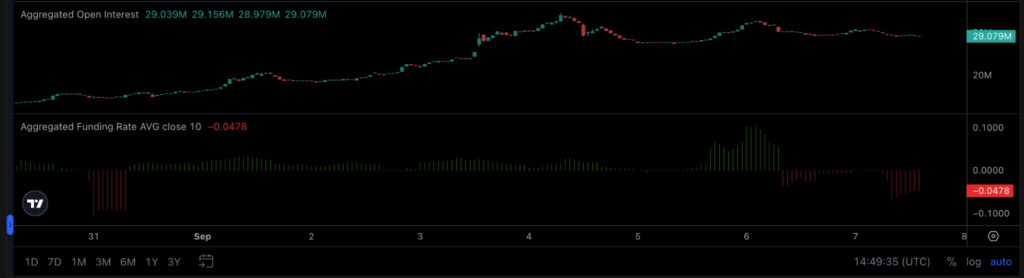
Derivatives data backs up how the market actually chased this move. Open interest climbed from roughly 29M to a peak above 29.1M through the rally, and funding rates flipped positive; traders were paying up to stay long into strength.
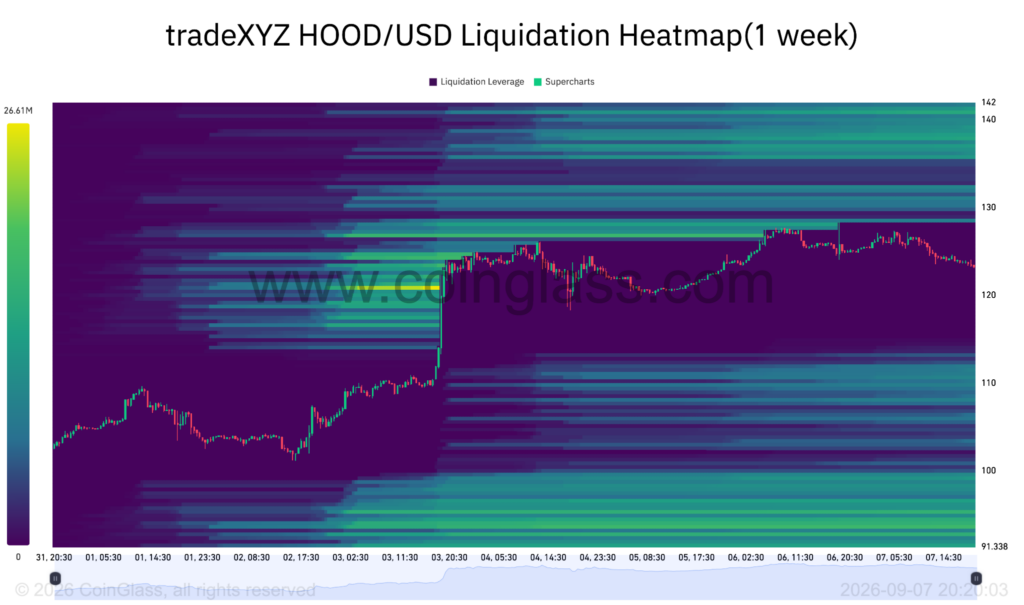
The liquidation heatmap shows exactly why the move had such little friction going up: leverage had clustered thick just above the old range, and once price broke through, there wasn’t much resistance left to absorb it.