
Amazon (NASDAQ: AMZN) is the company behind the online store most Indians already know, but most of its profit now comes from somewhere else. Its cloud arm, Amazon Web Services (AWS), earned 60% of the company’s operating income in Q2 2026, and its advertising business is growing faster than its shops.
It hit a record in August, then slid as investors worried about a $220 billion AI spending plan. This guide explains what the company does, how it makes money, what the latest numbers say, and how you can invest from India.
| Item | Detail |
| Full name | Amazon.com, Inc. |
| Ticker | AMZN |
| Exchange | Nasdaq |
| Founded | 1994 |
| Headquarters | Seattle, Washington |
| CEO | Andy Jassy |
| Employees | About 1.6 million |
| FY2025 net sales | $716.9 billion |
| Market value | About $2.71 trillion |
| Dividend | None |
| 52-week range | $196.00 to $287.20 |
Company figures from Amazon’s Q2 2026 results. Market data as of the 5 October 2026 close.
Amazon runs three large businesses under one roof.
| Business | What it is | Why it matters |
| Stores | Online shopping, third-party seller services, Prime, Whole Foods | Most of the revenue, thin margins |
| AWS | Cloud computing, AI infrastructure and custom chips | The main profit engine |
| Advertising | Sponsored listings, display and video ads, Prime Video ads | Fast-growing and high-margin |
It also has longer-term bets. Amazon Leo, its satellite internet network, had nearly 400 satellites in orbit by mid-2026. Zoox, its robotaxi unit, received US approval to charge for rides. Neither moves the numbers yet.
Here is how Q2 2026 net sales of $200.6 billion split by revenue stream:
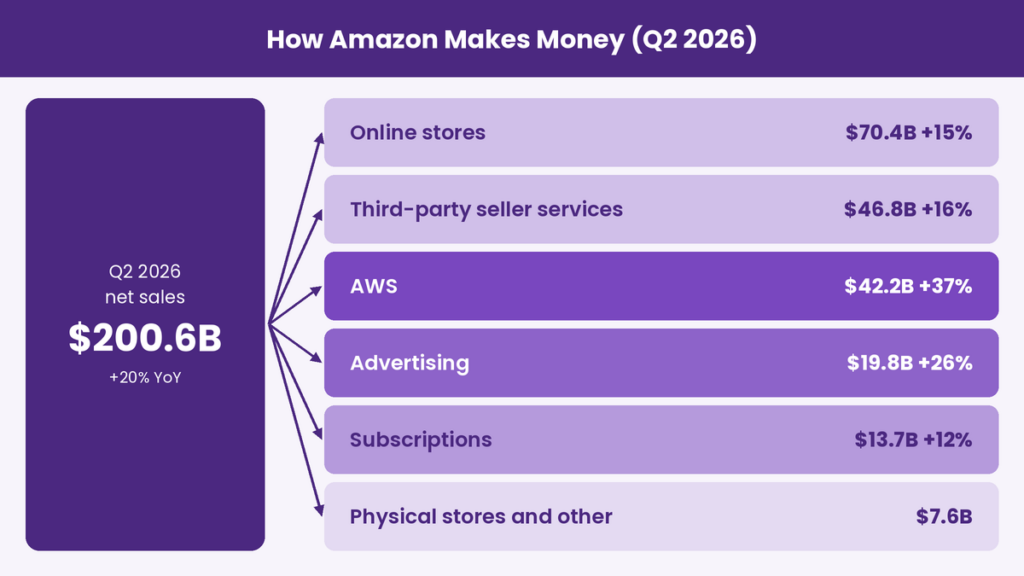
Online stores and third-party seller fees together brought in about $117 billion in Q2 2026. Sellers on Amazon’s marketplace pay commissions, fulfilment and shipping fees, and 61% of paid units came from third-party sellers. Grocery and everyday essentials are growing faster than the rest of retail, according to CEO Andy Jassy. Amazon Now, its 30-minute delivery service for everyday items, is available in nine countries and over 250 cities and towns.
AWS rents computing power, storage and AI tools to businesses. It grew 37% in Q2 2026, its fastest pace in 18 quarters, and now runs at a $169 billion annualised revenue rate. Growth has sped up for five straight quarters, from 17% in Q2 2025 to 37% now.
The customer base is broad. Graviton, Amazon’s own server processor, is used by 98% of the top 1,000 EC2 customers, and hundreds of thousands of companies use Amazon Bedrock to run AI models from multiple providers, according to the Q2 release.
Advertising revenue grew 26% to $19.8 billion in Q2 2026. Brands pay to appear in Amazon search results and on Prime Video, which makes this one of the company’s most profitable lines. Amazon doesn’t report advertising profit separately, but advertising revenue has grown at 19% or more in every quarter since Q1 2025.
Subscription revenue, which includes Prime memberships, Prime Video and music, grew 12% to $13.7 billion in Q2 2026. Prime also feeds the rest of the business. Amazon says customers who have tried its Alexa+ assistant sign up for Prime at a nearly 25% higher rate.
Revenue and profit tell very different stories at Amazon.

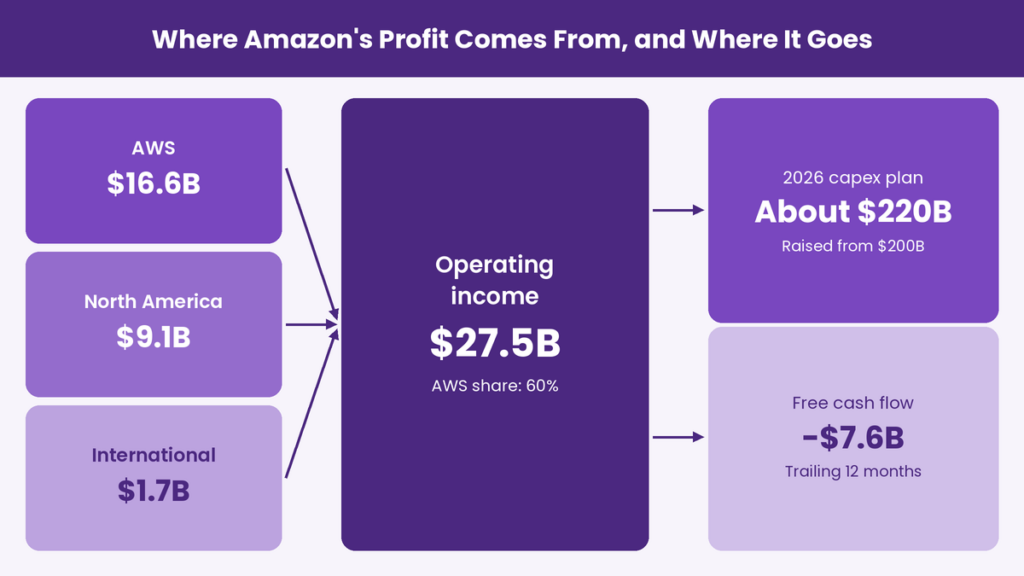
| Segment | Q2 2026 net sales | Q2 2026 operating income | Operating margin |
| North America | $116.2 billion | $9.1 billion | 7.9% |
| International | $42.2 billion | $1.7 billion | 4.1% |
| AWS | $42.2 billion | $16.6 billion | 39.4% |
| Total | $200.6 billion | $27.5 billion | 13.7% |
AWS made up 21% of sales but 60% of operating income ($16.6 billion divided by $27.5 billion). That single fact is the key to understanding why investors watch AWS growth more closely than anything else.
Three Common Misconceptions
| Year | Milestone |
| 1994 | Founded by Jeff Bezos as an online bookstore |
| 1997 | Lists on the Nasdaq |
| 2006 | Launches AWS |
| 2021 | Andy Jassy takes over as CEO |
| 2022 | Completes a 20-for-1 stock split |
| 2026 | Raises its capex plan to about $220 billion and crosses a $3 trillion market value |
AWS is in the middle of an AI-driven demand surge. In Q2 2026, Amazon said its AWS AI business and its chips business each passed a $25 billion annual revenue run rate, both growing at triple-digit rates.
Three things sit behind that:
Amazon is also a major investor in Anthropic. That stake produced a $53.4 billion paper gain in Q2 2026, which is why reported net income looks unusually high.
| Metric | FY2025 |
| Net sales | $716.9 billion |
| AWS net sales | $128.7 billion |
| Advertising revenue | $68.6 billion |
| Operating income | $80.0 billion |
| Net income | $77.7 billion |
| Diluted EPS | $7.17 |
| Free cash flow | $11.2 billion |
AWS and advertising figures are the sum of Amazon’s four 2025 quarters.
Amazon reported Q2 2026 results on 30 July 2026.
| Metric (Q2 2026) | Value | Year-on-year change |
| Net sales | $200.6 billion | +20% |
| AWS net sales | $42.2 billion | +37% |
| Advertising revenue | $19.8 billion | +26% |
| Operating income | $27.5 billion | +43% |
| Net income | $62.6 billion | Up from $18.2 billion |
| Diluted EPS | $5.75 | Up from $1.68 |
| Free cash flow (trailing 12 months) | Outflow of $7.6 billion | Down from an inflow of $18.2 billion |
Quarterly net sales crossed $200 billion for the first time.
For Q3 2026, Amazon expects net sales of $197 billion to $202 billion and operating income of $22.5 billion to $26.5 billion. The 9% to 12% growth range looks low because Prime Day moved into Q2 this year. Amazon says growth would be nearly 4 percentage points higher without that shift.
This is the single most important thing to understand about the stock in 2026.
In February, Amazon said it would spend about $200 billion on capital expenditure in 2026, mostly on AI data centres. The stock fell 11% in extended trading. On 30 July, it raised that plan to about $220 billion, citing higher memory chip prices. This time the stock rose 15.3% the next day, because AWS growth had accelerated enough to justify the spend.
Jassy told analysts that even at that level, Amazon will still not have enough capacity to meet demand in 2026.
The cost shows up in two places:
Bulls point to AWS’s own history, where years of heavy spending built Amazon’s most profitable business. Bears worry the spending keeps growing before the cash comes back.
Shares hit a 52-week low of $196.00 on 17 February 2026, after the first capex announcement. They then climbed to an all-time high of $287.20 on 3 August, after Q2 results pushed Amazon past a $3 trillion market value for the first time.
Since then, the stock has drifted lower. It closed at 251.40on5October,about12%belowitshigh(287.20 minus $251.40, divided by $287.20). Over the past year, it is up about 15%.
Two more things to know:
| Bull case | Bear case |
| AWS growth accelerated for five straight quarters | Free cash flow is negative |
| $496 billion AWS backlog | Capex could rise again in 2027 |
| Advertising growing 26% at high margins | Reported profit includes large paper gains that can reverse |
| Custom chips reduce reliance on outside suppliers | Retail margins stay thin |
READ MORE: For analyst targets and scenarios through 2030, see our Amazon (AMZN) stock price prediction.
Amazon’s Q3 2026 results are expected on 29 October. Amazon confirms the date on its investor relations site a few weeks ahead. Its call starts at 5:00 PM Eastern, which would be 2:30 AM IST on 30 October.
Watch three numbers: AWS growth, the Q4 guide, and any update to the $220 billion capex plan.
AMZN trades only in the US. As of October 2026, you have four practical routes:
For the step-by-step process, read our guide on how to buy Amazon stock in India.
Our comparison of tokenized spot, LRS and GIFT City for Amazon breaks down cost, tax and ownership. If you want to act on news at night or on weekends, see how to trade Amazon stock 24/7 in India.
The business is easy to understand, and all three segments are profitable at the operating level. Analysts are broadly positive.
The open question is the spending bill. Buying today is a bet that $220 billion a year of investment turns into the kind of returns AWS delivered in its first decade. A sensible approach is to keep the position modest, buy in installments, and decide your holding period before you start, since tax treatment depends on it.
Amazon trades on the Nasdaq as AMZN. On Mudrex, the tokenized version is listed as AMZNB.
Mainly through online sales, fees from third-party sellers, AWS cloud services, advertising and Prime subscriptions. AWS is the largest source of operating profit.
No. Amazon does not pay a dividend and reinvests its cash into the business.
Net income of $62.6 billion included a $53.4 billion non-operating gain, primarily from Amazon’s investments in Anthropic. Operating income, at $27.5 billion, is a better guide to the core business.
Amazon Web Services is Amazon’s cloud computing arm. It rents servers, storage, databases and AI tools to businesses, and earned $16.6 billion of Amazon’s $27.5 billion operating income in Q2 2026.
Mainly because of the spending bill. Heavy capex has pushed trailing free cash flow negative, and that has weighed on sentiment even as AWS growth accelerated.
Mostly to build AI data centres and capacity for AWS, where demand currently exceeds supply.
The estimated date is 29 October 2026, after the US close. That is early on 30 October in India.
No. AMZNB tracks the share price and is backed 1:1 by a real share in custody, but you hold a token, not the share, and you don’t get voting rights.
For shares bought through LRS or GIFT City, gains on holdings over 24 months are generally taxed at 12.5%, and shorter holdings at your slab rate. Tokenized stocks are taxed as virtual digital assets at a flat 30% plus cess, with 1% TDS on transfers.
This article is for information only and is not investment, tax or legal advice. Please consult a SEBI-registered investment adviser before investing. Figures are as of October 2026.