The VanEck Semiconductor ETF (SMH) is one of the most closely watched ways to invest in the chip industry, a sector that sits at the center of the AI, cloud computing, and advanced manufacturing boom. Rather than betting on a single chipmaker, SMH bundles 25 of the largest US-listed semiconductor companies into one fund, giving investors broad exposure to the industry’s biggest names in a single purchase. Launched by VanEck and passively tracking the MVIS US Listed Semiconductor 25 Index, it has become a popular core holding for investors who want targeted semiconductor exposure without picking individual stocks.
If you are looking to buy VanEck Semiconductor ETF shares in India, you have two real options. The traditional LRS-and-brokerage route, or tokenized SMH stock through a platform like Mudrex. This guide walks through both routes, what each actually costs, and the steps to buy tokenized SMH stock on Mudrex.
Key Takeaways
VanEck Semiconductor ETF (NASDAQ: SMH) can be bought from India either through an LRS-based international brokerage account or through tokenized SMH stock on a platform like Mudrex.
The traditional route involves LRS remittance limits and a 20% TCS above ₹10 lakh per year. Forex markup fees and NASDAQ trading hours add further friction.
Tokenized SMH stock, available on Mudrex as SMHB, can be bought with INR directly, starting from as little as ₹100, with no LRS paperwork.
Tokenized SMH stock is not the same as owning the real ETF units. You do not get shareholder rights, and it is taxed at a flat 30% under India’s VDA rules.
SMH holds a concentrated basket of semiconductor stocks. Nvidia alone makes up over a fifth of the fund, worth understanding before treating SMH as broadly diversified.
How to Buy VanEck Semiconductor ETF Shares in India
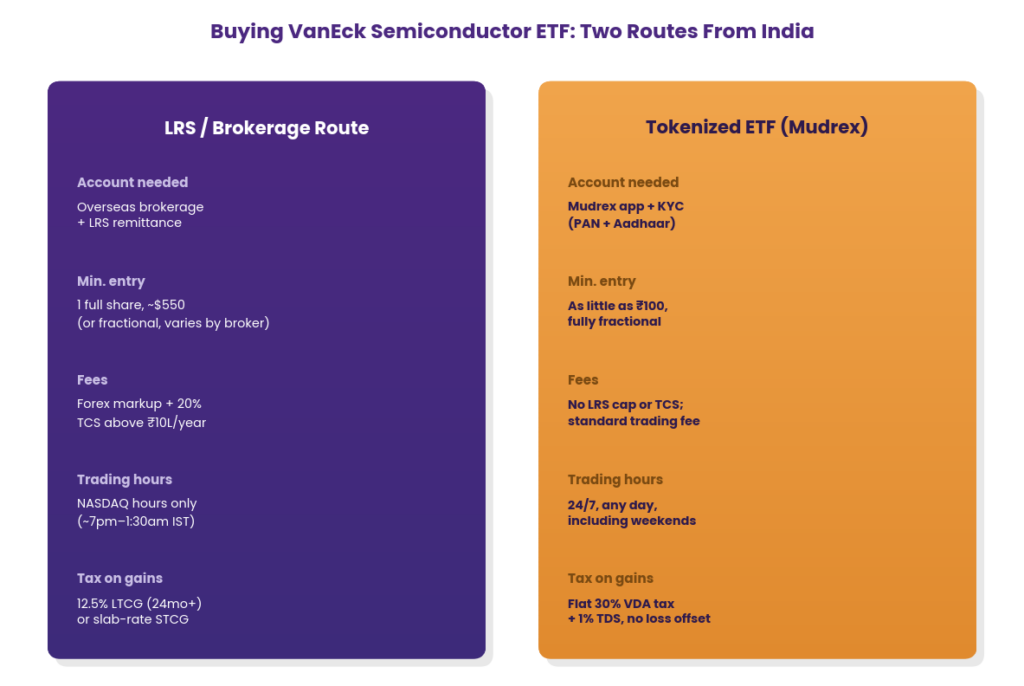
The traditional way to buy real SMH units from India is through an international brokerage account. This is funded using the Reserve Bank of India’s Liberalised Remittance Scheme, or LRS. It lets you remit up to $250,000 per financial year for permitted investments, including US-listed ETFs. Above ₹10 lakh remitted in a year, the government collects 20% tax collected at source, or TCS, before your money even reaches a US broker.
Beyond the remittance itself, a few practical challenges show up consistently with this route.
Broker access: you need an international brokerage account or an Indian platform with US market access, along with a completed W-8BEN form for tax purposes.
Forex charges: currency conversion from INR to USD typically carries a markup, on top of any brokerage fees.
US market timings: NASDAQ trades 9:30 am to 4:00 pm Eastern Time, which lands at roughly 7:00 pm to 1:30 am IST depending on daylight saving time.
Taxation: real SMH units held over 24 months qualify for 12.5% long-term capital gains tax; shorter holding periods are taxed at your income slab rate.
Share price: at over $550 per unit, buying a full share of SMH is a meaningful outlay, though many brokers now support fractional purchases.
None of these steps are unreasonable individually, but together they add real friction for someone who simply wants price exposure to the semiconductor sector without the paperwork. For a broader look at these traditional routes, see our guide on how to buy US stocks from India.
What Is Tokenized VanEck Semiconductor ETF Stock?
Tokenized VanEck Semiconductor ETF stock is a blockchain-based token designed to track the price of real SMH units. It does not require you to open a US brokerage account or move money through LRS. On Mudrex, this tokenized version trades under the ticker SMHB, and its price is designed to closely mirror the actual NASDAQ-listed fund.
Two very different paths to semiconductor sector exposure from India.
Because tokenized SMH stock trades on a crypto platform rather than directly on NASDAQ, it is not bound to US market hours the way the real ETF is. You can buy or sell it any time, including late at night or on weekends, when the actual NASDAQ-listed fund is closed. This matters in practice, since real SMH trading hours fall in the middle of the night in India.
VanEck Semiconductor ETF vs. Tokenized SMH Stock: Key Differences
Buying real SMH units, whether through LRS, an international broker, or a GIFT City receipt, makes you an actual unit holder with a legal claim on the fund’s underlying holdings. The units sit in a brokerage or demat account in your name. The price tracks the fund’s net asset value, based on the combined value of its semiconductor holdings.
Tokenized SMH stock works differently. SMHB on Mudrex is a token designed to track SMH’s price, not a direct legal claim on the underlying fund units.
Ownership: real SMH units carry fund holder rights and indirect dividend entitlement from underlying holdings; tokenized SMHB generally does not.
Trading hours: real SMH is limited to NASDAQ hours; tokenized SMHB trades 24/7.
Minimum investment: real SMH often requires either a full unit or broker-dependent fractional access; tokenized SMHB starts from ₹100 on Mudrex.
Taxation: real SMH held over 24 months qualifies for 12.5% LTCG. Tokenized SMHB is taxed at a flat 30% with no loss offset and 1% TDS on transactions.
Settlement: real SMH settles through traditional broker and custodian infrastructure; tokenized SMHB settles on blockchain rails.
Neither route is universally better. The traditional route gives you an actual fund unit with holder standing and a more favorable long-term tax rate. The tokenized route gives you faster, cheaper access and fractional entry, at the cost of ownership rights and a less favorable tax treatment.
Can I Buy Tokenized VanEck Semiconductor ETF (SMH) Stock in India?
Yes, tokenized SMH stock is available directly on Mudrex as SMHB, alongside other tokenized US assets including Nvidia, Microsoft, and SanDisk. Buying it follows the same steps as buying any other asset on Mudrex Spot.
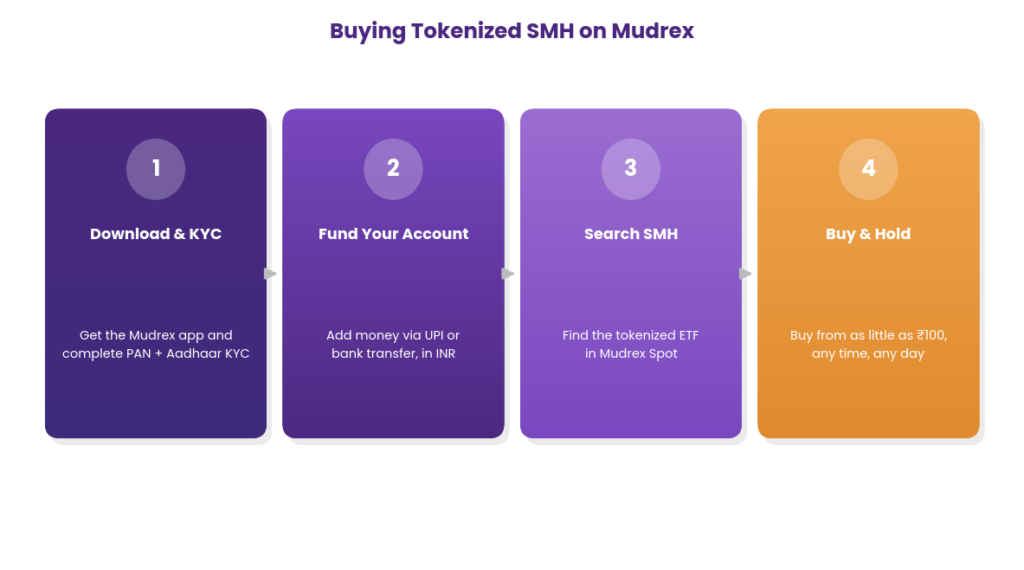
Buying tokenized SMH on Mudrex takes four simple steps.
Download the app and complete KYC: sign up on Mudrex and verify your identity using your PAN and Aadhaar. This is the same process used for any crypto purchase on the platform.
Fund your account: add money using UPI for smaller amounts or a bank transfer for larger deposits, entirely in INR.
Search for SMHB: navigate to Mudrex Spot and search for the tokenized ETF by ticker.
Place your order: buy starting from as little as ₹100, at any time of day, including weekends.
There is no separate onboarding process for tokenized stocks specifically. It uses the same Mudrex account and KYC you would already have for buying cryptocurrency on the platform. Investors who prefer futures exposure instead can also trade SMH on Mudrex through the SMHUSDT perpetual contract.
Conclusion
How to buy VanEck Semiconductor ETF shares in India comes down to a genuine tradeoff between two real options. The traditional LRS and brokerage route gets you an actual fund unit and a better long-term tax rate. That comes at the cost of remittance limits, forex fees, and odd-hours trading.
Tokenized SMH stock on Mudrex removes that friction entirely, letting you buy from ₹100 at any hour. It comes without fund holder rights and under India’s flatter, less favorable VDA tax treatment. Given SMH’s concentrated exposure to a handful of dominant chipmakers, understanding both routes and what you are actually holding is worth the extra few minutes.
This article is for informational and educational purposes. It is not financial advice, and you should do your own research and consult a qualified financial advisor before making investment decisions.
Ready to explore tokenized SMH stock? Download the Mudrex app for Android or iOS, or subscribe to our YouTube channel for market updates.
FAQs
Can Indians buy VanEck Semiconductor ETF shares?
Yes, Indians can buy real SMH units through an LRS-based international brokerage account, or get price exposure through tokenized SMH stock on platforms like Mudrex.
How can I buy SMH stock from India?
You can open an international brokerage account and remit funds under the RBI’s LRS, or buy tokenized SMHB stock directly with INR on Mudrex, without LRS paperwork.
What is the minimum amount needed to invest in VanEck Semiconductor ETF?
Real SMH units cost over $550 each, though some brokers offer fractional access; tokenized SMH stock on Mudrex starts from as little as ₹100.
Can I buy fractional VanEck Semiconductor ETF shares?
Yes, some international brokers support fractional units of real SMH, and tokenized SMH stock on Mudrex is fully fractional from ₹100.
What charges apply when buying VanEck Semiconductor ETF stock from India?
The LRS route involves forex markup fees and 20% TCS above ₹10 lakh remitted per year, on top of the fund’s own 0.35% expense ratio; tokenized SMH stock carries standard Mudrex trading fees with no LRS charges.
How are gains and dividends from VanEck Semiconductor ETF shares taxed in India?
Real SMH units held over 24 months qualify for 12.5% long-term capital gains tax; tokenized SMH stock is taxed at a flat 30% under India’s virtual digital asset rules, with 1% TDS and no loss offset.
What is tokenized VanEck Semiconductor ETF stock, and is it the same as owning the underlying share?
Tokenized SMH stock (SMHB) is a blockchain-based token that tracks the ETF’s price. It is not the same as owning real fund units, since it generally does not carry holder rights.
How can I buy tokenized VanEck Semiconductor ETF stock in India?
Download the Mudrex app, complete KYC with your PAN and Aadhaar, fund your account via UPI or bank transfer, then search for SMHB in Mudrex Spot and buy starting from ₹100.
Risk Disclaimer
Trading tokenized stocks and other virtual digital assets carries the risk of capital loss. VanEck Semiconductor ETF (SMH) is a sector-concentrated fund with meaningfully higher volatility than broad-market ETFs, given its heavy weighting toward a small number of large chipmakers, and tokenized stocks currently sit outside SEBI’s regulatory framework in India. The figures, comparisons, and steps in this article are illustrative and for educational purposes only; they are not financial advice. Please consult a qualified financial advisor before making any investment decisions.
Siri is a writer venturing into the exciting realms of blockchain technology, cryptocurrency, and decentralized finance (DeFi), eager to explore the transformative potential of these innovations. She brings a unique perspective that bridges traditional industries and cutting-edge technology, often infused with a touch of humor through memes. She has a rich background in real estate and interior design, having previously contributed to NoBroker, where she crafted blogs and assets on these topics.