If you want to buy US stocks from India, you’re not short on options anymore. You can remit money under RBI’s LRS, trade fractional receipts through GIFT City, buy an Indian mutual fund that holds US stocks, or buy a tokenized version of the stock on a crypto platform like Mudrex.
Each route works differently, costs differently, and is taxed differently. This guide walks through best ways to invest in US stocks India currently offers, what each one actually costs, and where each one falls short, so you can pick the route that fits what you’re trying to do.
Key Takeaways
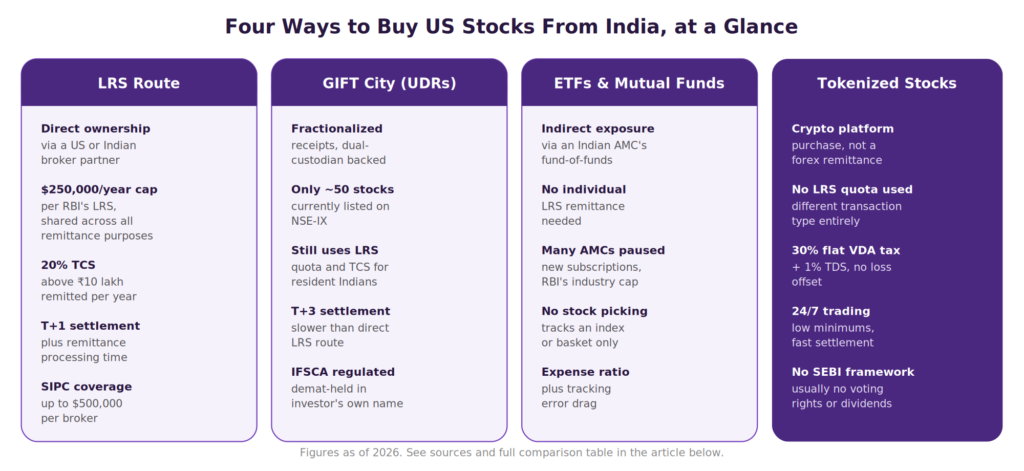
The LRS route gives you direct stock ownership but caps you at $250,000/year and applies 20% TCS above ₹10 lakh remitted.
GIFT City’s NSE-IX UDRs are fractionalized, IFSCA-regulated receipts, but still consume your LRS quota, are limited to about 50 stocks, and settle slower.
Indian mutual funds and ETFs give indirect exposure without an individual remittance, but SEBI’s industry-wide overseas investment cap has left only a fraction of international funds open.
Tokenized stocks are bought through a crypto platform, a fundamentally different transaction type, so LRS limits and TCS don’t apply the way they do to the other three routes.
No route is “better” outright. Each is suited to a different mix of ticket size, ownership preference, and tolerance for paperwork.
What Are Your Options for Buying US Stocks From India?
Broadly, there are four routes: remit money abroad directly under LRS US stocks investing, buy fractionalized receipts through GIFT City, buy an Indian fund that holds US stocks, or buy a tokenized version of the stock through a crypto platform.
How to Buy US Stocks From India 2026: LRS, GIFT City, ETFs or Crypto?
The first three all involve, directly or indirectly, moving money out of India as foreign exchange. The fourth doesn’t. That single difference is what shapes almost everything else about how each route is taxed and regulated, and it’s worth keeping in mind as we go through each one.
How Does the LRS Route for Buying US Stocks Work?
Under the RBI’s Liberalised Remittance Scheme (LRS), resident Indians can remit up to $250,000 per financial year for permitted purposes, including buying foreign securities. You open an overseas trading account, either with a domestic broker that partners with a US broker or directly with a foreign broker, remit funds through your bank, and the broker executes trades on your behalf.
This gets you direct ownership of the actual share. You’re the shareholder of record, with full voting and dividend rights, subject to a 25% US withholding tax on dividends (offset against your Indian tax liability under the India-US Double Tax Avoidance Agreement). For Indian tax purposes, US-listed shares are treated as unlisted equity, since no Securities Transaction Tax is paid on foreign exchange trades: gains are long-term if held over 24 months, taxed at 12.5%, and short-term otherwise, taxed at your income slab rate. Trades settle on a T+1 basis, matching current US market settlement.
Brokerage accounts in the US typically carry Securities Investor Protection Corporation (SIPC) coverage of up to $500,000 per broker in case the brokerage itself fails.
What Are the Drawbacks of Investing in US Stocks via LRS?
The $250,000 annual limit is shared across every LRS purpose you use in a given year, not just stock investing. If you also remit money for a child’s education or a family trip abroad, all of it counts against the same cap.
Above ₹10 lakh remitted in a financial year, banks collect 20% Tax Collected at Source (TCS) on the amount over that threshold. This isn’t an extra tax on top of what you owe; it’s adjustable against your final tax liability when you file your return, and refundable if you have no offsetting liability, but it still means less capital reaches your US account upfront, and refunds take time to process.
On top of TCS, you’ll pay currency conversion charges, brokerage fees, and often a minimum account balance or setup charge depending on the broker. For frequent, smaller trades, these costs add up in a way that’s easy to underestimate.
How Does GIFT City Investing in US Stocks Work?
GIFT City, India’s international financial services hub in Gujarat, offers a newer route through NSE-IX’s Unsponsored Depository Receipts (UDRs). A UDR is a fractionalized receipt representing part of a US share, held through a dual-custodian structure: an Indian custodian holds legal title on your behalf, while a US sub-custodian safekeeps the actual shares.
Because UDRs are fractionalized, they lower the entry ticket size considerably; you don’t need the full price of one share to get exposure. UDRs are held in your own demat account in India, regulated by the International Financial Services Centres Authority (IFSCA), rather than sitting in a broker’s pooled account the way direct LRS holdings often do.
What Are the Limitations of GIFT City UDRs?
As a newer product, GIFT City UDRs currently cover only around 50 US stocks, a fraction of what’s available through direct LRS investing. Liquidity is thinner too, which can mean wider bid-ask spreads and less predictable execution than trading the underlying share directly.
Settlement takes T+3, slower than the T+1 you’d get on a direct US brokerage trade. And importantly, for resident Indians, buying UDRs still counts as an LRS remittance: the same $250,000 annual cap and 20% TCS above ₹10 lakh apply here too. GIFT City changes how you hold the investment, not whether LRS and TCS apply to it.
What About ETFs and Mutual Funds for US Market Exposure?
Several Indian asset management companies (AMCs) offer funds that invest in US stocks or track US indices like the Nasdaq 100, often structured as a fund-of-funds. Since the fund itself makes the international investment rather than you individually remitting money, you don’t use your personal LRS quota to invest in these, and there’s no per-transaction TCS.
This makes it one of the simplest ways to get diversified US exposure from India: no overseas account, no remittance paperwork, and you can invest through a regular Indian demat or mutual fund account.
What Are the Drawbacks of ETFs and Mutual Funds for US Exposure?
SEBI caps the mutual fund industry’s total overseas investment at $7 billion, in consultation with the RBI, with separate sub-limits for individual fund houses and for overseas ETFs specifically. As inflows into international funds have pushed several AMCs close to their limits, fund houses have repeatedly paused fresh subscriptions: as of early 2026, only around 28 international mutual funds and 6 international ETFs such as the Motilal Oswal Nasdaq 100 Fund Of Fund remain open to new investment, with Axis Mutual Fund (May 2026) and Nippon India (April 2026) among the more recent pauses. Funds like these often close or reopen for new investments at regular intervals. For those interested in investing, keeping an eye out would be beneficial.
SEBI has reportedly considered raising the industry cap to $12-15 billion, but as of this writing the $7 billion limit still stands. This is a compliance measure, not a reflection of fund quality, and existing holdings and redemptions continue as normal, but it means a fund being available today is no guarantee it’ll be open when you actually want to invest.
You also don’t get to pick individual stocks this way; you get whatever basket or index the fund tracks. Expense ratios and tracking error eat into returns compared to holding the underlying stocks directly, and you’re one step removed from the actual shares at all times.
How Are Tokenized Stocks Different From LRS, GIFT City, or ETFs?
Tokenized stocks are bought on a crypto platform, using INR converted to a crypto asset, not through a foreign exchange remittance. That’s a structurally different transaction from the other three routes, and it’s worth being precise about why that matters, rather than treating it as a workaround.
LRS and TCS apply specifically to outward remittances of foreign exchange for the purposes listed under the RBI’s scheme. A tokenized stock purchase on a domestic crypto platform isn’t that kind of transaction, in the same way that buying a gold ETF or a domestic stock isn’t. So the $250,000 LRS cap and the 20% TCS above ₹10 lakh simply don’t apply to this route, not because of an exemption or a loophole, but because it’s a different category of transaction from the start.
What applies instead is India’s tax treatment for virtual digital assets (VDAs): a flat 30% tax on any gains, with 1% TDS deducted on transfers, and no ability to offset losses against other income. That is a less favorable tax structure than the capital gains treatment available on LRS-based holdings, especially for long-term investors who’d otherwise benefit from lower long-term rates.
What Are the Advantages of Buying Tokenized US Stocks (Spot) in India?
For an active trader specifically, rather than a long-term holder, several practical advantages stand out, most of them coming from the fact that the entire transaction happens on a crypto platform rather than through cross-border banking rails.
24/7 trading access. Tokenized stocks typically trade around the clock, including weekends and Indian and US holidays, unlike the other three routes, which are bound to US or Indian market hours.
Low minimum ticket sizes. Tokens can represent small fractions of a share, so you can start with a few hundred rupees instead of needing the full price of one share upfront.
Fast settlement. Trades settle in minutes rather than days, since there is no cross-border wire transfer, remittance processing, or T+1/T+3 cycle involved.
Simpler onboarding. You complete KYC once on the crypto platform you’re already using, rather than opening a separate overseas brokerage account or a GIFT City demat account with its own paperwork.
No individual remittance paperwork. Since it’s not an LRS transaction, there’s no Form A2, no bank-side documentation for an outward remittance, and no impact on your annual LRS quota, leaving that headroom available for other purposes like education or travel.
This combination tends to matter most for someone making frequent, smaller trades, where the fixed costs and paperwork of a remittance-based route would otherwise eat into returns disproportionately. For a large, one-time investment intended to be held for years, the calculation looks different, which is exactly what the next section covers.
What Are the Tradeoffs of Tokenized US Stocks?
The flip side matters just as much. Most tokenized stock products today use a custodial model where the token represents a claim on a share held by a custodian, not direct legal ownership; you generally don’t get voting rights or dividends the way you would through LRS or GIFT City. SEBI does not currently have a dedicated regulatory framework for tokenized assets offered through crypto platforms, unlike the SEBI-regulated brokerage route or IFSCA-regulated GIFT City. And the flat 30% VDA tax, with no loss offset, can work out more expensive than capital gains tax for investors holding for the long term.
If you’ve weighed the tradeoffs above and want to try the tokenized route, buying a tokenized US stock on Mudrex follows the same steps as any other Spot purchase on the platform.
Download the Mudrex app and sign up using your phone number and email address, verifying both with the OTPs sent to you.
Complete KYC verification with your PAN and Aadhaar. This is mandatory before you can deposit funds or buy any asset, since Mudrex is an FIU-IND registered platform.
Add INR to your account via UPI or bank transfer from the home screen.
Search for the tokenized stock you want, for example the ticker for Apple or Tesla, using the search bar.
Tap Buy, enter the amount you want to invest, and confirm the order.
Yes, you can invest, buy, sell and trade in US stocks from India via multiple methods. You can remit money under RBI’s LRS, trade fractional receipts through GIFT City, buy an Indian mutual fund that holds US stocks, or trade US stocks in a tokenized version in spot trading on Mudrex.
What’s the best way to buy US stocks from India?
There isn’t a single best route. LRS gives direct ownership but has a $250,000 annual cap and 20% TCS above ₹10 lakh. GIFT City fractionalizes access but covers fewer stocks. ETFs are the simplest but offer no stock-picking. Tokenized stocks allow spot trading and do not have LRS/TCS but carry a flat 30% tax and no shareholder rights. The right one depends on your goals.
Does LRS apply to tokenized stocks in India?
No. LRS and TCS apply to outward remittances of foreign exchange. Buying a tokenized stock on a crypto platform is a domestic INR-to-crypto-asset transaction, not a foreign remittance, so it isn’t governed by LRS rules. It’s taxed instead under India’s virtual digital asset rules.
How much TCS do I pay on LRS remittances for US stocks in 2026?
20% on the amount remitted above ₹10 lakh in a financial year, for investment purposes specifically. This TCS is adjustable against your final tax liability when you file your income tax return.
Can I invest in US stocks from India without an overseas broker account?
Yes, through GIFT City UDRs (via an IFSCA-registered broker), an Indian mutual fund with US exposure, or a tokenized stock (spot) on a crypto platform like Mudrex. Each avoids opening a direct overseas brokerage account, though GIFT City still uses your LRS quota.
Are tokenized stocks in India legal?
There’s no law banning them, but SEBI doesn’t currently regulate tokenized assets on crypto platforms the way it regulates brokerage-based investing. Gains are taxed under India’s virtual digital asset rules at a flat 30%, with 1% TDS.
Risk Disclaimer
Trading tokenized US stocks and other virtual digital assets carries risk of capital loss. Tokenized products may involve custodial or synthetic exposure structures that differ from direct stock ownership. Foreign stock investments, whether via LRS, GIFT City, or mutual funds, are subject to market risk, currency risk, and country-specific regulatory changes. Any figures, rates, or thresholds cited in this article reflect rules as of 2026 and are subject to change; verify current rates with your bank or a tax professional before transacting. This article is illustrative only and not financial or tax advice. Please consult a qualified financial advisor before making investment decisions.
Siri is a writer venturing into the exciting realms of blockchain technology, cryptocurrency, and decentralized finance (DeFi), eager to explore the transformative potential of these innovations. She brings a unique perspective that bridges traditional industries and cutting-edge technology, often infused with a touch of humor through memes. She has a rich background in real estate and interior design, having previously contributed to NoBroker, where she crafted blogs and assets on these topics.