Microsoft Stock Price Prediction: Where Could MSFT Go by 2030?
The Microsoft stock price prediction for the years ahead comes down to one tension: Microsoft is the best cash machine in software, and it is also making the largest AI infrastructure bet any company has ever made. In a single recent quarter, Microsoft spent $41 billion on chips and data centers. The question every investor is asking is whether that spending comes back as profit or quietly eats the returns.
This Microsoft stock forecast breaks down where MSFT stock could realistically go through 2026, 2027 and 2030. The short answer: most analysts see near-term upside, with an average MSFT analyst price target around $573, but the long-term Microsoft stock forecast depends on whether Azure growth and Copilot adoption outrun that giant AI capex bill.
Below, you get the full picture, including the Microsoft bull case, the Microsoft bear case, technical support and resistance levels, and whether MSFT stock is overvalued at current prices. Let us walk through it.
Before you predict anything, you anchor to the tape.
As of the close on 11 September 2026, Microsoft traded near $495.63, giving it a market cap of roughly $3.68 trillion. The stock sits inside a 52-week range of $349.20 to $553.72. It trades at about 27.6x trailing earnings and 25x forward earnings, with a slim dividend yield near 0.73%.
Think of the price right now as a coiled spring. After a hard rally off the June-area lows near $349, MSFT has spent months digesting in a tight band, mostly between the high $480s and the low $500s. It is up big from the bottom, yet still about 10% below its old high.
Here is the snapshot at a glance:
Metric
Value
Recent price
$495.63
Market cap
$3.68 trillion
52-week range
$349.20 – $553.72
Forward P/E
25x
Dividend yield
0.73%
Analyst consensus
Strong Buy
Average 12-month target
$573
Next earnings
27–28 October 2026
Microsoft Stock Key Details
What Just Happened: The Earnings That Set the Stage
Every Microsoft stock forecast now runs through one engine: the cloud.
In its fiscal Q4 2026 (the quarter ending 30 June, reported 29 July), Microsoft posted revenue of $90.01 billion, up 18% year over year, beating estimates. GAAP earnings per share came in at $4.81, up 32%. For the full fiscal year, revenue reached $331.8 billion and net income hit $133.8 billion, a 31% jump.
But the number that made traders lean in was Azure. Azure and other cloud services grew 43% in the quarter, actually accelerating from the prior period, and crossed $100 billion in annual revenue for the first time.
Then came the counterweight. Capex was $41 billion in that single quarter. Full-year spending landed near $145 billion, and management guided calendar 2026 and fiscal 2027 spending toward roughly $175 billion each. Roughly two-thirds of that goes into short-lived GPUs and CPUs that must earn their keep fast.
That is the pattern you will see repeat in every section below: strong growth, heavy spending, and a market trying to price the gap between them.
Microsoft Stock Price Prediction 2026
So where could MSFT stock be by the end of 2026?
Wall Street leans bullish. According to analysts polled by S&P Global, Microsoft carries a Strong Buy consensus with an average 12-month target near $573, implying roughly 15% upside from recent levels. The lowest target sits around $400 and the highest reaches $870.
For a base case into year-end 2026, a reasonable range is $520 to $575, assuming Azure holds in the low-to-mid 40% growth zone and Copilot seat numbers keep climbing. A push toward the old high near $554 would need a clean earnings beat plus reassurance that capex growth is finally slowing relative to cloud growth.
Watch the late-October earnings report closely. It also brings the first quarter of Microsoft’s new “Azure in dollars” disclosure, which strips out GitHub and some security products to show cleaner infrastructure growth. That single reporting change could move sentiment more than any headline.
Microsoft Stock Price Prediction 2027
Push the clock out a year and the story shifts from momentum to math.
By 2027, the debate is whether the AI spending converts into visible free cash flow. If Azure growth stays strong while capex growth cools, the “convergence” thesis some analysts favor plays out: cash flow stabilizes, and the multiple can expand. In that scenario, a $600 to $680 range becomes defensible, echoing the more constructive Street targets like Wells Fargo’s $700 and Bernstein’s $660.
If capex stays pinned near $175 billion while cloud growth softens, the stock likely stalls and re-rates lower. That is the bear path, and it is the reason a respected shop like Stifel still rates MSFT a Hold despite lifting its target, wanting proof that spending discipline arrives before paying up.
Your 2027 Microsoft stock forecast, in plain terms: the ceiling is high, but it is gated by free cash flow, not enthusiasm.
Microsoft Stock Price Prediction 2030: The Long-Term View
By 2030, the Microsoft stock forecast leans on a few big trends playing out: cloud adoption keeps growing, AI starts paying off, and Microsoft keeps compounding the way it has for years. The further out you look, the more the outcome depends on execution, so these numbers are best read as scenarios rather than fixed targets.
The long-term Microsoft stock forecast rests on a few durable pillars: recurring software revenue from Microsoft 365, a distribution machine that pushes Copilot to hundreds of millions of users, custom silicon like Maia 200 to cut AI costs, and its own MAI models to reduce reliance on any single partner.
If Microsoft compounds revenue in the mid-teens and margins hold, a 2030 Microsoft stock price prediction in the $800 to $1,100 range is plausible under a healthy-execution scenario. A weaker path, where AI monetization disappoints or regulation bites into bundling, could leave the stock closer to today’s levels for years.
The honest framing: Microsoft is the highest-quality compounder in the mega-cap group. The 2030 question is not whether the business is good. It is whether $175 billion a year of spending gets paid back fast enough.
Every good Microsoft stock price prediction shows both sides. Here is the tug-of-war in full.
Bull case for Microsoft stock:
Azure holding in the low-to-mid 40% growth zone, even under the stricter new definition
Copilot crossing 30 million paid seats and agent monetization scaling
Capex growth finally slowing relative to cloud growth
Free cash flow stabilizing after the GPU building spree
Owned models and silicon cutting long-term AI cost risk
Bear case for Microsoft stock:
Data center capacity staying tight, so Azure growth disappoints
Capex holding near $175 billion while free cash flow compresses
The OpenAI relationship becoming less exclusive after 2026 changes
Google Cloud or AWS clawing back share
Regulators (FTC, EU DMA, UK CMA) targeting the M365, Azure and Copilot bundle
Is MSFT Stock Overvalued? A Quick Valuation Check
At 25x forward earnings, Microsoft is not cheap in absolute terms. But context matters.
Some analysts note the forward multiple is near its lowest level since 2023, arguing the price has decoupled from improving fundamentals. The bull view is that you are paying a fair price for a business growing earnings faster than the market. The bear view is that the multiple already assumes AI converts smoothly into cash, leaving little room for error.
So is MSFT stock overvalued? It is priced for success, not for failure. That is a meaningful distinction for anyone building a long-term position.
Technical Analysis: Support and Resistance Levels
For traders, the chart tells its own version of the Microsoft stock price prediction.
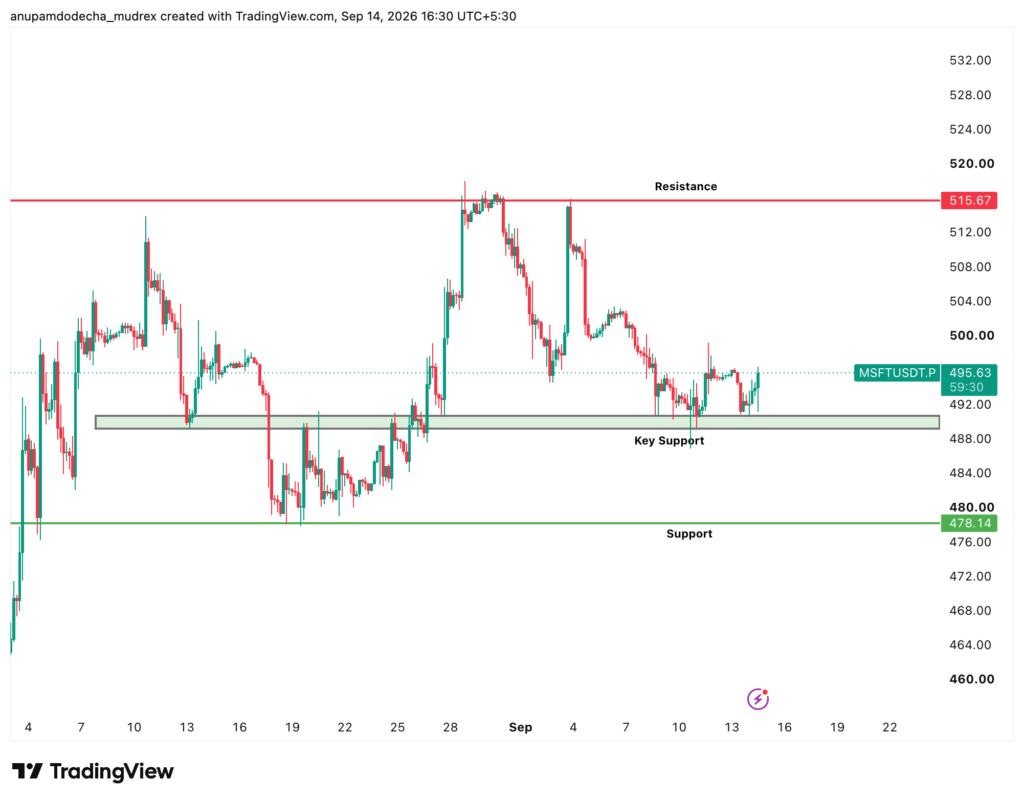
Microsoft Price Chart and Key Levels
Price sits above both the 50-day and 200-day moving averages, so the medium-term trend still points up. Short term, MSFT is range-bound under the $500 to $518 zone, with a neutral RSI around 53 to 56.
Zone
Level
Role
Immediate support
$492 – $496
Recent closes / pivot
Near support
$486 – $490
First real shelf
Stronger support
$477, then $450 – $455
Moving-average cluster
Near resistance
$499 – $503
Short-term MAs
Next resistance
$510 – $518
Recent swing high
Major resistance
$550 – $554
52-week high zone
A daily close above $518 reopens a run at the highs. A break below $486, then $477, would signal the consolidation has failed.
How Investors in India Can Buy MSFT Shares
You do not need a US bank account to own a slice of Microsoft.
Indian investors can buy MSFT stock (Tokenised) directly on Mudrex using INR, with fractional shares so you can start small instead of paying for a full share. That means you can own a piece of Microsoft with the money you already have, in the currency you already use. Setup is quick, and you can begin building a US stock portfolio in minutes
What is the Microsoft stock price prediction for 2026? Most analysts hold a Strong Buy rating with an average 12-month target near $573, roughly 15% above recent prices. A reasonable year-end 2026 range is $520 to $575, driven mainly by Azure growth and Copilot adoption.
What is the latest analyst price target for MSFT? The consensus average target is about $573, with a low near $400 and a high of $870. The overall rating is Strong Buy from roughly 55 analysts.
Is Microsoft stock a good long-term investment? Microsoft is widely viewed as the highest-quality compounder among mega-cap tech, backed by recurring software revenue, Azure and Copilot. The main long-term risk is whether heavy AI capex pays back fast enough. This is not investment advice.
What could make MSFT stock rise? Key catalysts include Azure growth staying above 40%, rising Copilot paid seats, slowing capex growth relative to cloud revenue, and stabilizing free cash flow.
Is MSFT stock overvalued or undervalued? At about 25x forward earnings, Microsoft is priced for continued execution. Bulls point to its cheapest forward multiple since 2023, while bears note the valuation already assumes AI converts to cash.
Can Microsoft stock reach a new all-time high? Yes, a move back above the $550 to $554 zone would set a new high. It likely requires a strong earnings beat plus evidence that capex growth is cooling relative to cloud growth.
Anupam has over 3 years of experience in the crypto industry, having worked with top indian crypto exchanges. He writes about Bitcoin, altcoins, AI, and emerging tech, helping readers understand what’s driving markets and where the digital asset ecosystem is headed.