Cryptocurrency markets tend to move in cycles, with capital rotating between Bitcoin and a myriad of altcoins. Understanding altcoin dominance – the market share of all cryptocurrencies other than Bitcoin – can give traders an edge in spotting these rotations. In this guide, we’ll break down what altcoin dominance is, how to read the key charts (like BTC.D, TOTAL2, etc.), and how to use this knowledge to identify altseason signals and trade the crypto market cycles effectively.
Altcoin dominance is the percentage of the total crypto market capitalization held by altcoins (every coin except Bitcoin).
Bitcoin dominance itself is the ratio of Bitcoin’s market cap to the total crypto market cap. So when Bitcoin is, say, 50% of the total market value, altcoin dominance would also be about 50%. A rising altcoin dominance means altcoins are collectively gaining a bigger share of the market (often because they’re rising in price faster than Bitcoin), whereas a falling altcoin dominance means Bitcoin is capturing more of the market (money shifting back into BTC or even into stablecoins during uncertainty).
In practical terms, traders watch altcoin dominance as a gauge of risk appetite in crypto:
When altcoin dominance is climbing, it suggests money is flowing into altcoins (risk-on behavior, seeking higher returns).
When altcoin dominance is falling, it suggests money is consolidating into Bitcoin or stable assets (risk-off, seeking safety).
BTC.D, TOTAL2, TOTAL3, OTHERS.D – When to Use Each
There are a few key tickers and indices that help visualize market dominance and capitalization splits:
Altcoin Dominance: How to Read the Chart & Trade the Cycle
BTC.D (Bitcoin Dominance Index): This is the percentage of total market cap that belongs to Bitcoin (often charted on TradingView as BTC.D). It’s the mirror image of overall altcoin dominance. Traders use BTC.D to quickly see if Bitcoin’s influence is growing or shrinking. A rising BTC.D generally means Bitcoin is outperforming the rest of the market, while a falling BTC.D means altcoins are collectively outperforming. Use case: Check BTC.D for broad market regime shifts – e.g., a trend change in BTC.D can hint at an upcoming altcoin cycle if BTC.D starts dropping from high levels.
Altcoin Dominance: How to Read the Chart & Trade the Cycle
TOTAL2 (Total Market Cap Excluding BTC): This index (available on TradingView as CRYPTOCAP:TOTAL2) shows the absolute dollar value of the entire altcoin market (all crypto except Bitcoin). TOTAL2 going up means the altcoin market cap is growing – a necessary confirmation that altcoins are actually gaining value, not just that Bitcoin fell. Use case: Use TOTAL2 to confirm an altcoin uptrend; for example, if BTC’s price is flat but TOTAL2 is climbing steadily (especially with rising volume), it indicates capital is rotating into altcoins.
Altcoin Dominance: How to Read the Chart & Trade the Cycle
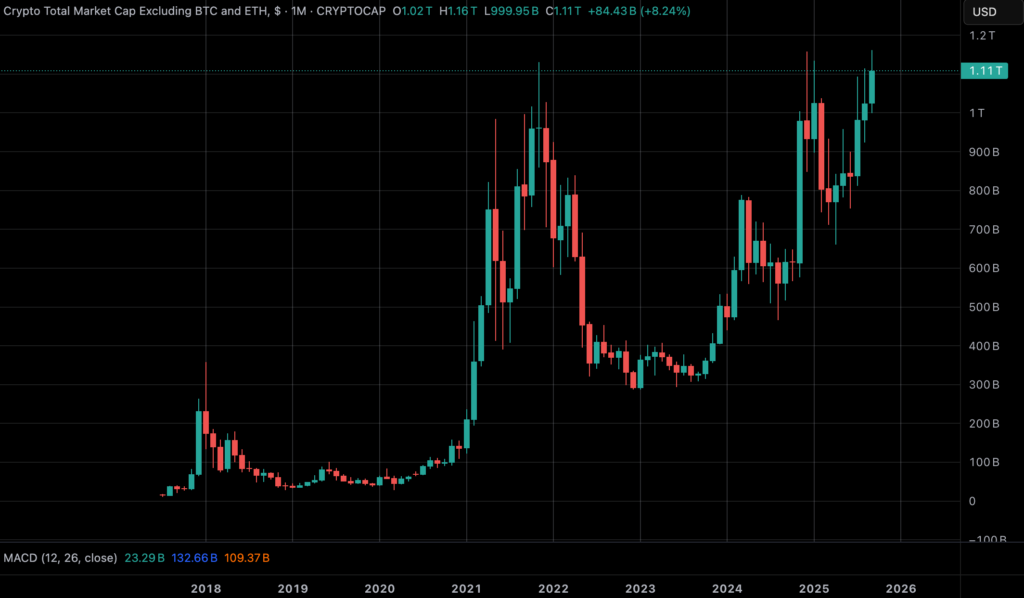
TOTAL3 (Total Cap Excluding BTC & ETH): (CRYPTOCAP:TOTAL3 on TradingView) This is the total market cap of all crypto excluding the two largest coins (BTC and Ethereum). It’s a gauge of the “smaller” altcoin market. Since Ethereum is the largest altcoin, sometimes analysts remove both BTC and ETH to see how the rest of the altcoins are doing. Use case: TOTAL3 is useful for spotting when mid-cap and small-cap coins are rallying. For instance, if TOTAL2 is rising but TOTAL3 is flat, it means most gains are concentrated in Ethereum (and perhaps a few top alts) rather than the broader altcoin market.
Altcoin Dominance: How to Read the Chart & Trade the Cycle
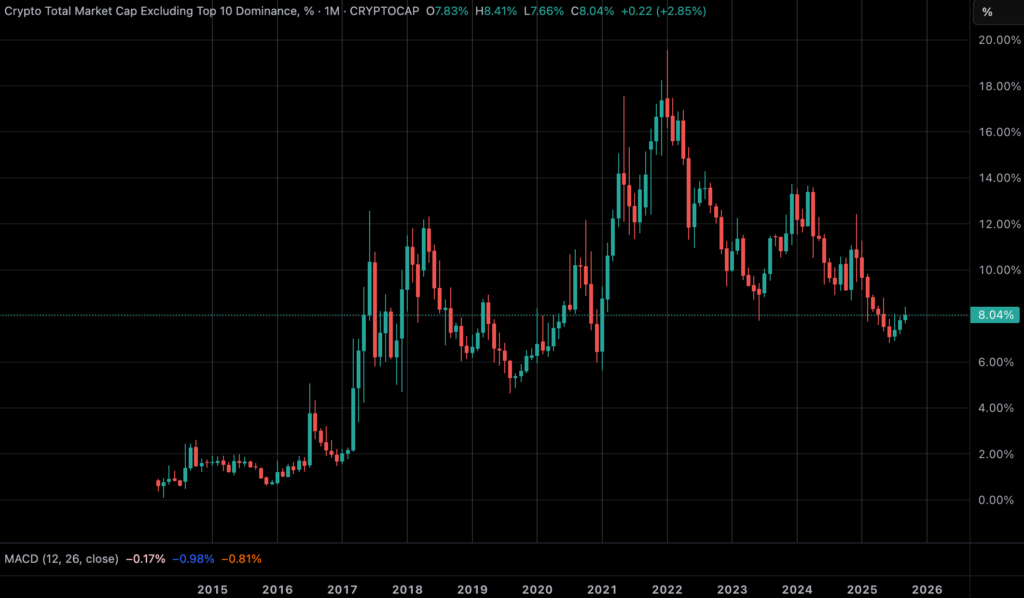
OTHERS.D (Others Dominance Index): This chart (ticker CRYPTOCAP:OTHERS.D) measures the combined dominance percentage of all cryptocurrencies outside of the top 10 by market cap. In other words, it filters out Bitcoin, Ethereum, and other large-caps (as well as major stablecoins). An increase in OTHERS.D implies that smaller-cap coins are taking a larger share of the market. Use case: Traders watch OTHERS.D for signs of a broad altcoin rally. A strong uptrend in OTHERS.D means money isn’t just flowing into a few large alts, but into the wider altcoin space – a hallmark of a true “altseason.”
Each of these metrics has its nuances. BTC.D is a classic indicator but can be skewed by the presence of stablecoins and Ethereum’s large share. TOTAL2 and TOTAL3 measure actual market cap growth of alts (in USD terms), which is great for confirmation of trend. OTHERS.D specifically amplifies the movements of smaller alts, giving an extra signal when the risk appetite is so high that traders are buying up even the little altcoins.
Stablecoin Dominance Caveat
One important caveat in reading dominance charts is the role of stablecoins. Stablecoins (like USDT, USDC, BUSD, etc.) are typically counted as part of the “altcoin market cap” since they are non-Bitcoin crypto assets. However, they behave very differently from speculative altcoins – their market caps can grow during flight-to-safety periods.
For example, if investors sell Bitcoin and altcoins during a market downturn and park a lot of money in USDT (Tether), the total crypto market cap might not fall as much because that value just moved into stablecoins. Bitcoin’s market cap portion falls, so BTC dominance drops. This makes it look like altcoin dominance is rising (since stablecoins are lumped in with “altcoins”) even though speculative altcoins might be flat or also falling. An uninformed analyst could mistakenly cheer a falling BTC.D as a bullish altseason signal, when in reality it was a “stablecoin season”– capital fleeing to stables, not into risky alts.
To avoid this trap, consider stablecoin dominance separately. For instance, charting USDT.D (Tether’s dominance) helps. Generally:
Rising stablecoin dominance (USDT.D going up) means more money is sitting in stables – a risk-off sign.
Falling stablecoin dominance (USDT.D down) means money is leaving stablecoins (potentially moving into BTC or alts – a risk-on sign).
But context is key: a decline in USDT.D could mean money flowing into Bitcoin or Ethereum just as much as into altcoins. So use multiple indicators. The safest read is: look for agreement between metrics. For a true altcoin season, you’d ideally see stablecoin dominance dropping alongside other signals like BTC dominance dropping and TOTAL2 rising. Declining stablecoin share is encouraging, but it needs confirmation from things like volume surges and broad altcoin price strength before you declare an altseason
How to Read the Chart
BTC ↑ / Altcoin Dominance ↑: Risk-on. BTC is healthy but alts are gaining share faster → classic early/mid-altseason setup.
BTC ↑ / Altcoin Dominance ↓: BTC-led phase. Capital concentrates in BTC; alts lag (often early bull legs or flight to quality).
BTC ↓ / Altcoin Dominance ↑: Two reads: (a) healthy rotation after a BTC run (alts hold/advance while BTC cools), or (b) distortion if stables inflate “alt” share while prices fall. Confirm with TOTAL2/volumes.
BTC ↓ / Altcoin Dominance ↓: Broad risk-off. Alts usually bleed more than BTC; dominance shifts back to BTC/stables. Not altseason.
Signals & Thresholds
BTC.D trend break ↓: Sustained downside from a high range = rotation risk rising. Avoid one-day dips; seek structure breaks.
TOTAL2 / TOTAL3 + volume: Breakouts with rising, broad volume confirm real alt demand; TOTAL3 strength = deeper breadth.
2017 – ICO Boom. Bitcoin started 2017 with altcoin dominance above 85%. The ICO mania, powered by Ethereum and ERC-20 tokens, funneled capital into new alts. By January 2018, BTC dominance fell to ~38% as ETH led and a broad alt rally followed. The euphoric peak reversed into a harsh bear market, underscoring how brief late-stage altseasons can be.
2020–2021 – DeFi Summer to NFT Mania. After the 2018–2019 winter, Bitcoin led into early 2021. Capital then rotated to DeFi, and later to NFTs and gaming, pushing BTC dominance from >70% in January 2021 toward ~40% by May. The move was sector-driven and more mature than 2017, but it faded as BTC and ETH corrected.
2024–2025 – The ETF Era. Institutional flows around spot BTC ETFs boosted Bitcoin and likely raised the floor for BTC dominance. Alt strength appeared in rotating pockets, from memecoins to AI and gaming. Rather than one synchronized blow-off, mini-altseasons emerged by sector as narratives evolved. A broader altseason is in motion at the time of this writing.
Myths & Traps in Interpreting Dominance
Falling BTC.D = Altseason? Not always. Bitcoin dominance can drop because of a market sell-off or rising stablecoin share, not just because alts are rallying. Altseason requires alt prices and volumes to rise, not just percentage shifts.
Stablecoin distortion. Growing USDT or USDC supply can make BTC’s share look smaller, even if speculative alts aren’t moving. Always track stablecoin dominance alongside BTC and alt charts.
Index drift. Metrics like OTHERS.D and TOTAL3 change composition over time. Coins moving in or out of the top 10 can skew the data. Cross-check dominance with raw price and volume trends.
Altseason ≠ guaranteed gains. Not every coin pumps. Sector rotation matters, and some alts or narratives will outperform while others lag or fail entirely.
Ignoring macro context. altcoin dominance metrics only work when read with the broader cycle. A true altseason usually comes after Bitcoin rallies and consolidates, not while it’s in a parabolic run or during a global risk-off shock.
Conclusion
Altcoin dominance is a valuable guide for reading crypto cycles. By pairing these charts with price action, traders can spot when capital is rotating from Bitcoin into altcoins and back again. Altseasons are the phases when BTC steps aside and alts deliver outsized gains, but catching them early and knowing when they end is what protects profits.
Here’s a quick Altseason Checklist to reference:
✅ Bitcoin Rally Done? Bitcoin had a strong run-up and is now flattening or slowing down (no longer in a roaring uptrend). ✅ BTC Dominance Breaking Down: BTC.D chart shows a sustained decline or break of trend, after a period of Bitcoin strength or high dominance. ✅ Altcoin Market Cap Up: TOTAL2/TOTAL3 charts are in uptrends, indicating capital is increasing in altcoins (ideally with rising trading volumes for confirmation). ✅ Ethereum/Majors Outperforming: ETH/BTC and other major alt vs BTC pairs are strengthening – the large caps are leading the way for smaller alts. ✅ Stablecoin Capital Deploying: Stablecoin dominance (e.g., USDT.D) is trending down, implying money is flowing out of stables back into crypto assets (risk-on tilt). ✅ Broad Participation: Many altcoin sectors and coins are moving up together – a healthy breadth, not just one isolated niche. OTHERS.D and market breadth indicators are climbing, showing even smaller alts have momentum. ✅ Sentiment Heating (but not at euphoria yet): Crypto community chatter shifts toward altcoin opportunities, and moderate positive sentiment returns without the full froth of late-stage hype.
If most of these boxes are checked, an altseason is likely underway. That’s the time to rotate into strong alts with discipline and a clear exit plan. When the signals flip—BTC.D climbing, stables rising, alt volumes fading, it’s time to step back. Using this checklist helps you ride Bitcoin’s waves, capture altcoin surges, and avoid the traps that cut cycles short.
FAQs
How to calculate altcoin dominance? Subtract BTC dominance from 100%, or divide total altcoin market cap by total crypto market cap.
Does altseason start when BTC drops? Not always; it usually starts after BTC rallies and then consolidates, giving alts room to run.
What happens when BTC dominance goes up? Capital concentrates in Bitcoin, meaning alts typically underperform or bleed harder.
How long does altseason last? Typically a few weeks to a few months, often shorter and sharper than Bitcoin’s rally.
Do altcoins drop during halving? They may lag as focus shifts to BTC, but often surge later in the cycle once BTC cools.
How to see crypto market dominance? Check charts like BTC.D, TOTAL2, TOTAL3, or dashboards on CoinGecko and CoinMarketCap.
How to read BTC dominance chart? An uptrend means BTC is gaining share; a downtrend shows alts outperforming.
What is the highest dominance in crypto? BTC held >95% in early years; altcoin dominance peaked ~62% in Jan 2018.
How to spot altseason early? Look for BTC.D breaking down, ETH/BTC rising, TOTAL2 climbing, and broad alt participation.
Anush is a crypto researcher dedicated to making blockchain insights clear and accessible. A proud Solana maxi who still appreciates a good Layer 2 debate, he dives deep into market trends so others don’t have to (but really should). Passionate about simplifying crypto, he strives to make the space less intimidating and a lot more relatable, one report at a time.