
The best semiconductor stocks in India give investors exposure to multiple areas of the chip industry. These include chip design, packaging, and testing. Despite this, not every company connected to semiconductors earns much of its revenue from the sector. Other areas that matter include financial condition, valuation, debt, and profits from new projects.
This blog analyzes five semiconductor-related stocks listed in India, their business models, and the key financial metrics. The guide also elaborates on their long-term growth potential and the related risks.

India’s semiconductor industry is witnessing growth as the country continues to invest in chip design, packaging, and testing. Products such as smartphones, electric vehicles, computers, and AI systems thus get support. While demand for these products increases, it creates broader opportunities for companies across the chip supply chain.
The India Semiconductor Mission is another major reason for the sector’s growth. Through this initiative, which aims to build local chipmaking capacity and reduce reliance on imports, the government is also supporting the space.
Global demand is also rising, adding to the growth of the semiconductor sector in India. According to the Semiconductor Industry Association, global chip sales hit a remarkable $791.7 billion in 2025. This reflects a strong demand across several technology markets.
The best semiconductor stocks in India include companies linked to chip design, engineering, packaging, and testing. But these companies have different business models and levels of exposure to the industry. Comparing their core activities can help you understand their business growth and how semiconductor exposure benefits them.
Here are the five semiconductor-related stocks to watch in 2026:
| Company | Symbol | Semiconductor Exposure |
|---|---|---|
| HCLTech | HCLTECH (NSE) | Chip design and engineering services |
| CG Power and Industrial Solutions | CGPOWER (NSE) | Semiconductor packaging and testing |
| Kaynes Technology India | KAYNES (NSE) | Electronics manufacturing and semiconductor packaging |
| MosChip Technologies | MOSCHIP (NSE) | Chip design and engineering services |
| VanEck Semiconductor ETF | SMH (Nasdaq, not listed on NSE) | Invests in global semiconductor companies, including chipmakers and semiconductor equipment manufacturers |
It is worth noting that market capitalization, financial performance, and stock prices can vary over time. The list here is not a recommendation to buy these stocks.
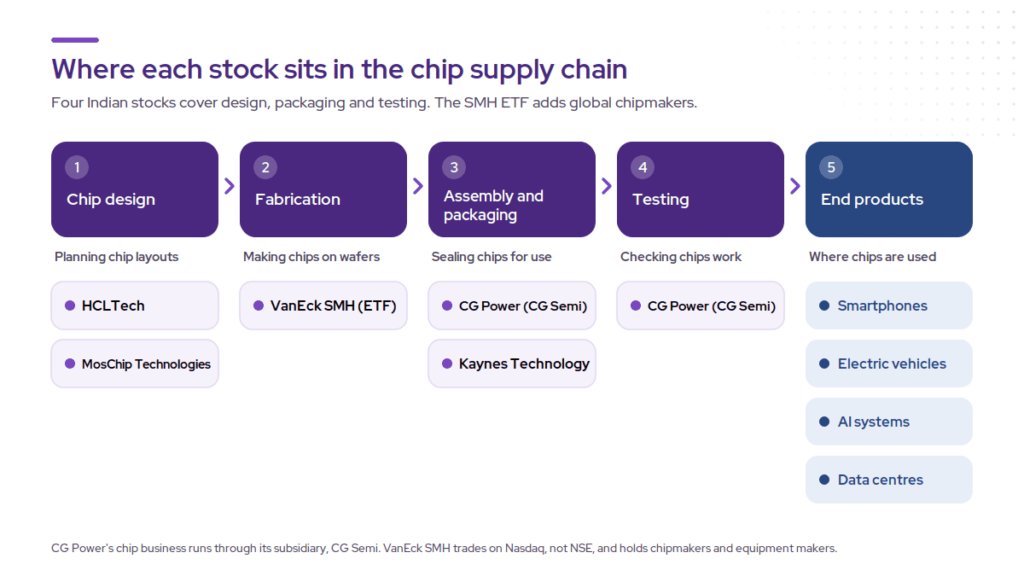
HCLTech offers semiconductor design and engineering services to companies across tech spaces. The areas of focus include chip design, verification, and product development. Thus, investors can access the semiconductor sector without relying on chip manufacturing alone.
HCLTech’s revenue comes from several IT services. This means that the semiconductor-related work is only one part of its business. Investors can learn about the company’s annual report, revenue growth, profit margins, and semiconductor service developments to assess its growth potential.
CG Power and Industrial Solutions focuses on electrical equipment and industrial systems. It is also expanding into semiconductors through CG Semi. Its semiconductor business focuses on outsourced semiconductor assembly and testing.
This gives CG Power another potential source of growth beyond its established businesses. Investors should check the latest disclosures for production progress, customer demand, capital expenditure, and the role of the semiconductor business in overall earnings.
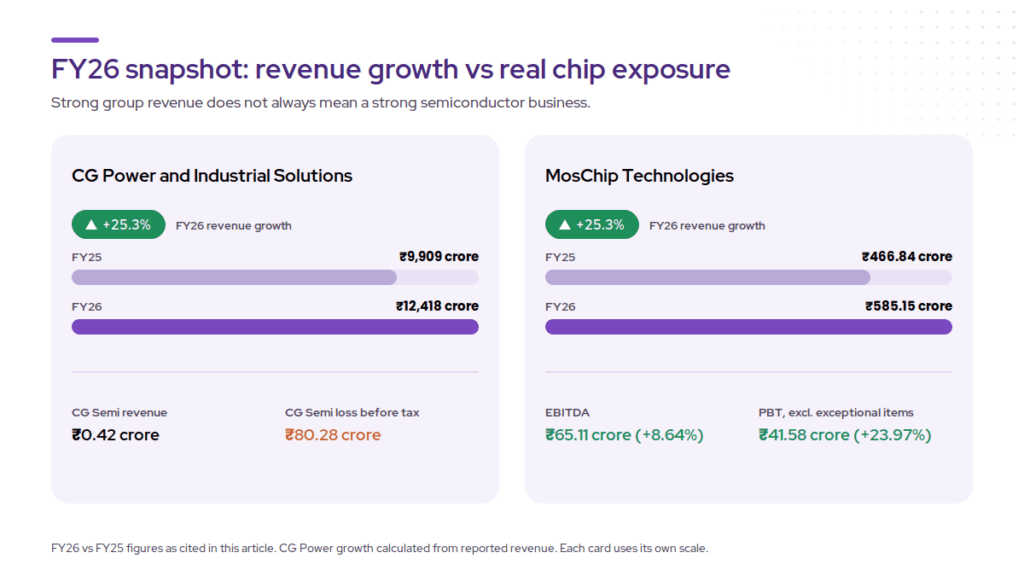
The company’s consolidated revenue increased to ₹12,418 crore in FY26 from ₹9,909 crore in FY25. But its CG Semi subsidiary saw only ₹0.42 crore in revenue. It also reported a loss before tax of ₹80.28 crore in FY26.
Kaynes Technology is now expanding into semiconductor packaging along with its existing electronic manufacturing services. The company connects electronics production with the semiconductor supply chain.
Significantly, the company may post gains from increased demand for local electronics manufacturing and semiconductor packaging. But before concluding its success, investors need to assess its revenue growth, profit margins, debt, cash flow, and progress in bringing in new projects. Reports claim that Kaynes Technology’s revenue hit ₹946.02 crore, up 40.47% year over year. But the profit tax declined to ₹87.88 crore, down 8.54% year over year.
MosChip Technologies is mainly about semiconductor design and engineering services. The work includes chip design and development. This makes it different from companies that focus on manufacturing or packaging.
Here, demand for advanced chips could create opportunities for engineering service providers. Investors should examine the company’s revenue growth, net profit, operating margins, customer base, and new projects.
Interestingly, the company saw FY26 revenue of ₹585.15 crore, up by 25.34% from ₹466.84 crore in FY25. Its EBITDA surged by 8.64% to ₹65.11 crore. Definition [EBITDA]: a measure of operating earnings before interest, tax, depreciation, and amortisation. Also, profit before tax, excluding exceptional items, rose to ₹41.58 crore, up 23.97%.
The VanEck Semiconductor ETF (SMH) offers exposure to the global semiconductor industry through a single exchange-traded fund. It is listed on the Nasdaq and tracks an index of companies involved in semiconductor production and equipment. Thus, investors get access to several major chip companies. This means they don’t need to buy each stock separately.
As of September 23, 2026, the fund has total assets of $74.19 billion. It has delivered a year-to-date return of 66.89%. In addition, the fund held 26 securities, with NVIDIA accounting for about 19.36% of its portfolio. According to VanEck’s official data, its total expense ratio was 0.35%.
It is important to note that investments in semiconductor stocks will give you exposure to companies linked to the chip industry. But crypto and tokenized stocks offer different ways to access financial markets. While each option has its own benefits and risks, your choice should depend on your goal and risk tolerance.
Crypto markets are available to trade 24/7. This allows traders to respond to market movements at all times. Crypto futures also allow you to take long or short positions, while leverage can magnify losses. As cryptocurrencies are highly volatile, losses and gains could be unpredictable.
At the same time, tokenized stocks provide blockchain-based exposure to traditional assets. Depending on the product and platform, the stocks’ availability, ownership rights, and trading conditions may change. What is important to note is that it may be significantly different from holding the shares directly.
With Mudrex, you can explore crypto futures and access supported markets in India. You will be subject to our terms and applicable laws. Before starting to trade, you should know the fees, margin requirements, liquidity, and risks involved.
The growth prospects of semiconductor stocks in India depend on rising chip demand, new investments, and the company’s ability to turn projects into profits. But as these companies have different levels of exposure to the semiconductor industry, their financial performance and expansion plans are important to note.
In addition, there are many factors that could support the sector’s future growth. Areas like chip design, packaging, assembly, and testing could get more opportunities. Also, demand from artificial intelligence (AI), electric vehicles, smartphones, and data centres may also support the sector.
Although semiconductor stocks can benefit from long-term industry growth, they cannot guarantee strong stock returns. For new projects, they need substantial investments. Lower-than-expected demand can affect profits. The company’s valuation is also important, as the share price reflects expectations of future growth.
The time required to start new semiconductor facilities should be considered. Delays in construction, equipment installation, or customer approvals can increase costs and affect expected returns. Competition from established global players could also affect a company’s growth. The company’s financial health should also be analyzed, focusing on debt, cash flow, profit margins, etc.
In conclusion, the best semiconductor stocks in India can offer exposure to different parts of the chip supply chain. HCLTech, CG Power, Kaynes Technology, MosChip Technologies, and VanEck Semiconductor ETF are the best semiconductor stocks to buy in 2026.
However, it should be understood that industry growth alone is not sufficient to guarantee higher returns. In addition to the stock market growth, other metrics like market capitalization, revenue, net profit etc., should also be considered. It is also important to understand the related risks.
HCLTech, CG Power, Kaynes Technology, MosChip Technologies, and SPEL Semiconductor are the top semiconductor stocks 2026 in India. Their business models, performance, and semiconductor exposure are different.
Check the company’s business model, financial health, growth plans, and position in the semiconductor supply chain. Review its latest financial reports and compare its performance with competitors before making an investment decision
Compare revenue growth, net profit, operating margins, debt, cash flow, and valuation ratios such as price-to-earnings (P/E). Also, check customer demand, project progress, and how much of the company’s revenue comes from semiconductor-related activities.
Semiconductor stocks may suit investors who can handle market fluctuations and have a long-term investment horizon. Demand from AI, electric vehicles, and other technologies could support the industry, but company performance and stock valuations will influence returns. Past performance does not guarantee future gains.
Yes. Semiconductor stocks could be risky like any other shares. High project costs, delays, competition, changing demand, and expensive valuations could bring risks.
Yes. Indian residents can access US-listed semiconductor companies through eligible international investment platforms or other permitted routes, subject to applicable regulations. The Reserve Bank of India’s Liberalised Remittance Scheme (LRS) allows eligible overseas investments within its prescribed limits.
Investments in stocks and cryptocurrencies involve risk and may result in the loss of capital. Crypto futures carry additional risks because leverage can magnify both gains and losses. This article is for educational purposes only. Examples and financial figures are illustrative of the companies discussed and do not constitute investment advice. Conduct your own research (DYOR) and consult a qualified financial adviser before making investment decisions.