Bitcoin Diversification Strategy: How to Size BTC and Build a Balanced Crypto Portfolio
Diversifying your crypto portfolio with Bitcoin is not about simply holding a bunch of coins. A smart bitcoin diversification strategy means using BTC as an anchor, sizing it appropriately, and layering in other assets so that your downside is controlled while your upside remains strong.
In this guide, we cover how to think about BTC’s role in your portfolio, how to size it, and how to build and maintain balanced allocations for 2025.
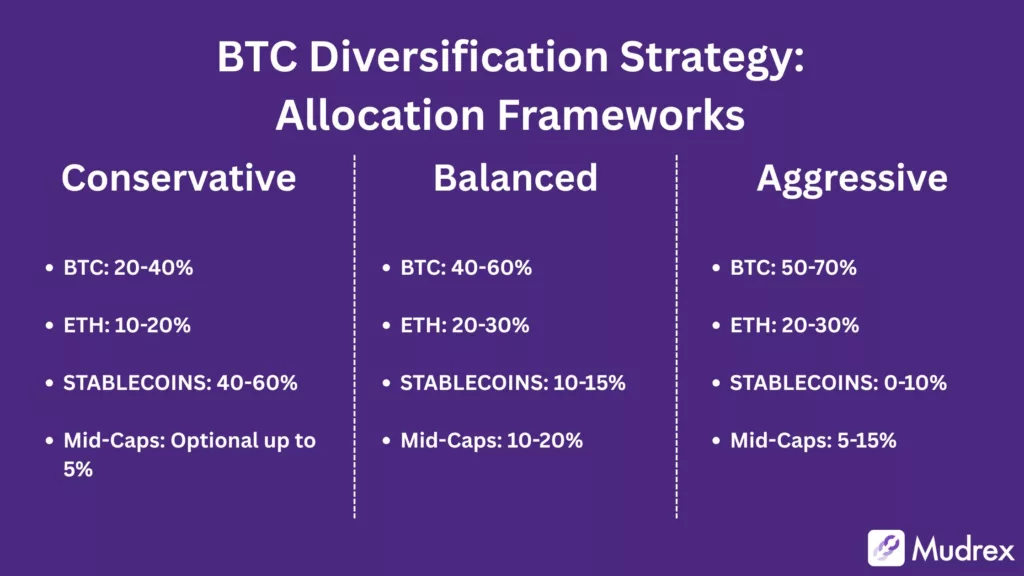
These are sample frameworks; adapt them to your risk profile, goals, and time horizon.
Crypto markets are highly volatile and speculative. This article is for educational purposes and not financial advice. Always assess your risk tolerance, do your own research, and consult a financial advisor if needed.
In traditional finance, diversification means spreading investments across assets that do not move in perfect lockstep, for example, stocks and bonds. In the crypto world, diversification has a similar goal, but the dynamics are different.
Crypto assets are generally more volatile and can move together in extreme market conditions. However, not all crypto assets correlate equally. By holding BTC alongside other types of assets, you can reduce the risk that comes from being exposed to only one high-volatility asset, while still capturing upside.
Diversification in crypto is not simply owning many tokens. It is about choosing assets that behave differently, layering risk intelligently, and rebalancing to manage drift over time.
Correlation 101: BTC vs ETH, SOL, DeFi, Stablecoins, S&P 500
Diversification only works when assets do not move in the same way at the same time. This is why understanding correlation is essential for building a Bitcoin diversification strategy that actually reduces risk.
Correlation measures how two assets move relative to each other on a scale of minus 1 to plus 1.
A value near +1 means the assets move together.
A value near 0 means they move independently
A value near minus 1 means they move in opposite directions.
In crypto, correlations change often. They tighten during fear or greed cycles and loosen during stable market phases. Learning to read these patterns helps you build more balanced allocations.
Why Correlation Matters in Diversification
If two assets have a high correlation, holding both does not reduce much risk. You may feel diversified because you own many coins, but in reality, your portfolio behaves like one large, highly volatile bet. On the other hand, low correlation pairs can smooth volatility, which is the foundation of intelligent diversification.
For example:
BTC and ETH tend to rise and fall together, so holding both still exposes you to similar market movements.
BTC and stablecoins have near-zero correlation, which means stablecoins can help stabilize your portfolio when BTC is volatile.
BTC and the S&P 500 have seen rising correlation in recent years, which matters for investors who hold both equities and crypto.
Approximate Crypto and Equity Correlations (Oct-Nov 2025)
Estimated 90-Day Rolling Correlations for Key Pairs
Bitcoin and Ethereum move together because they share liquidity drivers, large investor overlap, and macro sensitivity. This means ETH adds some diversification, but not as much as completely different categories like stablecoins or DeFi.
Solana’s correlation is lower because its price action is more strongly influenced by its ecosystem events, usage spikes, validator performance, and technology updates. This creates more independent movement relative to BTC.
The DeFi index shows weaker correlation because individual protocol tokens respond to governance votes, revenue cycles, emissions schedules, hacks, and regulatory risks.
Stablecoins remain close to zero correlation because they are engineered to hold a fixed value. They act as dry powder and stabilizers during high volatility phases.
The S&P 500 shows a moderate relationship with BTC because both respond to global liquidity and interest rate expectations. Correlation rises during macro shocks and declines when crypto-specific catalysts dominate.
This sets up the next question a rational investor asks.
If correlations are mostly positive, how do you actually manage risk inside a crypto portfolio?
This is where risk metrics come in.
Key Risk Metrics Defined for Diversification
These metrics explain how much risk you are adding or removing when you increase Bitcoin exposure or mix it with ETH, SOL, mid-caps, or stablecoins. This section is intentionally placed here because correlation only tells you whether assets move together. It does not tell you how intensely they move or how deeply they can fall.
Understanding both correlation and risk metrics is what turns random token picking into structured portfolio construction.
Beta: Beta measures how sensitive an asset is to market movements. A beta greater than 1 means the asset moves more sharply than the market.
Bitcoin typically has a beta above 1 relative to equities but lower than most altcoins. This makes Bitcoin volatile, but still more stable compared to the wider crypto market.
Standard Deviation (Volatility): Standard deviation shows how wide price swings are over a period. A higher standard deviation means more volatility.
Bitcoin’s volatility is high compared to traditional assets but comparatively lower than most altcoins. This is one reason Bitcoin often serves as the anchor in a diversified crypto portfolio.
Maximum Drawdown: Maximum drawdown captures the largest fall from a peak to a bottom. Crypto assets can have drawdowns greater than 70 percent.
This metric explains why stablecoins and conservative allocations matter for long-term investors.
Sharpe Ratio: The Sharpe ratio measures return relative to risk.A higher ratio indicates that an asset rewards the investor more for each unit of volatility.
Bitcoin has historically produced one of the strongest Sharpe ratios across multi-year periods among major crypto assets.
Bitcoin Diversification Strategy: Is Bitcoin a Diversifier or a Risk-On Asset?
Bitcoin can be both, depending on market conditions.
When Bitcoin acts as a diversifier
During altcoin bubbles, smaller-cap tokens may rally harder and fall harder, while BTC tends to be more stable.
When liquidity is concentrated in large-cap assets, BTC often retains liquidity even in downturns.
For long-term investors, BTC’s dominance and liquidity make it a relatively safer base.
When Bitcoin behaves as a risk-on asset
During macro risk-off phases, BTC has increasingly correlated with equities. According to CME Group, its correlation with the S&P 500 has risen in recent years.
Institutional flows and ETF adoption have tied Bitcoin more closely to traditional markets.
In rapid bull markets, Bitcoin often rallies aggressively, behaving like a leveraged play on risk appetite.
The role BTC plays in your portfolio depends on timing, market regime, and your goals.
Sizing Bitcoin in Your Portfolio for Diversification
How much BTC you hold has, perhaps, more impact than which alts you choose. Under- or over-allocating BTC can dramatically change risk and return.
Position-Sizing Frameworks for Diversification
Ladder-based allocation
Begin with a small allocation (1-3%) if you are new or risk-averse.
Increase to 5% as you build conviction and monitor performance.
Move toward 10% or more only once you are comfortable with crypto volatility and your capital base supports it.
Ratio-based analogies
60% BTC / 40% ETH: A simple, balanced crypto-native version of the traditional 60/40 asset mix.
70% BTC / 30% ETH: More weight to BTC for stability.
80% BTC / 20% other: For highly risk-averse investors who want maximum BTC exposure while limiting downside.
Goal-based sizing
If your priority is capital preservation, lean toward a higher stablecoin or BTC share.
For growth, you might allocate more to ETH or selected altcoins.
For active trading, keep a part of your portfolio in stablecoins to deploy into dips.
Back-tested Scenarios: How Position Sizing Behaves Over Time
Back testing is a useful tool in crypto because it allows investors to see how different allocation strategies would have behaved across past market cycles. Bitcoin has experienced multi-year rallies, steep drawdowns, and long consolidations. Testing strategies across these environments helps investors understand which approaches tend to manage risk, which approaches chase volatility, and which are suited for long-term accumulation.
Back tests are not predictions. They simply show how rules-based strategies would have performed under real historical conditions. This helps investors assess whether a Bitcoin-heavy portfolio or a more diversified mix fits their risk tolerance.
Lump Sum vs Dollar Cost Averaging (DCA)
These two approaches create very different psychological and financial outcomes.
Lump Sum Investing
A lump sum refers to deploying your entire planned investment at once.
In Bitcoin bull markets, lump sum entries have historically produced higher returns because capital is exposed to upside immediately. For example, in strong expansion phases like 2017, 2020, and late 2023, lump sum strategies captured the full acceleration of price increases.
However, lump sum investing also carries timing risk. If the entry happens before a correction, the portfolio may experience drawdowns of 30 to 50 percent before recovering. This makes a lump sum better suited for investors with high conviction and strong risk tolerance.
Dollar Cost Averaging (DCA)
DCA spreads purchases across fixed intervals, such as weekly or monthly.
In Bitcoin’s highly volatile environment, this approach reduces the emotional pressure of picking the perfect entry. It also naturally buys more BTC during dips and less during rallies, which results in a smoother cost basis over time.
Historically, DCA has produced more stable outcomes for investors focused on long-term accumulation. It reduces regret during sharp corrections such as 2018, 2021, and early 2022 because losses are softened by staggered entries. This makes DCA particularly important for diversified portfolios where BTC is one component rather than the entire allocation.
Why this matters in a Bitcoin diversification strategy
A BTC-heavy portfolio often feels volatile. Back testing shows that the choice between lump sum and DCA changes the experience of volatility more than the allocation itself. Investors who struggle with drawdowns tend to prefer DCA, while high conviction investors seeking maximum upside often prefer a lump sum. Understanding this distinction helps align the portfolio strategy with personal risk tolerance.
Rebalance whenever an asset’s weight deviates by a pre-specified amount (e.g., ±5% or ±10%).
Can capture momentum more effectively, because you only rebalance when allocations drift significantly.
Often more efficient than frequent time-based rebalancing, especially in trending markets.
Threshold rebalancing generally outperforms simple fixed-interval rebalancing because it adapts to market moves rather than forcing trades on a rigid schedule.
The Rule of 72, 80/20, 70/30, and 90/10
Rule of 72
I've loved the rule of 72 since I've learned about it. I use it for goal setting for plans like retirement and education plans 💚 All our plans are on track in this home. Using time is the biggest advantage in investing.
Mid-caps (optional): Up to 5% – For cautious exposure to growth without large swings
This model is suited for risk-averse investors or those in accumulation mode who want to remain exposed to crypto upside while preserving capital.
2. Balanced Model
BTC: 40-60%
ETH: 20-30%
Mid-caps: 10-20% (like L2s, DeFi leaders)
Stablecoins: 10-15%
This structure balances stability (BTC), long-term growth (ETH), and upside (mid-caps). It captures participation in innovation while retaining a strong foundation.
Aggressive Model
BTC + ETH: 50-70%
Mid-caps: 20-30%
Small-caps: 5-15% small-cap tokens that have high growth potential but also high risk
This allocation is for growth-focused investors who are willing to accept high volatility. The mid- and small-cap layers are more speculative, but they also offer the potential for outsized gains.
Add-ons (Optional): RWAs, L2s, Oracles, DeFi Blue Chips
Once you have your core (BTC, ETH, maybe mid-caps), you can layer in thematic or infrastructure plays:
RWAs (Real-World Assets): Tokenized real-world securities or yields
Oracles: Chains that provide off-chain data (e.g., Chainlink)
DeFi Blue Chips: Proven protocols with high TVL and sustainable business models
These layers are optional and should not displace your core allocation unless you have conviction and risk capacity.
Strategy Layer: How to Stay Diversified Over Time
Building the right allocation is just the first step. Maintaining it is where discipline and strategy matter.
Rebalancing Strategy
Time-based rebalancing: Rebalance on a fixed schedule (monthly, quarterly).
Threshold-based rebalancing: Rebalance when an asset’s weight deviates by a set amount (e.g., ±10 %).
Tax-aware rebalancing: In high-tax jurisdictions, rebalancing less often may minimize tax impact.
Stablecoins as Dry Powder
Stablecoins play a dual role: they act as a buffer during volatility and as dry powder for buying dips.
Benefits:
Provide liquidity without selling other crypto
Help in layering into high-conviction positions
Serve as a risk-off reserve
Risks to consider:
Peg risks (though rare for major stablecoins)
Issuer risk (centralized stablecoins)
Regulatory risk and changes in stablecoin policy
Hedging Techniques
If you want to protect part of your crypto exposure, consider these hedging strategies:
Protective puts: Buying a put option on BTC caps downside loss.
Covered calls: Holding BTC and selling call options; you earn a premium but sacrifice some upside.
Futures/perpetuals: Taking small short positions to hedge spot exposure, though this requires careful leverage management.
These are advanced strategies and may not suit every investor, but they can improve risk control for more experienced users.
Custody Diversification
Where you store your crypto is also part of diversification:
Exchange wallets: Easy access but counterparty risk
Hardware wallets: Secure and cold storage for long-term holdings
MPC (multi-party computation) / co-wallets: Distribute control across devices or parties for added security
Spreading custody reduces the risk of a single failure or hack compromising your entire portfolio.
Common Mistakes to Avoid
Diworsification: Adding too many coins without understanding correlations weakens the portfolio.
Chasing narratives: Buying speculative assets solely because they are trending can lead to poor risk/return tradeoffs.
Ignoring correlation: If you own multiple coins that all move with BTC, you’ve not truly diversified.
Over-leveraging: Using too much leverage in a volatile market amplifies losses.
Fee drag and slippage: Too many trades or rebalances, especially in illiquid assets, can erode returns.
India Corner: Tax and Compliance Realities
If you are in India, certain tax rules materially affect how you should build and rebalance your crypto portfolio.
30% flat tax: Profits from crypto transactions are taxed at 30%. There is no lower tax rate for long-term holdings or preferential treatment.
1% TDS (Tax Deducted at Source): Every time you trade, 1% is withheld as tax, which reduces liquidity and increases friction.
No set-off across assets: Unlike some capital assets, you cannot offset losses on one crypto with gains on another.
No lower rate for long-term: There is no distinction between short-term and long-term gains in the current Indian tax rules.
Cash-out myths: Some believe you can avoid tax by using peer-to-peer (P2P) exchanges or offshore platforms. These are largely misconceptions. Compliance requires you to acknowledge and report gains properly.
In practice, Indian investors should build portfolios with tax impacts in mind. Rebalancing too often or realizing gains frequently can reduce after-tax returns. A stablecoin buffer and long-term conviction can help minimize tax churn.
Conclusion
A robust bitcoin diversification strategy is not about putting all your faith in BTC or hopping on every altcoin trend. It is about thoughtfully sizing Bitcoin, layering complementary assets, and maintaining discipline through rebalancing and risk controls. In 2025, Bitcoin remains the anchor of many portfolios because of its liquidity, institutional demand, and historical resilience.
But diversification means more than just holding BTC. You need to understand correlations, maintain stablecoin reserves, thoughtfully add thematic exposure, and hedge or rebalance when needed. With a strategy that balances conviction and risk, you can build a portfolio that not only survives volatility but is positioned for long-term growth.
For more research-driven crypto guides, frameworks, and portfolio strategies, explore Mudrex Learn, where we break down advanced investing and risk management tools. Also, subscribe to the Mudrex YouTube channel for in-depth video content on crypto investing.
FAQs
Is Bitcoin a good way to diversify?
Yes. Bitcoin is often used as a core asset in a crypto portfolio because of its liquidity, market dominance, and relatively lower risk compared to smaller tokens.
Is Bitcoin a good way to diversify?
Yes. Bitcoin is often used as a core asset in a crypto portfolio because of its liquidity, market dominance, and relatively lower risk compared to smaller tokens.
What is the 80/20 rule in crypto?
It is a guideline suggesting that 80% of capital goes to safer assets (like BTC or ETH) and 20% to higher-risk, higher-reward tokens.
What is the Rule of 72 in Bitcoin?
It is a heuristic: Divide 72 by your expected annual return rate to estimate how many years it will take for your BTC investment to double.
What is the best timeframe for BTC trading?
Long-term investors typically use weekly or monthly charts. Shorter timeframes are more prone to noise and can lead to overtrading.
Siri is a writer venturing into the exciting realms of blockchain technology, cryptocurrency, and decentralized finance (DeFi), eager to explore the transformative potential of these innovations. She brings a unique perspective that bridges traditional industries and cutting-edge technology, often infused with a touch of humor through memes. She has a rich background in real estate and interior design, having previously contributed to NoBroker, where she crafted blogs and assets on these topics.