As of Feb 3, 2026, Cardano (ADA) is priced at $0.2964, or around ₹29.07. Backed by strong fundamentals and a growing global community, ADA remains one of the well-known blockchain projects in the crypto space.

ADA is the native token of the Cardano blockchain, a decentralized and open-source network launched in 2017. Cardano uses a proof-of-stake system and focuses on scalability, low transaction costs, and energy efficiency.
Based on the current market price of ADA, a slight upward move is expected in the very near term (today and tomorrow). After this short bounce, the price is likely to enter a consolidation phase, with limited movement over the rest of the week. Over the next 30 days, a slow and steady upside is possible if market sentiment remains supportive.
| Date | Forecasted Price |
| Jan 29, 2026 | $0.30–$0.31 |
| Jan 30, 2026 | $0.32–$0.33 |
| Feb 05, 2026 | Around $0.36 |
| Feb 28, 2026 | Around $0.38–$0.40 |
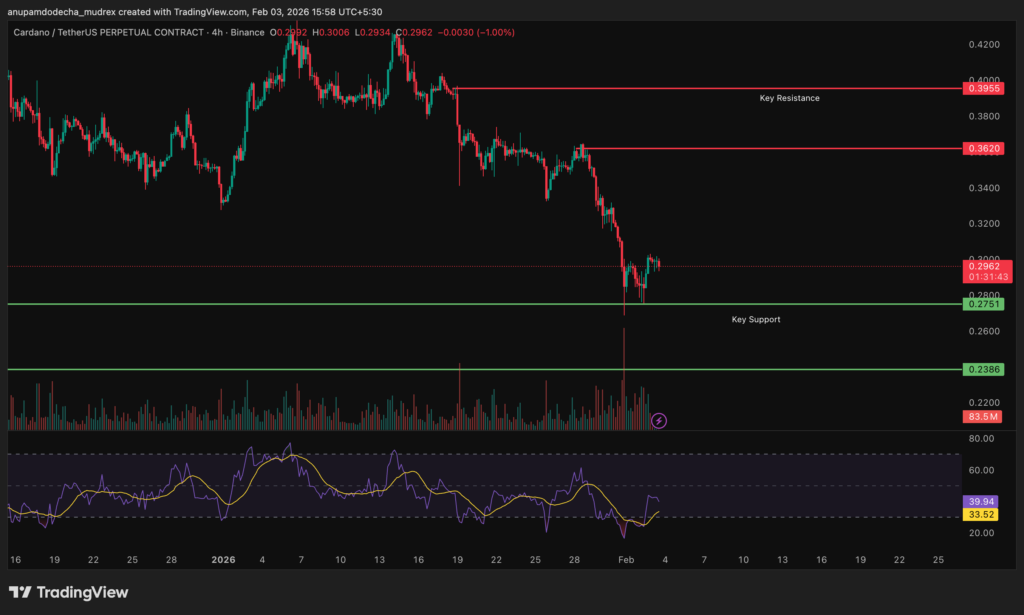
ADA is holding above the key support at $0.2751 and appears oversold in the short term. The next major support below this level is at $0.2386. On the upside, immediate resistance lies at $0.3620, followed by $0.3955.RSI and other oscillators are showing early positive signals for the very short term, though follow-through will still depend on broader market conditions.
| Year | Low Estimate (USD) | High Estimate (USD) | Low Estimate (INR) | High Estimate (INR) |
| 2026 | $0.50 | $0.60 | ₹46 | ₹55 |
| 2027 | $0.38 | $0.50 | ₹35 | ₹46 |
| 2028 | $0.55 | $0.80 | ₹51 | ₹74 |
| 2029 | $0.75 | $1.10 | ₹69 | ₹101 |
| 2030 | $1.00 | $1.40 | ₹92 | ₹129 |
This outlook assumes a bear or consolidation phase in 2027, followed by gradual recovery in subsequent years. Growth is driven by steady adoption and market cycles rather than speculative excess or unrealistic valuation expansion.
2026
ADA could move toward $0.50–$0.60 by year end as markets stabilize and risk appetite slowly returns.
2027
A broader market slowdown or bear phase may keep ADA range-bound between $0.35–$0.50, with limited upside and long consolidation.
2028
Improving liquidity and early recovery signs could lift ADA back into the $0.55–$0.80 range.
2029
Sustained expansion and ecosystem progress may support a move toward the $0.75–$1.10 zone.
2030
In a realistic best-case scenario, ADA could approach $1.20–$1.40, driven by gradual utility growth rather than hype-driven speculation.
Cardano’s price can move if the network actually delivers faster speed, lower fees, and smoother smart contracts. Real usage beats promises every time.
If governments, enterprises, or big apps start using Cardano for identity, payments, or DeFi, demand for ADA rises. No users = no long-term price magic.
Clear crypto regulations between 2026–2030 can help ADA. Cardano’s research-driven and compliant approach may attract institutions when rules tighten.
ADA still follows Bitcoin and the broader market. Bull markets lift it, bear markets crush it. Timing matters more than tech in the short term.
Great tech doesn’t matter if people don’t use it. If developers and users choose faster or trendier chains, ADA can stay undervalued for years.
Cardano is known for moving slowly. If upgrades keep getting delayed, the market may lose patience and shift attention elsewhere.
Ethereum, Solana, and newer chains are fighting for the same users. If competitors innovate faster, Cardano risks falling behind.
Bear markets, harsh regulations, or global financial stress can drag ADA down regardless of fundamentals. Macro beats everything.
ADA reaching $1 is very realistic and mainly depends on overall market recovery; $5 is achievable in a strong bull cycle with solid adoption and positive sentiment; $10 would require sustained real-world usage, institutional interest, and a full-blown crypto supercycle; but $100 is not realistic, as it would push ADA’s market cap into multi-trillion-dollar territory, exceeding what even the largest global financial networks justify—basic market cap math breaks long before that level.
In 2026, a realistic higher-end target for ADA is around $0.50, assuming modest adoption and a stable market.
Cardano is better suited for long-term believers, not short-term traders chasing fast moves.
Unlikely in 2026. $1 would need a much stronger bull market than expected.
Cardano prioritizes security and decentralization, but it lags faster chains in speed and ecosystem growth.
Disclaimer: Crypto products and NFTs are unregulated and can be highly risky. There may be no regulatory recourse from any loss from such transactions.